Mirror Gazing Meditation Explained: How Eye Gazing and Soul Awareness Deepen Your Practice
Feeling like your meditation routine needs a refresh to get to that next level? Many practitioners discover transformative power when they add visual awareness techniques to their routine. Mirror gazing meditation offers a profound pathway to self-discovery that goes beyond traditional closed-eye practices.
This guide explores how mirror gazing meditation, tantric eye gazing, and soul awareness meditation can elevate your spiritual journey. You’ll learn step-by-step techniques, understand when to practice each method, and discover how combining these approaches creates powerful transformative experiences.
What Is Mirror Gazing Meditation?
Mirror gazing meditation is a visual awareness practice where you sit before a mirror and maintain a soft gaze for extended periods. Rather than focusing on your physical appearance, you direct your attention slightly above your head to view the wall behind you. This creates a unique experience where your body appears as a shadowy peripheral silhouette.
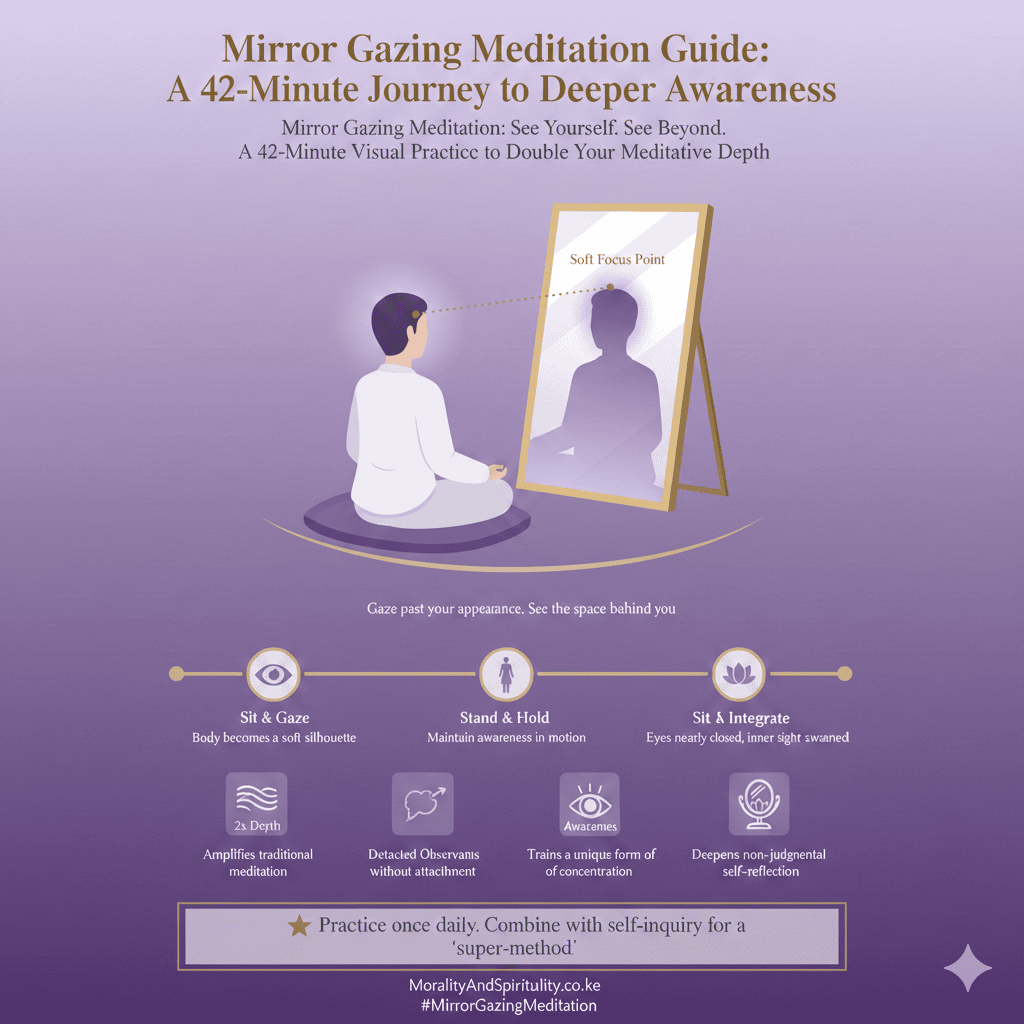
The practice typically lasts 42 minutes and includes three phases: 20 minutes of mirror gazing, 2 minutes of standing awareness, and 20 minutes of closed-eye meditation. This structure helps you maintain heightened awareness while transitioning between different states of consciousness.
Benefits include deeper self-awareness, enhanced concentration, and the ability to observe your thoughts without attachment. Many practitioners report that mirror gazing meditation virtually doubles the power of their regular meditation sessions. The technique works by engaging your visual consciousness in ways that traditional meditation doesn’t address.
Learn more on our blog on mindfulness and memory relationship and how to enhance mindfulness.
How to Practice Mirror Gazing Meditation (Step-by-Step)
This three-stage practice guides you to prepare a calm space, use a relaxed 20-minute mirror gaze, and integrate the experience through a brief standing awareness and 20-minute closing meditation. By keeping the gaze soft and focusing on the reflected space above your head, mirror gazing meditation reduces self-scrutiny and deepens visual awareness. Practice once daily, mindfully returning attention when thoughts arise, to safely extend awareness without eye strain.
Step 1 — Setting Up Your Space
Choose a quiet room where you won’t be disturbed. Position a large mirror at eye level when seated. Sit comfortably about two to three feet from the mirror. Ensure the lighting is soft and non-distracting. Place a cushion or chair that supports good posture without strain.
Step 2 — The 20-Minute Soft Gaze
Begin by settling into your seat and taking three deep breaths. Direct your gaze to the space just above your reflected head, focusing on the wall behind you. Allow your eyes to deeply relax their focus. Your face will appear as a shadowy outline in your peripheral vision. Avoid looking directly at your eyes or face, as this creates unnecessary intensity or self-conscious thoughts.
Maintain this soft gaze for 20 minutes. Your mind will wander, which is natural. When you notice thoughts arising, gently return your attention to the reflected space. The practice strengthens when you resist the urge to examine your physical features.
Step 3 — Standing Awareness & Closing Meditation
After 20 minutes, slowly stand while maintaining your heightened awareness. Stand silently for 2 minutes, feeling the shift in your body’s energy. Then return to your seat and close your eyes almost completely, allowing just two slits of light to enter. Sit in this quiet meditation for another 20 minutes.
This three-phase structure of mirror gazing meditation helps you integrate the visual awareness into deeper states of consciousness. Practice this method once daily maximum to avoid eye strain.
The Power of Tantric Eye Gazing for Partners
How Tantric Eye Gazing Works
Tantric eye gazing adapts the mirror technique for couples, creating profound intimacy and energetic connection. This practice requires a partner, preferably someone you love and trust deeply. You sit facing each other and gaze softly into each other’s eyes for 20 minutes.
The structure mirrors the solo practice: 20 minutes of eye contact, 2 minutes standing together in silence, then 20 minutes of seated meditation with eyes nearly closed. Tantric eye gazing creates a powerful energetic exchange that many couples find transformative for their relationship.
Emotional & Energetic Effects
When you practice tantric eye gazing, you open channels of non-verbal communication that go beyond words. Many couples report feeling their partner’s emotions, experiencing shared awareness, or sensing energetic shifts in the space between them. This practice breaks down barriers and creates vulnerability in supportive ways.
The extended eye contact can trigger emotional releases. You might cry, laugh, or feel waves of love washing over you. These responses indicate the practice is working, allowing suppressed emotions to surface and release.
Safety & Relationship Boundaries
Choose your tantric eye gazing partner carefully. This practice creates deep intimacy and can readily lead to romantic connection. Only practice with someone you trust completely and with whom you’ve established clear boundaries.
If you feel overwhelmed during the practice, communicate with your partner. You can take breaks while maintaining the overall structure. Some couples find that tantric eye gazing once or twice weekly provides the right balance between depth and integration time.
Never pressure anyone into this practice. Both partners must consent enthusiastically. The vulnerability required for effective tantric eye gazing only emerges in relationships built on mutual respect and safety.
Understanding Soul Awareness Meditation
What Is Soul Awareness?
Soul awareness meditation is an advanced technique recommended only for practitioners who have developed the ability to feel their subtle body. This method works with your field of visual consciousness rather than specific objects or thoughts. You practice it with eyes fully open, gazing at a blank wall or distant vista.
The technique involves using your mind’s eye to define your visual field as a circular clock. You mentally sweep your attention around the edges where consciousness meets empty space. This creates an experience of stepping back from your own mind and observing consciousness itself.
The Clockwise and Counterclockwise Consciousness Sweep
Begin by imagining the top of your visual field as 12 o’clock and the bottom as 6 o’clock. With your mind’s eye, slowly sweep your attention clockwise from 12 to 6 to 9 and back to 12. Then repeat counterclockwise. You mentally strain to observe the outer edges where light turns into darkness.
Continue this practice until you feel complete. Eventually, soul awareness meditation evolves into sudden expansion where you perceive the complete 360 degrees of consciousness in one jump. This advanced form creates the sensation of becoming identified with the void around the flame of consciousness, making that flame grow brighter.
When You Should Practice Soul Awareness Meditation
Only attempt soul awareness meditation after you’ve practiced other techniques long enough to feel floating as if not having a material body. If you cannot sense your subtle body, this method won’t be effective. Begin during formal sitting sessions before attempting it during activities like walking in safe locations.
This technique requires several years of meditation experience to practice effectively. The deprogramming effect allows you to appreciate existence as an ever-changing drama where you feel both within and beyond the play of life.
Through soul awareness meditation, you discover your visual consciousness is football-shaped, wider than it is tall. This reflects how human brains evolved to scan horizontally for food and danger rather than vertically. Understanding these patterns helps you transcend conditioned perceptual habits.
Benefits of Combining Mirror Gazing Meditation, Tantric Eye Gazing & Soul Awareness Meditation
Each technique offers unique benefits but combining them creates powerful synergistic effects. Mirror gazing meditation builds visual awareness and self-observation skills. Tantric eye gazing adds emotional depth and interpersonal connection. Soul awareness meditation develops your ability to perceive consciousness itself.
You can explore meditation foundations to understand how these practices fit within broader contemplative traditions. The practices share common elements while addressing different aspects of awareness.
Many advanced practitioners create “super-methods” by combining these techniques with other approaches. For example, practicing mirror gazing while using self-inquiry mantras multiplies effectiveness. Similarly, integrating soul awareness with tantric eye gazing creates experiences of shared consciousness between partners.
The connection between mindfulness and memory becomes more apparent as these practices deepen. You develop the ability to observe mental patterns without identifying with them. This metacognitive awareness transforms how you process experiences.
These combined approaches also align with principles explained in the law of vibration, as you become sensitive to subtle energetic shifts in consciousness. Research shows that meditation practices influence brain structure and function, providing scientific backing for the transformative effects practitioners report.
Safety Precautions & Practice Frequency
Strong meditation techniques work like medicine, which means you shouldn’t overdose on any single method. Practice mirror gazing meditation no more than once daily to prevent eye strain. Your eyes need recovery time between sessions.
Some people may find these techniques too intense initially. If you experience headaches, dizziness, or emotional overwhelm, reduce practice duration or take breaks between sessions. Start with shorter periods and gradually extend as your capacity builds.
People with certain mental health conditions, particularly those involving dissociation or psychosis, should consult healthcare providers before attempting these practices. The altered states these techniques induce can be destabilizing for some individuals.
Pregnant women should approach these practices gently, as emotional releases can be intense. Always honor your body’s signals and stop if something feels wrong. These are powerful tools that require respect and mindful application.
Final Thoughts & Next Steps
Mirror gazing meditation, tantric eye gazing, and soul awareness meditation offer profound pathways to expanded consciousness. Each technique addresses different dimensions of awareness while sharing the common goal of deepening your connection to yourself and reality.
Start with basic mirror gazing if you’re new to these practices. As you develop capacity, explore tantric eye gazing with a trusted partner. Reserve soul awareness meditation until you’ve built substantial experience with other techniques.
Remember that consistency matters more than intensity. Regular practice with proper rest creates sustainable growth. Track your experiences in a journal to notice patterns and progress over time.
Ready to transform your meditation practice? Choose one technique from this guide and commit to practicing it for 30 days. Notice what shifts in your awareness, relationships, and daily life. The journey of consciousness exploration awaits your dedicated attention.
Frequently Asked Questions
How long should I practice mirror gazing meditation as a beginner?
Start with 10-15 minute sessions and gradually build to the full 42-minute practice over several weeks. Your eyes need time to adapt to extended soft gazing without strain.
Can I practice tantric eye gazing with a same-sex partner or friend?
Yes, though the traditional description mentions opposite-sex partners, the technique works with any partner you trust. The key is mutual comfort, clear boundaries, and shared intention for the practice.
What if I see strange images or distortions during mirror gazing meditation?
Visual distortions are normal as your eyes relax focus. These phenomena arise from how your visual system processes prolonged soft gazing. Simply observe without attachment and return focus to the wall behind your reflection.
Is soul awareness meditation safe for everyone?
No, soul awareness meditation is only recommended for experienced practitioners who can already feel their subtle body. Beginners should master foundational practices first before attempting this advanced technique.
How often can I practice these techniques together?
Practice mirror gazing meditation once daily maximum. You can alternate between techniques on different days or combine them as suggested, but always respect the once-daily limit to prevent eye strain and energy depletion.
good insights
thankyou