
Consciousness and Time: How Your Mind Shapes Transformation
Have you ever wondered why some people seem able to effortlessly reinvent themselves while others remain stuck in repeating patterns? Why does a single insight sometimes change your entire life trajectory, while years of struggle produce no breakthrough? The answer lies in understanding a fundamental truth: how consciousness relates to time directly determines your capacity for personal transformation.
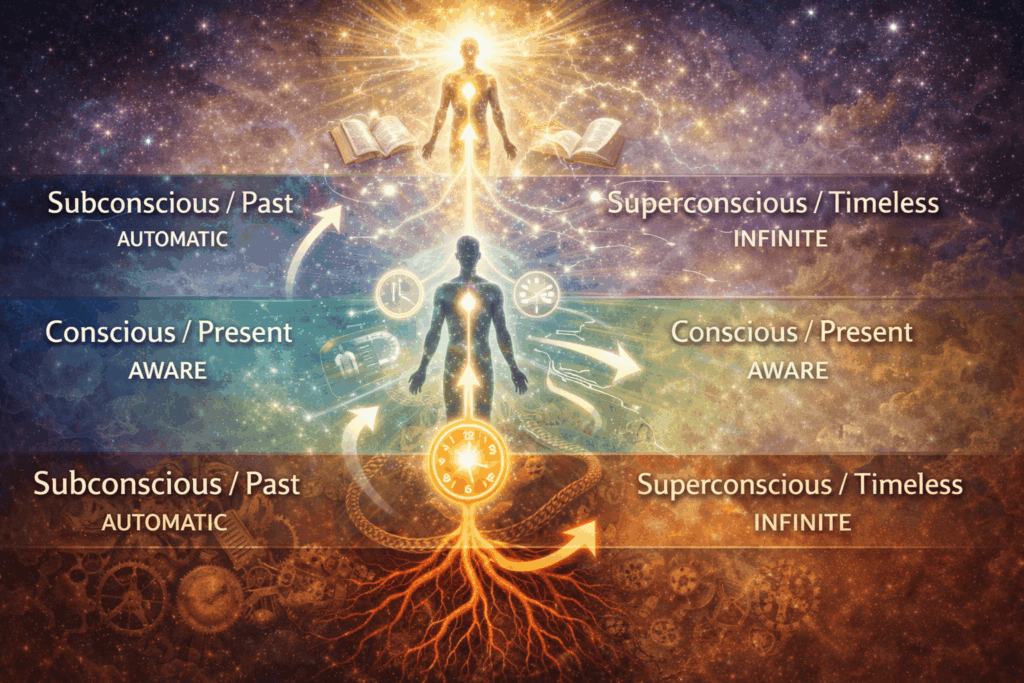
Most people think time is fixed and objective—the same for everyone. But your experience of time is deeply shaped by which aspect of your consciousness is dominant in any given moment. Your subconscious mind pulls you backward into past patterns and beliefs. Your conscious mind keeps you tethered to the present moment. Your superconscious mind connects you to timeless wisdom and unlimited potential.
In this comprehensive guide, you’ll discover how consciousness interacts with time, understand the three levels of consciousness and their unique relationship to past, present, and future, and learn practical techniques for leveraging this knowledge to accelerate your personal transformation. By the end, you’ll understand why transformation is possible for anyone willing to shift their consciousness and how to access the superconscious dimension that holds the key to transcending your limitations.
The Three Dimensions of Consciousness: Understanding Their Relationship with Time
The Subconscious Mind: Anchored in the Past
How consciousness relates to time begins with understanding your subconscious mind. The subconscious is entirely focused on the past. It functions as a vast repository of every experience you’ve ever had, especially the formative events of childhood. More importantly, the subconscious mind doesn’t just store memories—it stores the beliefs, emotional responses, and behavioral patterns attached to those experiences.
Your subconscious runs automatically, like a computer program executing in the background. When you touch something hot, you don’t consciously decide to pull your hand away—your subconscious instantly triggers that response based on past experience of pain. When someone says something that reminds you of criticism you received years ago, your subconscious generates an emotional reaction before your conscious mind even registers what happened.
This is why the subconscious is anchored in the past: it operates entirely from recorded experience. It creates urgency and impulse. The physical body, which the subconscious controls, demands immediate gratification. “I’m hungry and I want to eat right now.” “I’m tired and I want to sleep right now.” There’s no future planning in these statements—only present urgency rooted in past survival programming. This explains why Buddhists refer to the body as existing entirely in the here and now: the subconscious knows only immediate, reactive response.
The Conscious Mind: Navigating Past, Present, and Future
While the subconscious is locked in the past, the conscious mind possesses remarkable flexibility. Your conscious awareness can wander freely through time. It can drift into memory, examining past events to understand current patterns. It can project into the future, imagining possibilities and envisioning desired outcomes. This temporal flexibility is what makes consciousness relates to time such a crucial principle for transformation.
Consider this practical example: You’re experiencing depression and can’t understand why you feel so inadequate. Through conscious examination—perhaps during meditation or therapy—you suddenly remember a significant childhood event you’d forgotten. You recall that your parents criticized your creative interests, dismissing your dreams as impractical. In that moment of conscious recollection, you understand that your current depression isn’t random—it stems directly from this past experience and the beliefs you formed from it.
The conscious mind can also project into the future. Your vision of yourself as a successful artist might be what sustains you through years of ordinary work. Your image of yourself on a beach in perfect health might be what keeps you committed to your fitness journey. These future-oriented thoughts, generated by your conscious mind, directly influence your present choices and emotional state.
This temporal flexibility—the ability to access past, present, and future simultaneously—is essential for understanding how consciousness relates to time and makes personal transformation possible. You cannot transform without being able to consciously access both your past patterns and your future potential.
The Superconscious Mind: Accessing Timeless Wisdom
Beyond the conscious and subconscious lies the superconscious dimension—what might also be called your higher self, intuition, or connection to universal intelligence. The superconscious operates beyond linear time entirely. It contains the absolute sum total of your past lives and future potentials, according to spiritual traditions that recognize consciousness as transcending a single lifetime.
While traditional psychology focuses on reaching into childhood to understand current behavior, parapsychology and spiritual psychology extend this principle further. They recognize that we may need to look back not just to childhood, but to past-life experiences—what is sometimes called “the childhood of the soul.”
The superconscious holds access to these deeper dimensions of experience.
The transformative power of accessing the superconscious is well-documented. Many researchers, as outlined in the research on Unconventional Therapies for Mental Wellness, have found that individuals who struggled unsuccessfully for years with emotional issues through traditional psychotherapy experienced profound breakthroughs after a single past-life therapy session.
The mechanism isn’t mystical—it’s the principle of gaining a larger perspective. When you understand the deeper origin of a pattern, you automatically gain the ability to transcend it.
How Consciousness Shapes Your Self-Concept and Identity
The Present Self Draws from Both Past and Future
How consciousness relates to time directly determines who you are right now. Your current self-concept isn’t formed by the present moment alone. It’s a synthesis of three temporal dimensions:
From the past: Your accumulated experiences, successes, and failures shape how you see yourself. If you grew up receiving encouragement for intellectual pursuits, you likely see yourself as smart. If you experienced constant criticism around physical appearance, you probably struggle with body image regardless of objective reality.
From the present: Your current circumstances, abilities, and immediate experiences contribute to your self-image. But notice how much power the present alone has—very little, in isolation.
From the future: Your vision of who you can become profoundly shapes who you are right now. This is why future-oriented thinking is so transformative. A person who sees themselves as capable of becoming healthy will make different choices today than someone who sees themselves as chronically ill.
An illuminating experiment demonstrates this principle. Researchers hypnotized people so they couldn’t access memories of their past. Remarkably, these individuals felt incredibly optimistic and unlimited. Without the weight of personal history—failed relationships, past mistakes, previous limitations—they felt free and creative.
But when the same people were hypnotized so they couldn’t conceive of a future, they became deeply depressed. Unable to imagine possibilities beyond their immediate circumstances, they lost the very thing that makes life meaningful: hope and potential.
This reveals a profound truth: consciousness relates to time because your sense of who you are depends on your ability to access both past understanding and future vision.
The Transformative Principle: Consciously Choosing Your Narrative
The path to transformation lies in consciously choosing which aspects of your past to emphasize and which vision of the future to cultivate. Consider this scenario: You had a fair distribution of positive and negative experiences in childhood. As an adult, you could emphasize either set.
If you emphasize negative experiences—the times you felt rejected, criticized, or failed—you develop a negative self-image that limits your choices and perpetuates struggle. But if you consciously acknowledge and integrate your positive experiences—times you succeeded, felt loved, or overcame challenges—you develop a positive self-image that opens possibilities.
This conscious choice is the transformative principle in action. You’re not denying reality. You’re not pretending negative experiences didn’t happen. You’re exercising your conscious mind’s temporal flexibility to reframe your past and reimagine your future. This is precisely what related to understanding polar opposites in consciousness and how they shape reality—your choice between empowering and disempowering narratives literally determines your experience.
The Principle of Transcendence: How Expanded Perspective Creates Solutions
The Mountain View Metaphor
Imagine you live in a small village and are deeply in debt. You owe money to the butcher, baker, and candlestick maker. The situation feels hopeless, overwhelming, and inescapable. Every morning you wake with dread, unable to see any path forward.
One day, feeling desperate, you climb to the top of a nearby mountain. Looking down from this height, the village suddenly appears tiny. Your debts—which felt so enormous from ground level—no longer carry the same weight. They’re still real, still demanding attention, but they’ve shrunk in proportion to your expanded perspective.
You descend the mountain. Objectively, nothing has changed. You still owe the same amount to the same people. But something fundamental has shifted inside you. From this new perspective, you negotiate more creatively with your creditors. Instead of spiraling in fear, you problem-solve from a place of resourcefulness. The situation that felt impossible becomes manageable.
This is the principle of transcendence: When you’re bigger than the problem, that’s the solution to the problem. This principle is the essence of how consciousness relates to time to create transformation. By accessing your superconscious dimension—your higher perspective, intuition, and creative wisdom—you literally rise above your limitations and see solutions invisible from lower perspectives.
Accessing Superconscious Insight
The superconscious is accessible through various means: deep meditation, near-death experiences, past-life regression, intense creative flow, or spontaneous spiritual awakening. The common thread is that all these states involve temporarily moving beyond the conscious mind’s linear, logical processing. Learn more from our article on meditation and how to practice for enhanced benefits.
When you access superconscious insight, you experience what feels like wisdom arriving from outside yourself. Athletes call it “flow state.” Artists call it “inspiration.” Spiritual practitioners call it “divine guidance.” Scientists might call it “intuition” or “the subconscious processing information.” Regardless of terminology, the experience is consistent: you receive insight that transcends what your logical, conscious mind could generate alone.
Research on near-death experiences by pioneers like Raymond Moody, Robert Monroe, and Elisabeth Kübler-Ross documents remarkable transformations. People who’ve touched the superconscious dimension through these profound experiences consistently report:
- Loss of fear around death and life circumstances
- Expanded perspective on what matters
- Increased altruism and compassion
- Enhanced intuitive and psychic perception
- Fundamental shifts in world view and life purpose
In his study “Deathbed Observations by Physicians and Nurses,” researcher Karlis Osis reported remarkable findings. Rather than fear, the dominant emotion at the moment of death was peace, calmness, and even exaltation. One physician reported that a near-drowning experience brought him to such a beautiful state of consciousness that he was actually unhappy about being rescued. He had touched the superconscious dimension and found it more real than ordinary consciousness.
This is what true transformation looks like: not struggling to change through willpower alone, but shifting to a higher dimension of consciousness where the old problems literally dissolve in light of a greater understanding.
How These Three Levels Interact: The Continuous Flow of Consciousness
The Four-Stage Integration Process
Understanding how consciousness relates to time requires seeing how the three levels work together continuously:
Understanding how consciousness relates to time requires seeing how the three levels work together continuously:
Stage One – Conscious Input:
You consciously experience something new—a conversation, a book, a challenge, a success. Your conscious mind registers this present-moment experience.
Stage Two – Subconscious Integration:
Your superconscious mind works behind the scenes, synthesizing all your experiences, beliefs, and intuitions into deeper wisdom. Creative insights emerge. Intuitive knowing arises. You suddenly understand connections you couldn’t logically figure out.
Stage three – Conscious Action:
Your conscious mind uses both the subconscious habits and the superconscious insights to make choices in the present moment. These choices create the future experiences that will become tomorrow’s subconscious programming and superconscious wisdom.
This creates a continuous, upward spiral if you’re consciously directing it, or a limiting loop if you’re unconscious. The key is awareness.
The Relationship to Universal Vibration
Understanding how consciousness relates to time connects directly to understanding the law of vibration and how consciousness operates. Each level of consciousness vibrates at a different frequency. The subconscious vibrates at the frequency of past patterns and survival. The conscious mind vibrates at the frequency of present-moment awareness. The superconscious vibrates at the frequency of pure potential and universal intelligence.
When you raise your consciousness—by accessing superconscious wisdom—you literally raise your vibrational frequency. This higher frequency attracts different experiences, different people, and different opportunities than your previous frequency attracted.
Practical Application: Transforming Your Life Through Conscious Time Navigation
Accessing Your Superconscious Dimension Daily
While dramatic near-death experiences aren’t necessary for transformation, you can access superconscious wisdom through deliberate practice:
Meditation: Regular meditation quiets the conscious mind’s chatter and opens access to superconscious insight. Even 10 minutes daily begins opening this dimension.
Journaling: Writing about your past patterns and future vision activates all three consciousness levels. Your hand writes what your superconscious knows but your conscious mind hasn’t yet articulated.
Mindful Reflection: This practice connects directly to understanding how mindfulness relates to consciousness and memory. When you reflect mindfully on your experiences, you access superconscious wisdom about their deeper meaning.
Creative Expression: Art, music, movement, and other creative activities bypass the conscious mind’s logical constraints and access superconscious wisdom directly.
Reframing Your Past Consciously
You cannot change what happened, but you can change how you interpret it. Consciously examine your past:
- What beliefs did you form from your experiences?
- Which of those beliefs serve you, and which limit you?
- Can you find alternative interpretations that are equally true but more empowering?
- What strengths did you develop through challenges?
Envisioning Your Future Intentionally
Your conscious vision of the future literally shapes your present choices and your superconscious access. Spend time regularly imagining:
- Who do you want to become?
- What do you want to experience?
- What problems do you want to solve?
- How do you want to serve?
These future visions activate superconscious resources toward manifesting that future.
Frequently Asked Questions About Consciousness and Time
Q: Can I really change my past by changing how I think about it?
A: You can’t change events that happened, but you can change their meaning and impact on you. A challenging experience that you interpreted as “proof I’m inadequate” can be reframed as “proof I’m resilient.” Both interpretations reference the same event, but one empowers you while the other limits you. Your conscious mind’s interpretation determines how that past experience shapes your future.
Q: How does understanding my subconscious help me transform?
A: Your subconscious runs most of your behavior automatically. By bringing subconscious patterns into conscious awareness, you gain the power to choose differently. You can’t change what you’re not aware of. Awareness is the first step toward transformation—consciousness itself is the agent of change.
Q: Is the superconscious really accessible to everyone?
A: Yes. The superconscious isn’t special or mystical—it’s a dimension of consciousness accessible to everyone. Meditation, contemplation, creative flow, and even moments of awe or profound joy can open access. The more you practice quieting the conscious mind, the more readily superconscious wisdom flows.
Q: Can I access superconscious wisdom without meditation?
A: Meditation is a powerful tool, but not the only way. Superconscious insight comes through creative pursuits, time in nature, deep conversation, contemplation of meaning, and spontaneous moments of clarity. The key is quieting the mind’s constant chatter enough to notice the deeper wisdom that’s always available.
Q: How long does transformation typically take?
A: This varies greatly depending on how entrenched old patterns are and how consistently you practice. Some people experience shifts in perspective that change their life in a single moment of superconscious insight. Others gradually transform through consistent conscious choice over months or years. The principle is that insight itself becomes the catalyst—once you understand something deeply, you naturally make different choices.
Q: What’s the difference between this and positive thinking?
A: Positive thinking alone—forcing yourself to think good thoughts while your superconscious remains unaligned—creates internal conflict and rarely produces lasting change. True transformation involves accessing genuine superconscious wisdom that naturally reorganizes your thinking, beliefs, and choices from a deeper level than conscious willpower alone can achieve.
Conclusion: Becoming the Author of Your Transformation
How consciousness relates to time is ultimately about recognizing that you’re not a prisoner of your past, not limited to your present circumstances, and not powerless over your future. You possess three levels of consciousness, each with a unique relationship to time, and the ability to consciously direct their interaction.
Your subconscious holds your past patterns. Your conscious mind navigates your present moment. Your superconscious accesses timeless wisdom and unlimited potential. When you understand and work with all three—consciously integrating past learning, remaining present to this moment, and accessing superconscious guidance—you activate your innate capacity for transformation.
The most important insight is this: transformation doesn’t require struggling against yourself. It requires expanding your perspective until the problem that seemed insurmountable becomes manageable. It requires accessing the superconscious wisdom that’s always available. It requires consciously choosing which aspects of your past to emphasize and which future vision to cultivate.
Start today. Spend time in quiet reflection. Notice what your superconscious is trying to tell you. Consciously examine beliefs that limit you and choose new interpretations. Envision the future you want to create. When you do, you activate all three levels of consciousness in service of genuine, lasting transformation.