
Abnormal Psychology: Understanding the Fine Line Between Mental Illness and Psychic Phenomena
Can mental illness and psychic abilities coexist in the same person? This question challenges everything psychiatrists and spiritual researchers thought they understood about human consciousness. The answer reveals a stunning truth that neither field wants to fully acknowledge.
When a young woman nearly drowned in Lake Minnetonka, she developed both pneumonia and clairvoyance. Doctors focused on treating her illness while ignoring her ability to predict mail contents daily. When her health returned, her psychic abilities vanished completely. This case illustrates abnormal psychology’s most perplexing mystery: diseased mental states often accompany extraordinary psychic phenomena, yet mainstream science refuses to examine why.
In this guide, you’ll discover how abnormal psychology intersects with supernatural abilities, why the mediumship and hysteria connection fascinated early researchers, and what supernormal phenomena examples reveal about human consciousness. You’ll learn why these two fields aren’t opposites but complementary aspects of the same extraordinary human experiences.
What Is Abnormal Psychology and Why Does It Matter?
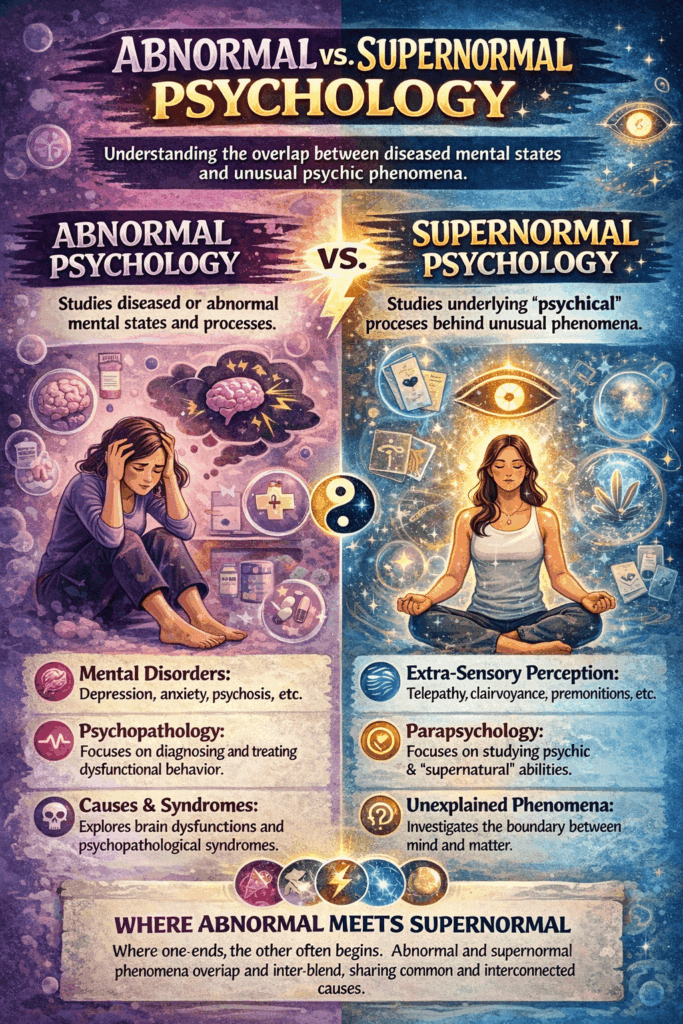
Abnormal psychology studies diseased or unusual mental states and processes that deviate from typical human behavior. This field examines conditions like schizophrenia, bipolar disorder, severe depression, and other mental health challenges requiring clinical intervention.
Psychiatrists traditionally view abnormal mental states as purely pathological—problems to diagnose and treat. They categorize symptoms, prescribe medications, and implement therapeutic interventions designed to return patients to “normal” functioning. This approach assumes mental abnormality represents malfunction rather than potentially revealing hidden human capacities.
Yet this narrow focus overlooks compelling evidence. Throughout documented medical history, individuals experiencing abnormal mental states have simultaneously displayed remarkable psychic abilities.
When illness struck, supernatural capacities emerged. When health returned, these abilities disappeared. This pattern repeats too consistently to dismiss as coincidence.
Understanding abnormal psychology requires acknowledging these phenomena exist beyond conventional psychiatric explanations. As explored in consciousness and thought power research, mental states we label “abnormal” may actually represent altered consciousness accessing information unavailable to typical awareness.
Understanding Supernormal Psychology
Supernormal psychology investigates psychical processes underlying phenomena formerly dismissed as “supernatural.” This field studies telepathy, clairvoyance, premonitions, mediumship, and other abilities that transcend normal sensory perception.
Where abnormal psychology ends, supernormal psychology begins—or so researchers initially believed. The truth proves far more complex. These disciplines don’t oppose each other but interblend extensively. Abnormal and supernormal phenomena shade into one another, often representing different aspects of identical experiences.
This overlap creates profound challenges for both fields. Psychiatrists dismiss psychic phenomena as hallucinations caused by mental illness. Psychic researchers argue mental instability simply creates favorable conditions for supernatural abilities to manifest. Neither explanation satisfies completely because both contain partial truth.
Consider the relationship between these fields: abnormal psychology provides the conditions, while supernormal psychology provides the phenomena. Mental instability doesn’t cause psychic abilities, but it correlates strongly with their emergence. Understanding this relationship transforms how you interpret both mental illness and spiritual experiences.
The Lake Minnetonka Case: When Illness Breeds Clairvoyance
A young woman fell into Lake Minnetonka and sank three times before rescuers pulled her unconscious body from the water. She developed severe pneumonia, experienced delirium, and nearly died during weeks of recovery. During this critical illness, something extraordinary occurred.
She became clairvoyant. Each morning, she accurately told her mother which letters waited in the mailbox and described their approximate contents. This wasn’t occasional lucky guessing but consistent, verifiable accuracy that her family witnessed daily. The phenomenon defied conventional explanation.
Then one morning, she awoke feeling significantly better. Coincidentally, her clairvoyance had entirely disappeared. She never again displayed the slightest psychic sensitivity. Her mother corroborated these facts, confirming the precise timeline between illness and ability.
This case demonstrates the abnormal vs supernormal psychology puzzle perfectly. You cannot claim abnormal condition caused clairvoyance—thousands experience near-drowning and pneumonia without developing psychic powers. You cannot claim clairvoyance caused pneumonia. Neither caused the other, but both emerged from underlying conditions making their simultaneous occurrence possible.
Such supernormal phenomena examples reveal that illness and psychic ability travel together without one necessarily causing the other. Some unknown factor creates favorable conditions for both manifestations.
Famous Mediums: Eusapia Palladino’s Head Injury
Eusapia Palladino ranks among history’s most documented physical mediums. Her remarkable phenomena—objects moving without contact, mysterious cold breezes, materialized forms—astounded researchers across Europe. Yet her mediumship traced directly to a traumatic head injury.
Palladino fell and cut her head severely on a cart wheel during childhood. This accident fundamentally changed her. The famous “cold breeze” that séance attendees reported issued specifically from this scar tissue. Over the injury site grew her distinctive lock of white hair, marking the spot where her abilities apparently originated.
This case exemplifies the mediumship and hysteria connection that fascinated early psychic researchers. The head trauma created abnormal neurological conditions. Simultaneously, extraordinary psychic abilities emerged. Dr. James Hyslop and other prominent investigators insisted this correlation between physical trauma and supernatural abilities demanded serious study.
The question remains: did brain injury create favorable conditions for latent psychic abilities to manifest? Or did trauma somehow unlock capacities that exist dormant in everyone? As discussed in research on social psychology of abnormalities, understanding these correlations requires examining both neurological and paranormal frameworks.
Molly Fancher: The Illness That Unlocked Vision
Molly Fancher’s case provides another striking example where abnormal psychology intersects with supernatural phenomena. Her documented clairvoyant powers developed precisely when serious illness struck. She could “see” events occurring miles away, read sealed letters, and perceive information impossible to obtain through normal senses.
Medical professionals examined her repeatedly, documenting both her illness and her abilities. Her condition defied easy categorization—neither purely physical nor entirely mental, yet undeniably abnormal by any clinical standard. Throughout this period, her clairvoyance remained consistently accurate and verifiable.
When her health improved, her psychic abilities diminished proportionally. As she returned to relative normalcy, the extraordinary vision faded until disappearing completely. This inverse relationship between health and psychic ability appeared in numerous documented cases throughout the late 19th and early 20th centuries.
This pattern suggests abnormal mental or physical states somehow facilitate access to information beyond normal consciousness. Whether through altered brain chemistry, heightened sensitivity, or removal of psychological barriers, illness appears to open perceptual doors that health keeps closed.
The Hysteria and Mediumship Connection
Jean-Martin Charcot, the famous French neurologist, frequently insisted on connections between hypnosis and hysteria. His student Cesare Lombroso extended this observation, noting strong correlations between hysteria and mediumship. These weren’t casual observations but patterns documented across hundreds of cases.
Dr. James Hyslop, one of early psychic research’s most rigorous investigators, confirmed these findings. He observed that many successful mediums displayed symptoms psychiatrists labeled as hysteria—emotional volatility, dissociative episodes, suggestibility, and other characteristics considered pathological.
Yet Hyslop argued the crucial question wasn’t whether mediums showed signs of mental instability. The question was: how did they obtain accurate information impossible to acquire through normal means? No amount of hysteria explains knowing strangers’ deceased relatives’ names or describing events occurring miles away.
This mediumship and hysteria connection reveals the limitation of purely psychiatric explanations. You can document every symptom of mental instability present in a medium, yet this documentation fails to explain the primary phenomenon: supernormal information acquisition. As explored in modern spiritualism practices, understanding these abilities requires frameworks beyond conventional psychology.
Why Physical Objects Move: The Primary Question
When studying cases like Eusapia Palladino, researchers debate which question deserves priority. Dr. Hyslop suggested the primary focus should examine the medium’s psychological instability, documenting hysteria or other mental conditions present during phenomena.
This approach misses the essential point. The primary question must be: do physical objects actually move without contact? Only after establishing this fact should researchers investigate secondary questions like the medium’s mental state, physiological peculiarities, or atmospheric changes during manifestations.
No amount of documented hysteria explains how material objects move when mediums merely will them to move. You can prove psychological instability exists, yet this proof doesn’t address the fundamental mystery. The abnormal mental state may create favorable conditions, but it doesn’t constitute sufficient explanation for the phenomena themselves.
This distinction matters crucially for abnormal psychology. If you assume mental illness fully explains supernatural phenomena, you dismiss legitimate mysteries requiring investigation. If you recognize mental states merely correlate with phenomena without causing them, you open inquiry into consciousness capacities mainstream science ignores.
The Interblending of Two Fields
Abnormal and supernormal phenomena aren’t opposed forces but complementary aspects of human experience. They supplement one another astonishingly, representing different angles on identical occurrences. Where psychiatrists see only pathology, psychic researchers see extraordinary capacity. Both perspectives contain truth.
The girl who developed clairvoyance after near-drowning experienced both abnormal physical condition and supernormal psychic ability. These weren’t separate events but intertwined manifestations of underlying factors affecting her consciousness. Her case illustrates how these fields interblend rather than oppose.
This interblending challenges both disciplines’ assumptions. Psychiatrists must acknowledge that mental abnormality sometimes accompanies genuine psychic phenomena. Psychic researchers must recognize that mental instability correlates strongly with supernatural abilities. Neither field possesses complete truth independently.
As discussed in vibrational frequencies and consciousness, human awareness operates across multiple levels. What appears abnormal at one level may represent supernormal function at another. Understanding requires integrating insights from both perspectives.
Modern Attempts to Explain Psychic Phenomena
Contemporary psychology increasingly attempts explaining psychic phenomena through frameworks like psychoanalysis. These approaches suggest unconscious conflicts, repressed desires, or psychological complexes create illusions of supernatural ability. Yet this explanation faces the same fundamental problem plaguing all purely psychiatric interpretations.
How does unconscious conflict explain accurate information about events the person couldn’t possibly know? How does repressed desire cause physical objects to move without contact? How does psychological complex enable detailed descriptions of deceased individuals the medium never met?
These questions remain unanswered because psychological frameworks alone cannot address them. You need combined understanding of abnormal psychology’s insights about altered mental states and supernormal psychology’s documentation of genuine psychic phenomena. As revealed in scientific studies of the human aura, consciousness operates through mechanisms mainstream science barely acknowledges.
The future of understanding these phenomena lies in integration rather than dismissal. Recognizing that abnormal mental states create conditions favorable for supernormal abilities without fully explaining them opens new research avenues. This approach respects both psychiatric knowledge and psychic phenomena’s genuine mysteries.
What This Means for Understanding Consciousness
The abnormal vs supernormal psychology debate reveals profound truths about human consciousness. Mental states we label diseased or abnormal may actually represent altered awareness accessing information unavailable to typical functioning. Illness might remove barriers rather than create dysfunction.
This perspective transforms how you understand both mental health and spiritual experiences. Psychic abilities emerging during illness aren’t necessarily hallucinations requiring treatment. They might represent genuine capacities temporarily accessible due to consciousness alterations illness produces.
This doesn’t mean mental illness should go untreated or that all psychic claims during illness are valid. It means careful investigation should precede dismissal. Some experiences labeled as symptoms of abnormal psychology may actually constitute supernormal phenomena examples deserving serious study rather than immediate psychiatric intervention.
Understanding requires holding paradoxes: illness is real AND psychic abilities can be genuine. Mental instability exists AND supernatural information can be accurate. These aren’t contradictions but complementary truths about consciousness complexity that neither field alone can fully address.
Frequently Asked Questions
What Is the Difference Between Abnormal Psychology and Supernormal Psychology?
Abnormal psychology studies diseased or unusual mental states like schizophrenia, depression, and other conditions requiring clinical treatment. Supernormal psychology investigates psychic phenomena like telepathy, clairvoyance, and mediumship that transcend normal sensory perception. These fields aren’t opposites but extensively interblended—abnormal and supernormal phenomena often occur simultaneously in the same individuals, representing different aspects of identical experiences rather than separate categories.
Why Do Psychic Abilities Often Appear During Mental Illness?
You cannot definitively say abnormal mental states cause psychic abilities, since thousands experience similar illnesses without developing supernatural capacities. The correlation suggests underlying factors create favorable conditions for both manifestations simultaneously. Mental instability may remove psychological barriers or alter brain chemistry in ways that allow access to information normally unavailable to consciousness. Illness and ability travel together without one necessarily causing the other.
How Did Researchers Explain the Mediumship and Hysteria Connection?
Early researchers like Charcot, Lombroso, and Hyslop documented strong correlations between hysteria symptoms and mediumship abilities. However, they disagreed on interpretation. Psychiatrists argued hysteria explained everything as mental illness. Psychic researchers countered that while hysteria might be present, it didn’t explain how mediums obtained accurate supernormal information about events they couldn’t possibly know through normal means. The primary question remained: how is impossible information acquired, regardless of mental state?
Can Supernormal Phenomena Examples Be Scientifically Verified?
You can verify specific cases through careful documentation and investigation. The Lake Minnetonka case involved family corroboration of daily accurate predictions. Eusapia Palladino underwent extensive testing by prominent scientists who documented physical phenomena under controlled conditions. Molly Fancher’s abilities were medically examined and recorded. While individual cases may involve fraud or error, the consistent pattern across hundreds of documented cases suggests genuine phenomena requiring explanation beyond simple psychiatric dismissal or acceptance of supernatural claims.