
Mindfulness and Memory: How Present-Moment Awareness Improves Recall and Cognitive Clarity
Have you ever sat down to meditate with the best intentions, only to find yourself lost in memories of yesterday’s conversation or replaying last week’s embarrassing moment? You’re not alone. This common experience reveals something fascinating about mindfulness and memory; they’re deeply connected, yet surprisingly different.
Understanding how these two mental processes interact can transform your meditation practice and daily awareness. Let’s explore this relationship and discover why it matters for your spiritual journey.
What Is the Difference Between Mindfulness vs Memory?
Many people assume that mindfulness simply means having a good memory. After all, traditional Buddhist texts define a mindful person as someone who can remember what was done or said long ago. However, this interpretation misses a crucial distinction.
The relationship between mindfulness vs memory becomes clearer when we examine what happens during meditation. Those wandering thoughts about past events—the very distractions that pull us away from present-moment awareness—are actually memories at work. Yet these mental detours represent a loss of mindfulness, not its expression.
Think about it: you can vividly recall a conversation from years ago while being completely unmindful in the present moment. Similarly, as the research on the effects of mindfulness on well-being outlines, daydreaming about future events (which relies on working memory and semantic memory) also disrupts mindfulness. This paradox reveals that mindfulness cannot simply be equated with memory, even though they share a relationship.
The True Nature of Their Connection
Rather than being the same thing, mindfulness enhances memory. When you’re fully present and aware, you naturally encode experiences more effectively. Your brain captures richer details, emotional context, and sensory information. Later, when you need to recall that information, a receptive mindful stance makes retrieval easier and more accurate.
This means mindfulness and memory work together synergistically: as our blog on how to control your mind outlines, mindfulness improves how you take in information and how successfully you access it later.
Does Mindfulness Improve Memory? The Scientific Answer
The question “does mindfulness improve memory?” has been thoroughly investigated by researchers, and the answer is a resounding yes—but with important nuances.
Studies show that people who practice mindfulness meditation regularly demonstrate:
- Enhanced working memory capacity
- Better recall of episodic information
- Improved ability to distinguish true memories from false ones
- Greater cognitive flexibility when accessing stored information
- Reduced age-related memory decline
However, the improvements come not from making memory and mindfulness identical, but from creating optimal conditions for memory to function. Mindfulness reduces the mental clutter and anxiety that often interfere with both encoding new memories and retrieving existing ones.
The Present Moment Paradox
Here’s where things get interesting: the most crucial aspect of mindfulness practice is staying in the present moment. This seems to conflict with memory, which is inherently about the past or future. How do we reconcile this?
The key lies in understanding that mindfulness provides a stable, clear awareness from which you can observe memories without becoming lost in them. You notice thoughts about the past arising, but you don’t identify with them or let them hijack your attention. This discrimination—staying present while memories flow through consciousness—is what separates mindful awareness from simple reminiscence.
Can Mindfulness Coexist with Unwholesome States?
One common misconception, particularly in later Buddhist commentary, is that mindfulness is always wholesome and therefore cannot coexist with negative mental states like anger or lust. This interpretation, however, doesn’t align with early Buddhist teachings or practical meditation experience.
The original instructions describe being aware of anger, lust, or the five hindrances at the time when they are present. This means mindfulness can—and must—remain established even when unwholesome conditions arise in the mind. In fact, it’s precisely when negativity manifests that mindfulness becomes most essential.
Why This Distinction Matters
If mindfulness could only exist during wholesome states, contemplation would become purely retrospective. You’d have to wait until anger passed to be mindful of it, which defeats the purpose of meditation as a tool for direct observation and transformation.
The wholesome repercussions of mindfulness practice come not from avoiding certain mental experiences, but from bringing clear awareness to whatever arises. Whether you’re observing joy or frustration, calm or restlessness, mindfulness remains the same non-judgmental attention.
This understanding preserves a key insight: mindfulness and memory are both neutral tools that can be applied to any content of consciousness. Neither inherently produces good or bad outcomes—the quality emerges from how we use them.
Practical Applications: Strengthening Both Mindfulness and Memory
So, does mindfulness improve memory in your daily life? Absolutely, when practiced correctly. Here are practical ways to leverage their relationship:
Daily Mindfulness Practices
- Single-Tasking: Give full attention to one activity at a time. Whether you’re washing dishes, having a conversation, or reading this article, be completely present. This trains both mindfulness and creates stronger memory traces.
- Sensory Awareness: Engage all your senses deliberately. Notice colors, textures, sounds, and smells around you. This rich sensory engagement improves both present-moment awareness and memory consolidation.
- Mindful Transitions: Pay special attention during transitions between activities. These moments often become memory gaps, but mindful awareness makes them vivid and memorable.
Meditation Techniques
As the article on what is meditation and why you should practice outlines, the relationship between mindfulness vs memory becomes most apparent during formal meditation practice:
- Breath Awareness: Return attention to your breath whenever you notice you’ve been caught in memories. This strengthens your ability to distinguish between present awareness and mental wandering.
- Open Monitoring: Notice whatever arises—thoughts, sensations, emotions—without trying to change it. This develops the receptive stance that facilitates both mindfulness and memory retrieval.
- Body Scanning: Move attention systematically through your body. This practice combines present-moment awareness with the sequential memory of where you’ve been and where you’re going.
The Path Forward: Walking with Mindful Remembrance
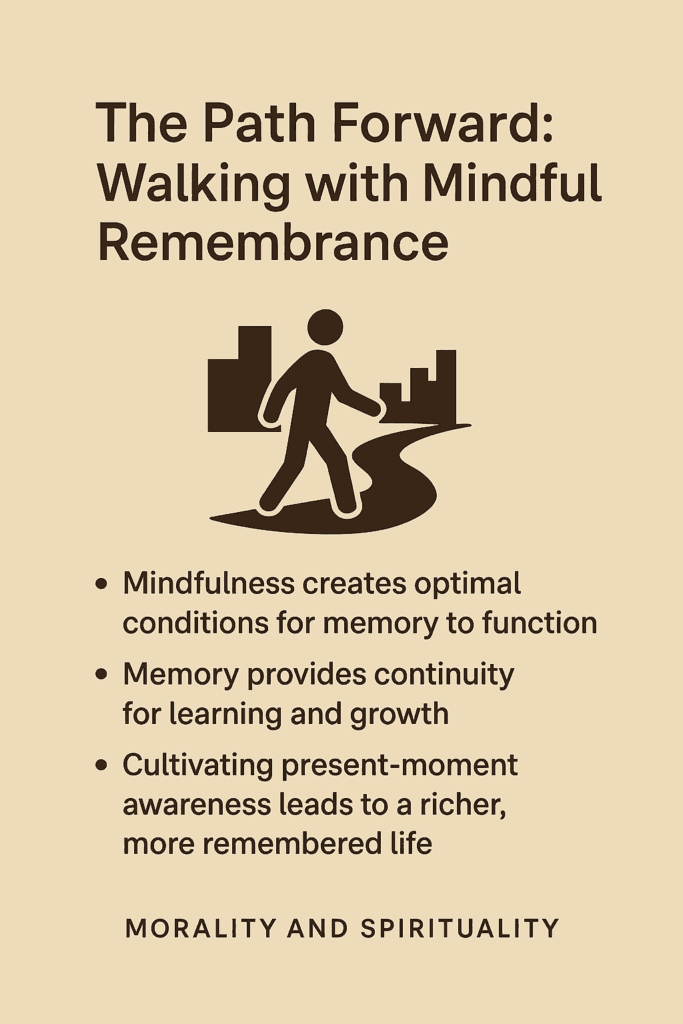
Think of learning a new route through a city. The first time, you need a guide and must pay careful attention to every turn, every landmark, every street sign. You bring intentional awareness—mindfulness—to the journey because you know you’ll need to remember it.
This same quality of attention can be brought to every moment of your life. Not because you need to recall it later (though you’ll remember better if you do), but because being fully present, fully aware, and fully alive is the point of the practice.
Mindfulness and memory aren’t competing forces or identical twins—they’re complementary capacities that support each other. Mindfulness creates the conditions for memory to function optimally, while memory provides the continuity that makes learning and growth possible.
The task isn’t to have perfect memory or constant mindfulness, but to cultivate the kind of present-moment awareness that naturally leads to a richer, more remembered life. Each moment fully experienced is a moment that transforms you, whether you recall the details later or not.
Conclusion: Integration Through Practice
Understanding the nuanced relationship between mindfulness and memory can free your practice from confusion, helping you move beyond the pressure to remember everything or forget everything. You’re learning instead to be fully present with whatever arises.
Insights from the Law of Vibration guide show that your thoughts and awareness carry energetic frequencies, meaning mindful presence doesn’t just support clearer memory — it elevates your overall state of being. So yes, mindfulness can improve memory, but more importantly, it reshapes your relationship with your own experience.
Recognizing the distinction between mindfulness vs memory, while appreciating how they subtly support each other, allows you to use both capacities with greater clarity and intention. Explore more from our guide on how emotions affect your body and how to nurture your emotional health.
As you continue your contemplative journey, remember: the goal isn't to become a memory master or achieve some permanent state of mindfulness. The goal is to cultivate the diligence and awareness that allows you to be fully present for your life as it unfolds, moment by precious moment.
Frequently Asked Questions on Mindfulness and Memory
How does mindfulness help with memory retention?
Mindfulness strengthens memory retention by reducing mental clutter and anxiety that interfere with encoding new information. When you’re fully present and attentive, your brain naturally captures richer details, emotional context, and sensory information.
Additionally, the receptive awareness cultivated through mindfulness makes it easier to access stored memories when needed. This dual benefit—improved encoding and retrieval—explains why regular mindfulness practitioners often report better memory performance.
Can you practice mindfulness without having good memory?
Absolutely. Mindfulness and memory are distinct capabilities, and you don’t need excellent memory to practice mindfulness effectively. In fact, people with memory challenges often find mindfulness particularly valuable because it emphasizes present-moment awareness rather than recollection.
The practice helps you work with your mind as it is right now, regardless of your memory capacity. Over time, mindfulness practice may naturally enhance memory function, but that’s a side benefit rather than a prerequisite.
What’s the best meditation technique for improving memory?
While various meditation techniques can benefit memory, practices that combine focused attention with open awareness tend to be most effective. Breath awareness meditation strengthens concentration, which improves encoding of new information.
Body scan meditation enhances sensory awareness and sequential processing. Mindfulness of thoughts meditation helps you observe memories without becoming lost in them. The key is consistency—regular practice of any mindfulness technique will likely yield memory improvements over time.
How long does it take for mindfulness to improve memory?
Research suggests that memory benefits from mindfulness practice can appear within 8-12 weeks of consistent daily practice, typically 20-30 minutes per session. However, some practitioners notice subtle improvements in attention and recall within just a few weeks. The timeline varies based on individual factors like baseline cognitive function, practice consistency, and the specific meditation techniques used.
The important thing is maintaining a regular practice rather than expecting immediate dramatic results—the benefits accumulate gradually and often become more noticeable over months rather than days.
Pingback: The Mind-Body Connection Sickness: More Than Just Physical Symptoms
Pingback: Control Your Mind: Unlock Lasting Inner Peace & Power