
Who Are the True Rulers of Mankind? Understanding Intellectual Leadership and Natural Hierarchy
Who truly governs human civilization? Is it presidents, monarchs, or legislators who hold the reins of power? The answer may surprise you. Throughout history, a profound truth has emerged: the true rulers of mankind are not those who sit on thrones or occupy legislative chambers, but the thinkers whose ideas shape the very foundations of society.
This concept emerges when we examine the natural inequality of men and understand how intellectual superiority drives societal evolution. Understanding this principle provides crucial insights into how civilization progresses and why certain individuals and ideas exert disproportionate influence over the trajectory of human development.
The Foundation: Natural Inequality of Men
The natural inequality of men represents a fundamental reality that modern egalitarian philosophies often overlook or minimize. This natural inequality of men extends across intellectual capacity, courage, industry, and moral character—differences that manifest within the same nation, generation, and social class.
While legal systems justifiably treat citizens as equals before the law, this procedural equality obscures a deeper biological and psychological truth: people possess vastly different innate abilities and potential. The natural inequality of men appears unavoidably evident in educational institutions, workplaces, sporting arenas, and during times of conflict. These observable differences cannot be disputed or reasonably dismissed.
This acknowledgment of natural inequality of men does not advocate for unjust hierarchies or discrimination. Rather, it recognizes that human excellence requires acknowledging that certain individuals possess superior intellectual and moral capacities that enable them to lead, innovate, and guide society forward. Understanding these variations becomes essential for comprehending how civilization actually functions beneath its formal institutional structures.
How Society Structures Around Superior Intellect
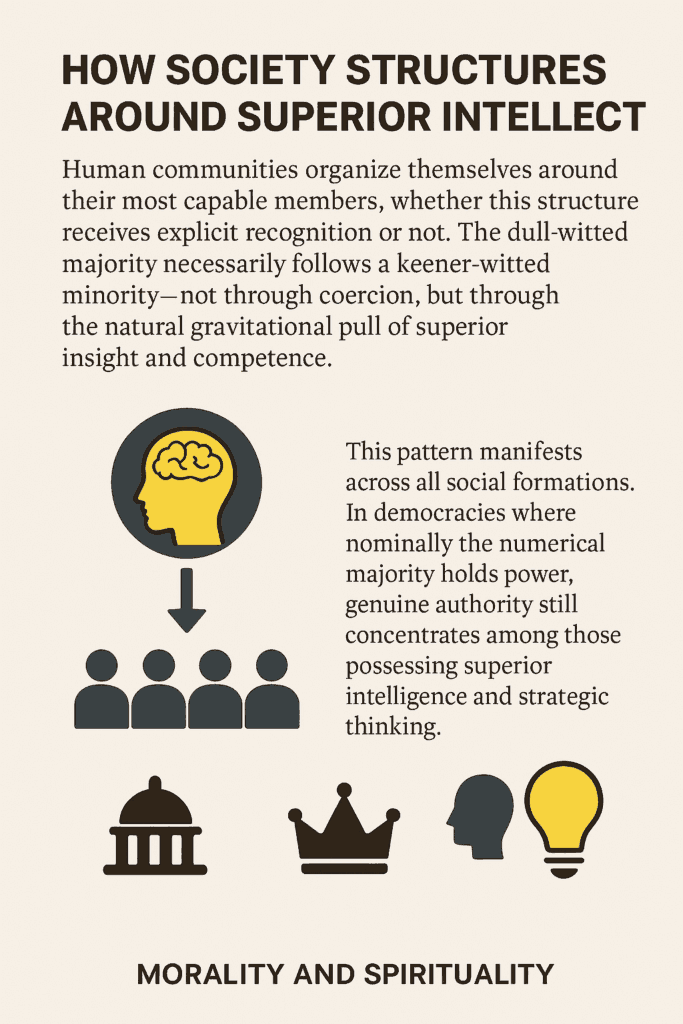
Human communities organize themselves around their most capable members, whether this structure receives explicit recognition or not. The dull-witted majority necessarily follows a keener-witted minority—not through coercion, but through the natural gravitational pull of superior insight and competence.
This pattern manifests across all social formations. In democracies where nominally the numerical majority holds power, genuine authority still concentrates among those possessing superior intelligence and strategic thinking. In monarchies and authoritarian systems, those with keenest intelligence and strongest characters quietly shape policy and direction. Regardless of political machinery or constitutional arrangements, the true rulers of mankind exercise influence through intellectual authority rather than formal position.
This dynamic reflects a fundamental law of nature: the higher intelligence sways the lower, just as human intelligence grants mastery over animal creatures. The community remains genuinely dominated by the will of an enlightened minority, even in systems claiming to represent the masses. This is not a defect requiring correction, but rather the salvation of society and the secret of genuine progress. Without intellectual leadership, civilizations stagnate; with it, they flourish.
Thinkers Who Shape Society: The Real Monarchs
The most profound insight regarding power and influence concerns the distinction between nominal and actual authority. Kings, statesmen, and legislators occupy positions of visible authority, yet they function as ministers executing the bidding of greater powers. The true rulers of mankind operate behind the scenes, invisible yet supremely influential.
These true rulers are the discoverers of new truths—the scientists, philosophers, mathematicians, and visionaries whose insights restructure human understanding. The thinkers who shape society possess an authority more potent than any throne or legislative body. While monarchs command armies and levy taxes, thinkers who shape society redirect the very foundations upon which civilization rests.
Just as human mastery over animals stems from superior knowledge rather than superior strength, human governance itself depends fundamentally on knowledge. As the research on social evolutionism outlines, the thinkers who shape society advance human understanding, creating the intellectual frameworks that subsequent generations inherit and build upon. These intellectual pioneers become the true though uncrowned and unsceptered kings of mankind—monarchs whose domains encompass the realm of ideas and human consciousness.
When we examine history’s greatest transformations, we consistently discover that institutional changes followed intellectual changes. The American and French revolutions became possible because Enlightenment thinkers first revolutionized human thinking about natural rights and governance. The industrial transformation emerged from scientific discoveries that revealed nature’s hidden mechanisms. The digital revolution originated from theoretical advances in mathematics and physics. In each case, the true rulers of mankind—those who advanced knowledge—preceded and enabled the actions of political leaders.
The Mechanism of Intellectual Dominance
How exactly does intellectual dominance operate within society? The mechanism involves the gradual dissemination of ideas from superior minds throughout the broader population. A fundamental principle of progress states, as our blog on how to control your mind outlines, that thoughts originating in a few superior minds gradually spread until they have leavened the whole of a community.
Consider this process: An individual possessed of exceptional intellectual capacity conceives a novel idea or discovers a previously hidden truth. This insight initially faces resistance from those invested in existing beliefs and arrangements. Gradually, however, the superiority of the new idea becomes undeniable. The thinkers who shape society through their contributions encounter initial opposition—often vigorous opposition—but their superior ideas ultimately prevail.
This propagation of superior thought represents the actual mechanism through which the thinkers who shape society influence civilization. The ideas themselves function as invisible rulers, transmitted from the exceptional few to the general population through education, publication, and social influence. What begins as the insight of one remarkable individual eventually becomes the common understanding of millions.
The true rulers of mankind exert their authority through this intellectual transmission. They do not command armies or police forces. Instead, they command attention, respect, and adherence to their superior frameworks of understanding. This form of rule proves far more durable and beneficial than rule through coercion.
The Struggle and Victory of Superior Ideas
Progress depends upon the continuous conflict between established error and emergent truth. The battle between prejudice and enlightenment characterizes every epoch, and the clamorous opposition that new ideas receive demonstrates the intensity of this struggle.
History reveals a consistent pattern: thinkers who shape society by challenging conventional wisdom face vigorous resistance. New truths conflict inevitably with old prejudices, generating opposition that may retard but cannot prevent their ultimate victory. The struggle itself proves necessary—it tests the validity of new ideas and ensures that only genuinely superior insights ultimately triumph.
This process extends beyond intellectual domains into practical application. Scientific discoveries that contradict religious doctrines face ecclesiastical opposition. Economic theories that challenge mercantilism face resistance from established merchants. Moral insights that undermine unjust hierarchies face opposition from beneficiaries of existing injustice. Yet the true rulers of mankind—those advancing knowledge—eventually prevail.
The better ideas ultimately carry the day because they align with reality. In the mental sphere, the struggle for existence proves no less fierce than in the physical realm. Competing ideas clash, false doctrines encounter contradicting evidence, and superior frameworks prove their worth through practical application. The strongest ideas, the truest understandings, the most useful knowledge systematically prevail. Explore more on our blog understanding good and evil for practical insights.
This victory proves incomplete and ongoing. Each generation inherits the intellectual achievements of its predecessors while remaining responsible for advancing knowledge further. The thinkers who shape society in our era build upon foundations laid by previous discoverers of truth, while creating frameworks their successors will refine and surpass.
Recognizing Intellectual Leadership in Modern Contexts
Contemporary society often obscures the fundamental principle that the true rulers of mankind operate through intellectual authority. Modern media celebrates political leaders, business moguls, and celebrities, diverting attention from those whose contributions prove genuinely transformative.
Yet the pattern continues unabated. In technology, the thinkers who shape society—from Alan Turing to the creators of artificial intelligence—drove revolutionary transformations that politicians merely regulated or attempted to control. In medicine, researchers whose discoveries reduced disease mortality exercised more profound influence over human flourishing than any legislator. In economics, theorists whose frameworks explained market mechanisms shaped policy more fundamentally than elected officials.
The true rulers of mankind in our era include climate scientists warning of atmospheric changes, epidemiologists guiding pandemic response, immunologists developing life-saving vaccines, and technologists creating platforms reshaping human communication. These thinkers who shape society exert influence precisely because their understanding of reality proves superior to alternatives.
Recognizing this pattern requires intellectual humility—acknowledging that those with superior knowledge merit authority over domains within their expertise. It requires understanding that natural inequality of men creates obligations as well as rights: those possessed of greater understanding bear responsibility for sharing that understanding and advancing knowledge further.
The Path Forward: Understanding Intellectual Authority
Progress demands that we clearly recognize where actual authority resides. The true rulers of mankind exercise influence through superior knowledge, not through force or formal position. Understanding this reality enables more rational approaches to governance, education, and social organization.
This recognition does not require abandoning democratic principles or egalitarian values in their proper application. Legal equality and dignity need not depend upon denying observable differences in capability. Democratic systems function most effectively when they incorporate the insights of those most knowledgeable in relevant domains—when they allow the thinkers who shape society to influence policy proportional to their expertise.
Similarly, understanding that thinkers who shape society operate through intellectual transmission emphasizes education’s supreme importance. Societies that prioritize education, support research, and enable the free exchange of ideas invest in their own future progress. Those that suppress intellectual innovation or restrict knowledge face inevitable stagnation.
The ultimate realization remains that the true rulers of mankind pursue no formal election and hold no offices, yet their influence exceeds that of all crowned heads throughout history. These are the discoverers of new truths, the advancers of human understanding, the thinkers who shape society by expanding what humanity knows and can accomplish.
Conclusion
The true rulers of mankind operate through mechanisms most societies fail to acknowledge or properly value. They are not the nominal governors visible in positions of authority, but rather the thinkers whose intellectual contributions advance human knowledge. The natural inequality of men creates the conditions for this intellectual leadership to flourish, enabling superior minds to guide civilization toward greater understanding and capability.
Recognizing this principle requires courage in an era emphasizing nominal equality and formal democracy. Yet without acknowledging that the thinkers who shape society merit authority proportional to their knowledge, we deny the actual mechanisms through which progress occurs. The true rulers of mankind stand as testament to human potential—reminders that civilization advances not through coercion, but through the triumph of superior ideas and the leadership of exceptional minds.
Future progress demands that we understand, support, and empower those intellectual pioneers who continue advancing human knowledge. In doing so, we align our institutions and values with the actual dynamics through which civilization genuinely progresses toward greater enlightenment and achievement.
Frequently Asked Questions
Who are the true rulers of mankind according to historical analysis?
The true rulers of mankind are thinkers, innovators, and discoverers who advance human knowledge rather than political leaders who hold nominal power. These intellectual pioneers generate ideas that gradually transform civilization, making them the real though uncrowned monarchs of humanity. Political leaders, legislators, and monarchs ultimately function as ministers who implement the concepts developed by these master minds. History demonstrates that lasting influence comes not from political position but from intellectual contributions that reshape how societies think and operate across generations.
How does natural inequality affect social progress?
Natural inequality of men—the observable variation in intelligence, creativity, and capability—drives social progress by ensuring that individuals with superior capacity for innovation guide collective development. This intellectual hierarchy operates regardless of political systems, as communities naturally follow those with keener insight and stronger vision. Rather than hindering progress, this arrangement enables advancement by allowing the best ideas to influence the broader population. The key is creating merit-based systems where good ideas can emerge from anyone while acknowledging that not all individuals possess equal capacity to generate transformative concepts.
Why do revolutionary ideas initially face opposition?
Revolutionary ideas face opposition because they threaten established beliefs, challenge existing power structures, and require people to abandon comfortable assumptions. When new concepts conflict with long-held prejudices or conventional wisdom, they generate clamorous resistance regardless of their validity. This pattern repeats throughout history as thinkers who advance knowledge encounter hostility during their lifetimes, only receiving recognition after their ideas prove indispensable. The opposition may delay but cannot prevent the ultimate victory of better ideas, as truth eventually prevails in the competitive marketplace of concepts where the fittest ideas survive.
How can society better support intellectual leadership?
Society can better support intellectual leadership by creating robust educational systems that identify and develop talent, establishing institutions that protect intellectual freedom, providing adequate funding for research and innovation, and cultivating cultural values that honor truth-seeking over conformity. This includes building universities that foster rigorous inquiry, publishing systems that disseminate new ideas effectively, legal frameworks that protect controversial thought, and economic structures that allow thinkers to pursue knowledge without excessive political interference. The most dynamic civilizations recognize that advancing human understanding requires investing in the exceptional individuals who generate transformative concepts that eventually benefit everyone.