
The Human Fluid: Historical Perspectives on Vital Magnetism & Energy
Have you ever felt an unseen energy in a room or from another person? Historical psychical research points to a possible explanation: a personal “fluid” or vital magnetism inherent to every human being.
During the 19th and early 20th centuries, researchers and philosophers proposed that the human body generates a unique form of energy—distinct from electricity or conventional magnetism. They called this phenomenon human fluid magnetism, describing it as a semi-fluidic force capable of flowing between organisms, imprinting objects, and even manifesting beyond the physical body.
In this guide, you’ll discover:
- What historical thinkers believed about the nature of human fluid
- Experiments conducted to demonstrate this vital energy
- How objects were thought to become “charged” with personal magnetism
- The phenomenon of exteriorized sensibility and the fluidic double
These ideas represent metaphysical views of the human body rather than established clinical science. While modern science uses different frameworks today, these historical concepts offer insight into how humans have long attempted to understand vitality, consciousness, and the relationship between mind and body.
Context & Scope
This article discusses historical, philosophical, and metaphysical concepts related to human vitality. These ideas are not recognized as clinical science and should not be used for medical diagnosis or treatment. The experiments and theories presented reflect historical perspectives on energy and consciousness, not contemporary medical knowledge.
Nature and Properties of the Human Fluid
Historical researchers theorized that human fluid magnetism differs fundamentally from other natural forces. Unlike electricity or conventional magnetism—which they considered “blind” forces requiring external direction—this vital energy appears responsive to mental intention and subconscious control.
The Fluidic Character
Within the worldview of that era, this vital magnetism appeared fluidic or semi-fluidic in form. Proponents believed it capable of flowing from one organism into another, forming the theoretical basis for magnetic healing practices. Operators would supposedly channel their fluid through their fingertips into a patient’s body, transferring vitality and promoting wellness.
Each individual was thought to possess uniquely constituted human vital energy, differing in quality and properties from all others. According to historical accounts, fully developed psychics could distinguish these individual signatures, one from another. This personal variation explained why certain objects retained impressions specific to their handlers—a concept central to the practice of psychometry.
To understand why this mattered historically, consider the scientific gaps of that period. Researchers lacked modern tools to measure bioelectrical fields, neurological activity, or quantum phenomena. The concept of human fluid magnetism served as a placeholder for forces they observed but couldn’t yet explain through conventional physics.
Historical Proofs and Experimental Evidence
From a modern perspective, these historical “proofs” reflect attempts to measure and validate subjective experiences using the scientific methods available at the time.
The Human Aura Connection
The human aura, described in earlier psychical research, was partly considered a manifestation of this vital activity. Researchers theorized that aura colors represented varying vibratory counterparts of radiated energy—visible expressions of human fluid magnetism extending beyond the physical body.
In psychometry practices, this human vital energy supposedly passed into objects, impregnating them with fluidic properties. A medium in trance state might establish communication with a deceased person through fluidic impressions left on personal belongings. Whether these phenomena reflected actual energy transfer or psychological projection remains debated.
The Oyster Experiment
One striking historical case involved a woman identified as “Madam X,” who reportedly possessed unusual preservative abilities. This fact received endorsement from several chemists and physicians who studied her case.
The experimental procedure:
Researchers allowed six oysters to decompose partially while six others received treatment from Madam X. The treated oysters never decomposed but instead dried up without any putrefaction. When the untreated oysters had partially decomposed—with bacteria visible under microscopic examination—Madam X placed her hands over them for fifteen minutes.
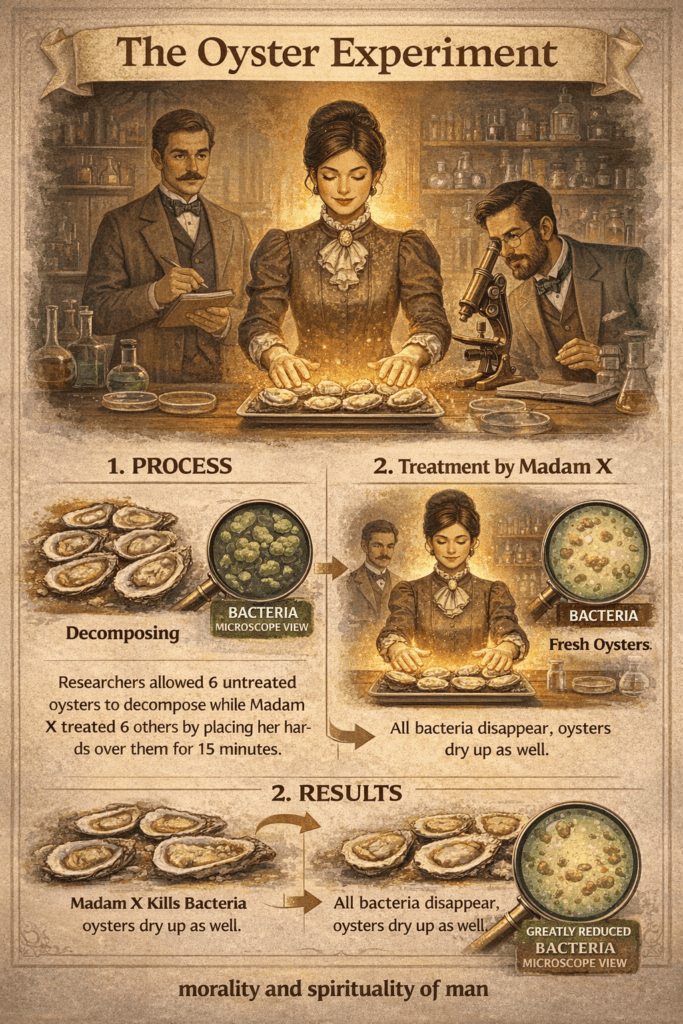
Upon re-examination, researchers claimed thousands of bacteria had been killed.
Within a few days, all bacteria disappeared, and those oysters dried up as well. Thenceforward, no decomposition was noted.
This experimental design attempted to demonstrate that vital emanation from her body destroyed bacteria normally present after death. The microscope traced this process, lending scientific credibility within the limitations of 19th-century methodology.
From a contemporary viewpoint, alternative explanations exist: temperature changes from hand proximity, chemical compounds in skin secretions, or observer bias in bacterial counts. Nevertheless, this case illustrates how researchers attempted to quantify human fluid effects.
The Flower Preservation Test
Many persons reportedly possessed the power of preserving flower life by treating them with their hands daily. Historical accounts suggest trying this experiment yourself:
- Select similar flowers of the same type
- Treat one set daily with focused hand placement
- Have another person preserve a second set under identical conditions
- Note any differences between the two sets over time
This practical exercise connected metaphysical theory to observable phenomena, encouraging personal investigation rather than passive belief. Understanding psychic development within this historical framework reveals how people sought experiential validation.
How Material Objects Become Charged
Historical theories proposed that material objects, particularly those of sponge-like nature such as wood, become highly charged by human fluid magnetism. When this occurred, objects supposedly came “en rapport” with the individual who charged them.
The Connection Mechanism
This vital, fluidic connection theoretically enabled practitioners to move or manipulate objects from a distance through willpower. The concept parallels modern ideas about consciousness and matter interaction, though framed in different terminology.
Researchers claimed experimental proof that this fluidic magnetism either sensed pain directly or served as the means whereby pain traveled from nerve centers to consciousness. This hypothesis attempted to explain mind-body interaction using the conceptual tools available before neuroscience emerged.
The relationship between these historical energy theories and contemporary biofield research remains a topic of philosophical debate. Some argue that vibrational principles underlying these old theories deserve reconsideration with modern measurement tools.
Exteriorization of Sensibility: The Fluidic Double
Among the most unusual claims in historical psychical research was the exteriorization of sensibility—the supposed separation of the fluidic body from its physical counterpart.
Colonel De Rochas’ Research
Colonel Albert De Rochas of Paris conducted experiments attempting to disengage the fluidic body of his subjects from their physical forms. Using hypnotic and magnetic processes, he claimed to remove the “etheric double” entirely and position it several feet from the entranced subject’s physical organism.
The experimental procedure:
De Rochas pricked the surface of the exteriorized fluidic body with needles. The sleeping subject reportedly experienced pain sensations in her physical body at spots exactly corresponding to the parts pricked on the etheric body. This suggested that human vital energy could be projected beyond bodily limits and maintain sensory connection.
According to research on animal magnetism and metaphysics, philosophers like Schopenhauer attempted to reconcile these phenomena with broader metaphysical frameworks. They explored how consciousness might extend beyond material boundaries.
From today’s perspective, these experiments raise questions about hypnotic suggestion, expectation effects, and the power of focused attention. Did subjects experience genuine exteriorization, or did belief systems create subjective sensations? The answer depends partly on one’s philosophical stance regarding consciousness itself.
Understanding abnormal and supernormal psychology provides context for how researchers categorized these unusual states of consciousness.
Practical Takeaways: What These Historical Ideas Offer Today
While modern science employs different frameworks and terminology, these historical concepts about human fluid magnetism raise enduring questions:
Curiosity Over Certainty
Could your own vital energy influence the space around you? Historical theories suggest “yes,” though through mechanisms now described differently. Contemporary biofield research, heart coherence studies, and investigations into electromagnetic signatures from living organisms echo these older questions using updated methodology.
Mindfulness of Personal Energy
Whether or not human fluid magnetism exists as described, cultivating awareness of your energetic state—your mood, presence, and physical vitality—affects how you interact with others and your environment. This practical insight transcends theoretical debates.
Object Relationships
The historical idea that objects absorb personal impressions resonates with modern attachment theory and the psychological significance we attribute to meaningful possessions. Whether this occurs through literal energy transfer or symbolic association matters less than acknowledging the phenomenon itself.
Further Exploration
For readers interested in exploring these concepts deeper:
- Research historical vitalism and its influence on biology
- Investigate contemporary biofield science and biophoton research
- Study the placebo effect and mind-body medicine
- Examine cross-cultural concepts of life force (chi, prana, ki)
Key Takeaways
- Historical context matters: Human fluid magnetism represented 19th-century attempts to explain observed phenomena
- Personal variation: Each individual was thought to possess unique vital energy signatures
- Experimental approach: Researchers conducted experiments (oysters, flowers, exteriorization) to validate theories
- Object charging: Materials supposedly absorbed and retained human vital energy
- Modern relevance: These ideas influenced contemporary research into biofields and consciousness
Frequently Asked Questions
Q: What is human fluid magnetism in historical context?
Human fluid magnetism refers to a historical theory proposing that the human body generates a unique, semi-fluidic energy distinct from electricity or conventional magnetism. Nineteenth-century researchers believed this vital force could flow between organisms, imprint objects, and respond to mental intention. This concept formed part of broader vitalist philosophies attempting to explain life, consciousness, and healing before modern biology emerged.
Q: Is the human fluid recognized by modern science?
No. Contemporary science does not recognize human fluid as described in historical psychical research. Modern physiology explains bodily processes through biochemistry, neurology, and biophysics rather than vital fluids or magnetism. However, current research into bioelectrical fields, biophotons, and electromagnetic signatures from living organisms explores related questions using updated frameworks and measurement tools.
Q: Why were these ideas influential in the past?
These concepts filled explanatory gaps during an era when science lacked tools to measure subtle biological phenomena. Human fluid magnetism offered a framework for understanding healing, psychic experiences, mind-body interaction, and consciousness extension. The theory aligned with widespread interest in spiritualism, mesmerism, and psychical research while attempting scientific validation through experimentation. It represented a bridge between religious/philosophical views of vitality and emerging scientific methodology.
Q: Can I experiment with these concepts safely?
Simple experiments like the flower preservation test pose no harm and may cultivate mindfulness about attention and intention. However, avoid using historical theories for medical treatment or diagnosis. If exploring consciousness practices, approach them as psychological or philosophical exercises rather than literal energy manipulation. Consult qualified healthcare providers for any health concerns, and recognize that historical claims lack modern scientific validation.
Conclusion: Historical Insight and Ongoing Inquiry
Historical ideas about human fluid magnetism reveal how earlier thinkers sought to explain vitality, consciousness, and the mind–body connection using the frameworks available to them. The experiments and observations described reflect the creativity and curiosity of early psychical research, even as they operated within the scientific limits of their era.
While these concepts remain unverified by modern science, the questions they raised—about consciousness, intention, and energetic interaction—continue to shape contemporary inquiry. Today, similar themes appear in emerging fields such as biofield research and consciousness studies, using updated language and more advanced methods.
Approached with critical thinking and historical context, these theories offer valuable perspective on humanity’s enduring quest to understand life, awareness, and energy. They remind us that scientific progress evolves, but curiosity about our nature remains constant.