
Modern Spiritualism: Understanding Spiritual Phenomena in Today’s World
Have you ever wondered why ancient mystical practices and contemporary psychic investigations seem to uncover the same extraordinary truths? The answer lies in understanding how modern spiritualism bridges centuries of spiritual exploration with today’s scientific inquiry.
Throughout history, humanity has sought communication with forces beyond the material world. From medieval theurgic arts—(rituals designed to invoke divine or spiritual entities)—to Franz Mesmer’s animal magnetism theories in the 18th century, each era has contributed building blocks to what we now recognize as spiritual phenomena. Today, you stand at the intersection of ancient wisdom and contemporary understanding, where the mysterious becomes measurable and the invisible reveals itself under specific conditions.
In this guide, you’ll discover how modern spiritualism differs from historical mysticism, what conditions create genuine spiritual manifestation, and why this knowledge matters for anyone seeking deeper spiritual connection. Whether you’re a curious skeptic or a dedicated practitioner, you’ll gain practical insights into navigating the spiritual realm safely and effectively.
What Is Modern Spiritualism?
Modern spiritualism represents a scientific investigation into forces that originate beyond our normal perceptual reality. Unlike medieval magic with its complex rituals and lengthy preparations, this contemporary approach offers accessible pathways to spiritual communication.
The movement traces its roots to the mid-19th century Rochester knockings, but its foundations rest on much older ground. Medieval practitioners understood theurgic arts as sacred work requiring fasts, vigils, and profound spiritual preparation. Mesmerism introduced the concept of invisible forces flowing between living beings. These traditions converged into modern spiritualism, creating a framework that honors both mystical heritage and empirical observation.
You might recognize modern spiritualism through phenomena like mediumship, psychic readings, or séances. Yet true practitioners view it as serious psychological and spiritual investigation rather than entertainment. The goal remains constant across centuries: demonstrating that a spiritual world exists within, around, and beyond material reality—a realm ordinarily hidden from embodied human senses but capable of manifest revelation.
Historical Connections: From Magic to Mesmerism
Understanding modern spiritualism requires examining its lineage. Medieval Christian mystics practiced what they called theurgy—essentially working with divine forces through ritual and prayer. These weren’t mere superstitions but sophisticated systems for engaging spiritual dimensions.
Franz Mesmer revolutionized this landscape in the 1700s by proposing animal magnetism: an invisible fluid permeating all living things. Though science later rejected his specific theories, Mesmer identified genuine phenomena that transcend simple physical explanations. German historians recognized this connection, using magnetic theories to interpret historical magical practices.
This historical thread matters because it reveals a fundamental truth: whether ancient mystics or contemporary investigators, humans have always discovered similar spiritual phenomena when properly seeking them. The methods evolve, but the underlying forces remain constant. As explored in understanding spiritual ascension, these pathways represent different expressions of identical spiritual laws.
Conditions for Spiritual Manifestation
Success in spiritual investigation isn’t random. Specific conditions for spiritual manifestation create environments where invisible forces become perceptible. Understanding and implementing these conditions separates genuine experiences from wishful thinking.
Essential Requirements for Spiritual Contact
Clear Intention: You must consciously seek communication with spiritual entities. This intentionality distinguishes planned spiritual work from spontaneous apparitions—unexpected spiritual encounters that occur without deliberate invitation. Your focused will acts as a beacon.
Harmonious Energy: Gathering with others requires emotional alignment. Conflict, skepticism, or hostility disrupts the subtle energies necessary for manifestation. This doesn’t mean blind faith—critical thinking remains valuable—but hostile energy actively blocks spiritual phenomena.
Atmospheric Conditions: The physical environment matters more than most realize. Dry, moderately warm atmospheres free from electrical or magnetic disturbances provide optimal conditions. This aligns with principles discussed in the law of vibration, where energetic frequency determines manifestation potential.
Circle Formation: Arranged seating creates energetic circuits. Whether you sit in physical circles or arrange consciousness symbolically, this structure channels and amplifies subtle forces.
Subdued Lighting: Harsh illumination disrupts spiritual phenomena. Dimmed light doesn’t hide trickery—it creates conditions where spiritual energies manifest more readily, much as darkness allows stars to become visible.
These conditions for spiritual manifestation haven’t changed across centuries. Medieval adepts knew them instinctively. Modern practitioners codify them systematically. Both approaches work when properly understood and applied.
Modern vs. Medieval: The Simplified Path
Here lies modern spiritualism’s most controversial aspect: it promises comparable results through dramatically simplified methods. Medieval mystics endured years of preparation—fasting, prayer, isolation, and rigorous self-discipline. They walked what practitioners called “the thorny path” toward spiritual mastery.
Contemporary spiritualism offers what appears as a “royal road”—results without extensive preparation. You don’t need years of monastic discipline. You don’t require specialized training or mystical initiations. Simply gather under proper conditions, and spiritual phenomena may manifest.
This accessibility raises important questions. If ancient methods were unnecessarily complex, why did wise practitioners universally prescribe them? If rigorous preparation was essential, how can casual approaches produce genuine spiritual phenomena?
The answer involves understanding different types of spiritual contact. Intense preparation creates profound, controlled, transformative experiences. Simplified methods may produce genuine phenomena but lack the depth, safety, and integration that traditional paths provided. As discussed in avoiding spiritual misuse, accessibility without understanding carries significant risks.
The Science Behind Spiritual Phenomena
Modern spiritualism distinguishes itself through scientific framing. Rather than accepting spiritual experiences on faith alone, practitioners investigate, document, and analyze. This empirical approach has revealed consistent patterns across diverse cultures and timeframes.
Spiritual phenomena demonstrate remarkable cross-cultural consistency. Whether examining 15th-century grimoires or 21st-century séance records, similar manifestations occur under similar conditions. This consistency suggests underlying natural laws governing spiritual interaction—laws as real as gravity or electromagnetism, though less understood.
You’re observing forces that originate outside normal material causation yet interact with physical reality in measurable ways. These aren’t hallucinations or psychological projections but genuine manifestations of non-physical intelligence. The evidence accumulates through repeated observation: unexplained physical movements, information unknown to participants, communications displaying consistent personality characteristics.
This scientific approach doesn’t diminish spirituality’s sacred nature. Rather, it reveals spirit as fundamental to reality’s structure, woven into existence as intrinsically as matter and energy. Understanding this helps navigate the concepts explored in moral clarity regarding spiritual practices.
Faith vs. Investigation in Modern Practice
One crucial distinction separates modern spiritualism from religious dogma: you’re not required to believe anything before investigating. This principle matters tremendously for authentic spiritual development.
Historical mysticism often demanded faith as prerequisite. You believed first, then possibly experienced confirmation. Modern spiritualism reverses this sequence. Experience comes first. Understanding follows. Belief emerges naturally from direct encounter rather than prescribed doctrine.
This approach honors both skepticism and openness. You can maintain critical thinking while remaining receptive to genuine phenomena. The phenomena themselves provide evidence, requiring neither blind acceptance nor hostile dismissal. As examined through philosophical frameworks of polar opposites, this balance between skepticism and openness creates optimal investigation conditions.
Many assume spiritual investigation requires believers. This misconception has hindered serious research for decades. In reality, the most valuable investigators bring questioning minds alongside open hearts. Phenomena manifest or don’t based on conditions created, not beliefs held.
Practical Implications for Your Spiritual Journey
Understanding modern spiritualism offers concrete benefits for your spiritual development. Whether you seek direct spiritual communication or simply wish to understand these phenomena, several practical principles emerge.
First, recognize that spiritual forces operate through natural laws, not arbitrary magic. Learning these laws—as you would learn any science—increases your effectiveness and safety. Approach spiritual investigation with the same rigor you’d apply to any important endeavor.
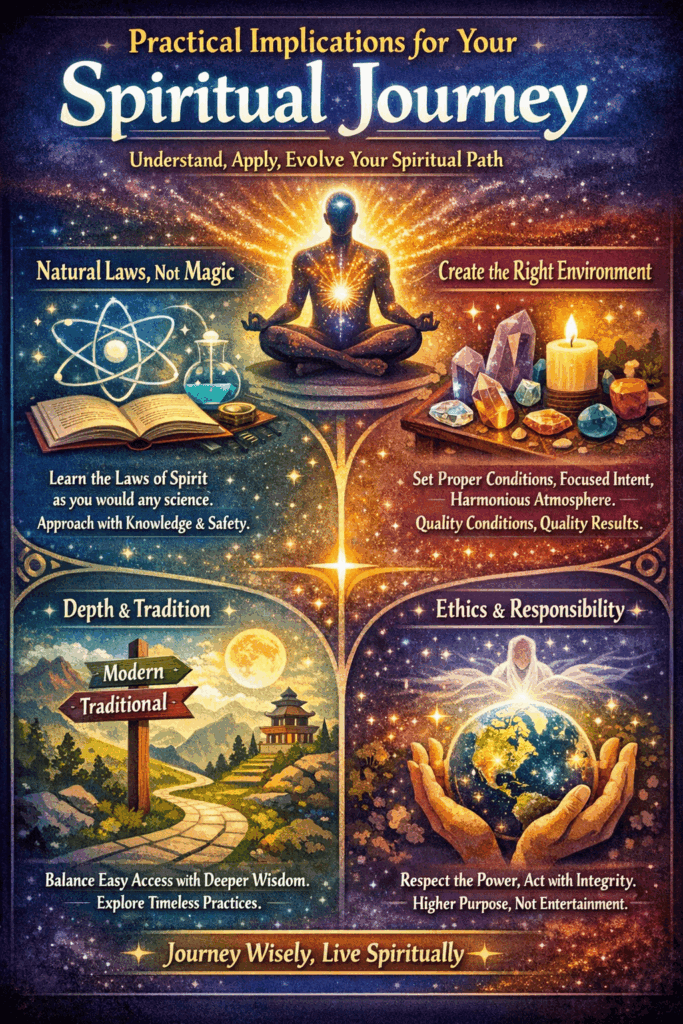
Second, respect the importance of proper conditions for spiritual manifestation. Don’t expect profound results from haphazard efforts.
Create appropriate environments, gather harmonious companions, and maintain focused intention. Quality conditions produce quality experiences.
Third, balance accessibility with depth. Modern spiritualism’s simplified approach offers valuable entry points, but don’t mistake ease of access for completeness of understanding. Consider exploring traditional practices that provide comprehensive frameworks for spiritual development.
Finally, maintain ethical awareness throughout your spiritual journey. The forces you engage are real and powerful. As detailed in comprehensive spiritualism resources, this power demands responsible application. Spiritual phenomena serve higher purposes than entertainment or ego gratification.
Moving Forward with Modern Spiritualism
Modern spiritualism stands at a unique historical moment. Ancient wisdom traditions have been preserved and transmitted. Scientific methodology has been refined and applied. Technology enables global communication among practitioners and researchers. You have unprecedented access to knowledge, community, and resources.
This accessibility carries responsibility. As more people explore spiritual phenomena without traditional safeguards, the need for informed, ethical practice intensifies. Your understanding of proper conditions, historical context, and scientific principles helps ensure that modern spiritualism fulfills its highest potential: demonstrating humanity’s connection to vast spiritual realities while maintaining safety, sanity, and sacred purpose.
The path forward combines ancient wisdom with contemporary insight. Honor the thorough preparations that traditional mystics prescribed while embracing the accessibility that modern approaches provide. Investigate phenomena scientifically while recognizing their sacred dimensions. Balance skepticism with openness, rigor with receptivity.
Whether you pursue modern spiritualism as serious practice or simply seek to understand its place in contemporary spirituality, you now possess foundational knowledge for navigating this terrain effectively and safely.
Frequently Asked Questions
What Makes Modern Spiritualism Different from Traditional Magic?
You can distinguish modern spiritualism through its simplified methodology and scientific framing. Traditional magic required years of preparation including fasting, prayer, and ritual discipline. Modern spiritualism achieves similar contact with spiritual entities through straightforward practices: gathering under harmonious conditions, forming circles, and maintaining clear intention. The key difference lies in accessibility—modern approaches democratize spiritual investigation without requiring extensive mystical training.
What Are the Essential Conditions for Spiritual Manifestation?
You need five primary conditions for successful spiritual manifestation. First, clear intention to communicate with spiritual entities distinguishes planned contact from spontaneous experiences. Second, harmonious energy among participants prevents disruptive interference. Third, favorable atmospheric conditions—dry, warm, electrically stable environments—support subtle phenomena. Fourth, proper circle formation channels spiritual forces effectively. Fifth, subdued lighting creates optimal conditions where spiritual energies manifest more readily than under harsh illumination.
Can Skeptics Successfully Investigate Spiritual Phenomena?
You absolutely can investigate spiritual phenomena while maintaining healthy skepticism. Modern spiritualism doesn’t require belief as a prerequisite for investigation. The phenomena themselves provide evidence through direct experience rather than demanding faith beforehand. Critical thinking actually enhances legitimate investigation by helping distinguish genuine spiritual contact from psychological projection or fraud. What matters is creating proper conditions while remaining open to whatever genuinely manifests.
How Does Modern Spiritualism Relate to Animal Magnetism?
You’ll find significant historical connections between animal magnetism and modern spiritualism. Franz Mesmer proposed that invisible magnetic forces flow through living beings, creating a conceptual bridge between medieval theurgy and contemporary spiritual investigation. While science rejected Mesmer’s specific theories, his work identified genuine phenomena that transcend simple physical explanations. Both animal magnetism and spiritualism recognize forces operating beyond normal material causation yet capable of producing observable effects under specific conditions.