
Mysterious Occult Places Linked to Supernatural Beliefs and Ancient History
What if certain locations on Earth were designed not merely for habitation—but to channel unseen forces that defy conventional understanding?
Many people visit ancient sites without realizing these locations have attracted occult practitioners, mystics, and spiritual seekers for centuries. These places hold reputations as centers of supernatural activity, built with symbolic intent and energetic purpose.
This guide explores mysterious occult places across the world, revealing their history, symbolism, and why they remain powerful ancient mystical locations today.
The Winchester Mystery House: Construction as Spiritual Protection
Sarah Winchester’s sprawling California mansion stands as one of America’s most enigmatic structures. Born Sarah Pardee in 1839, she married William Winchester, heir to the Winchester firearms fortune. Tragedy struck repeatedly—her infant daughter Annie died in 1866, and William succumbed to tuberculosis in 1881.
Legend claims Sarah consulted Boston medium Adam Coons, who warned that vengeful spirits of men killed by Winchester rifles would haunt her. Though no evidence confirms this meeting ever occurred, Sarah’s subsequent actions sparked decades of speculation.
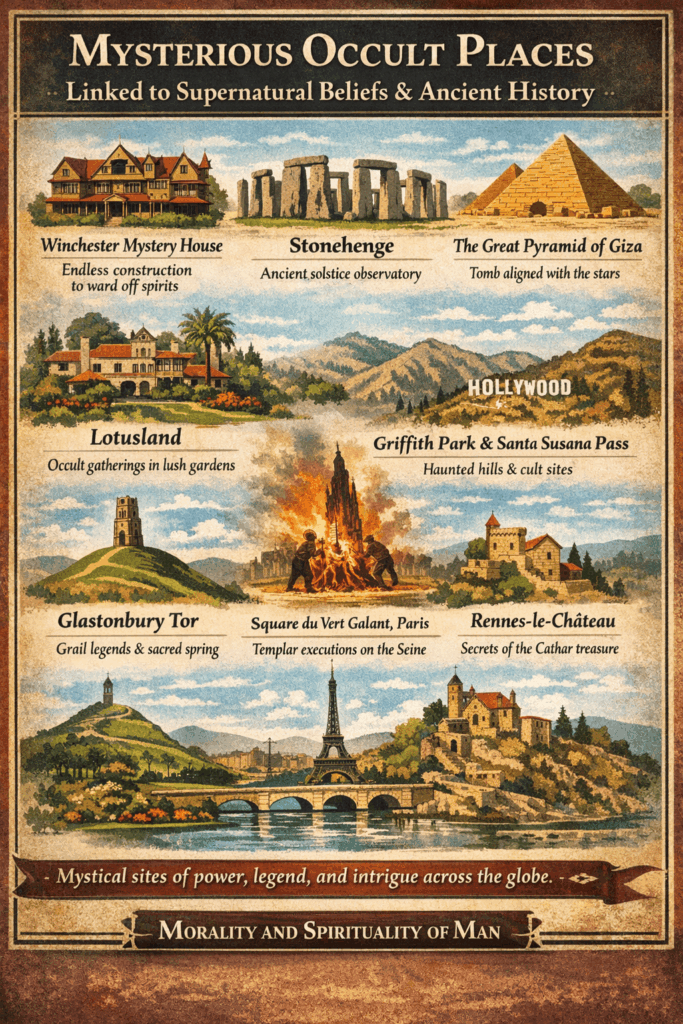
In 1884, she purchased an eight-room ranch house in San Jose and began endless renovations. For 38 years, construction never stopped.
The mansion eventually contained 160 rooms, 47 fireplaces, 10,000 windows, and 13 staircases leading nowhere.
The prevailing theory suggests Sarah believed continuous construction would prevent spirits from attaching to the property. This approach reflects a fundamental principle about mysterious occult places—they function as vessels for energy manipulation, whether that energy flows inward or outward.
Understanding this concept requires awareness of spiritual ethics and responsibility when exploring such locations.
Stonehenge: An Ancient Mystical Location of Cosmic Alignment
Stonehenge stands as perhaps the most recognized ancient mystical location in the world. Dating back 5,000 years, this stone circle in Wiltshire, England, served as an astronomical observatory and calendar aligned with the summer solstice.
Medieval legends attributed Stonehenge’s construction to the sorcerer Merlin. Modern archaeology reveals it regulated planting cycles and ritualistic ceremonies. The site’s precise solar alignments demonstrate sophisticated astronomical knowledge possessed by Neolithic builders.
Today, neo-pagans and druids gather at Stonehenge for seasonal celebrations. The enduring fascination with this site reflects broader patterns in psychology of supernatural belief and how humans assign meaning to enigmatic structures.
Lotusland: Where Opera Meets Occultism
In Santa Barbara’s exclusive Montecito neighborhood, Lotusland presents a different type of occult-infused estate. Opera singer Ganna Walska, born Hanna Puacz in 1887, created this 32-acre property with her sixth husband, Theos Bernard, who styled himself the “White Lama.”
Bernard convinced Walska to establish a refuge for Tibetan monks. The monks never arrived, and the marriage ended, but Walska retained the property until her death in 1984.
During those decades, Lotusland became notorious for unauthorized occult gatherings as thrill-seekers sneaked onto the grounds. The estate’s lush gardens now operate as a public attraction.
Its history illustrates how occult and supernatural places sometimes develop reputations independent of their creators’ intentions, becoming magnets for those seeking mystical experiences or practicing dark spiritual practices.
Los Angeles: Urban Centers of Supernatural Energy
Griffith Park: Beauty Under a Curse
Griffith Park encompasses over 4,000 acres of wilderness within Los Angeles. Beyond housing the observatory, zoo, and Hollywood sign, the park carries a reputation for supernatural occurrences dating to its Spanish land-grant origins.
Ghost stories permeate the park’s history. One infamous incident from 1976 involved a couple crushed by a falling tree limb during an intimate moment. More troubling are the park’s numerous unsolved murders and disappearances.
Santa Susana Pass: California’s Cult Magnet
The eastern Simi Valley, particularly around Santa Susana Pass, has drawn fringe religious movements for decades. The area hosted Spahn Ranch, where Charles Manson’s family resided in the late 1960s.
Earlier, in 1948, Francis Pencovic proclaimed himself Christ reincarnate and founded the Fountain of the World. His movement ended violently in 1958 when disgruntled followers detonated explosives, killing themselves and their guru.
The official Santa Susana Pass site documents this area’s complex history.
The Great Pyramid of Giza: Monument to Divine Power
The Great Pyramid represents perhaps the most mythologized structure globally. Built 4,000 to 5,000 years ago as Pharaoh Khufu’s tomb, its very purpose made it an occult site—designed to protect divine remains through architectural precision and ceremonial spells.
The pyramid’s symbolic meaning extends beyond burial function. Its alignment with celestial bodies, mathematical proportions, and construction methods continue generating theories about lost knowledge and hidden chambers.
Glastonbury: Britain’s Sacred Landscape
Beyond Stonehenge, Britain offers Glastonbury, a Somerset town steeped in Arthurian legend. The tale claims Joseph of Arimathea carried the Holy Grail to Roman Britain and concealed it near Glastonbury Tor, a distinctive conical hill.
The Tor guards a reputed entrance to the underworld and sources Chalice Well, a natural spring. Legend states Joseph’s thorn-wood staff took root there, growing into an unusual oriental thornbush.
Though a Puritan soldier destroyed the original tree in the 17th century to combat idolatry, a replacement now grows at the site. Glastonbury demonstrates how mysterious occult places blend historical events with spiritual narratives, creating destinations that serve both pilgrims and tourists.
French Sites of Mystery and Martyrdom
Square du Vert Galant: Where Templars Died
At the western tip of Paris’s Île de la Cité sits Square du Vert Galant. Here in 1314, Grand Master Jacques de Molay and other Knights Templar leaders burned at the stake.
Occultists believe these executions charged the location with anger and revenge energies that practitioners might harness. The site became a gathering place for modern occultists attempting exactly that.
This illustrates both the allure and danger of occult and supernatural places—they attract those seeking power without necessarily understanding the implications.
Rennes-le-Château: Cathar Country’s Enigmatic Village
In southern France, the mountain village of Rennes-le-Château holds the reputation as France’s most occult-laden location. It sits in Cathar territory, where a heretical Christian sect faced extermination during medieval crusades.
The village’s mystique stems from this violent history and subsequent treasure legends. Approaching such places requires moral clarity to separate historical fact from sensationalized fiction.
Understanding Energy and Intent at Sacred Sites
The common thread connecting all mysterious occult places involves energy—directing it into objects, thoughts, or locations, or extracting it for specific purposes. Whether through continuous construction, astronomical alignment, or ritualistic tragedy, these sites demonstrate humanity’s persistent belief in places of power.
Visiting such locations responsibly means recognizing their historical and cultural significance while maintaining healthy skepticism about supernatural claims. These ancient mystical locations deserve respect not because they necessarily harbor mystical forces, but because they represent human creativity, belief, and the search for meaning beyond the physical realm.
Frequently Asked Questions
What makes a location a mysterious occult place?
A location earns this designation through historical association with supernatural beliefs, ritualistic practices, or unexplained phenomena. Factors include architectural symbolism, tragic events, or deliberate construction to harness spiritual energy. Reputation often develops across generations as stories accumulate around the site.
Are ancient mystical locations dangerous to visit?
Physical danger depends on the specific location’s accessibility and maintenance. Spiritual danger is subjective and relates to personal belief systems. Most sites function as museums or tourist attractions with safety measures. Approach any location with respect for its cultural significance and awareness of local regulations.
Why do occult and supernatural places attract modern visitors?
These sites appeal to curiosity about human history, spiritual exploration, and the desire to experience places connected to legends. They offer tangible connections to past beliefs and practices. Tourism often blends genuine spiritual seeking with entertainment, creating complex motivations for visitation.
Can you practice spirituality safely at these locations?
Safe spiritual practice at any location requires clear intentions, respect for the space’s history, and understanding of your own boundaries. Avoid attempting rituals beyond your knowledge level or that appropriate closed cultural practices. Focus on observation and reflection rather than energy manipulation without proper guidance.
How do I distinguish authentic history from sensationalized legends?
Research multiple sources, prioritize academic and archaeological findings, and recognize that entertainment media often exaggerates supernatural elements. Visit official site documentation and understand that legends frequently contain kernels of truth wrapped in creative embellishment. Maintain critical thinking while remaining open to historical complexity.
Conclusion
Mysterious occult places continue captivating because they exist at the intersection of history, architecture, belief, and human longing for connection to something greater. From the Winchester Mystery House’s endless corridors to Stonehenge’s ancient stones, these ancient mystical locations remind us that people across cultures and centuries have sought to create, identify, or inhabit spaces of power.
Understanding these sites through the lens of cultural history rather than blind belief allows appreciation for human creativity and spiritual aspiration. Whether you approach mysterious occult places as tourist destinations, historical monuments, or genuine power sites, doing so with discernment and respect honors both the locations and those who built them.