
Consciousness · Neuroscience · Ancient Wisdom
Psychedelic Consciousness: How Ancient Wisdom and Modern Neuroscience Reveal the Mind’s True Potential
Deep inside the caves of Sulawesi, Indonesia, a 67,800-year-old red hand stencil has rewritten the story of the human mind. Psychedelic consciousness — the expanded, boundary-dissolving state of awareness accessed through entheogenic plants and fungi — appears to be as ancient as our human species itself. The artists who painted these walls did not simply record their environment; they deliberately modified their handprints into claw-like fingers, creating therianthropes — beings that were part human, part animal. They were documenting a transformation that runs straight into the heart of psychedelic consciousness and human evolution.
In this blog, you will discover how the stoned ape hypothesis links ancient mushroom use to the birth of symbolic language, how psilocybin and the mind’s eye are validated by modern brain imaging, and why the ancient cave artists of Sulawesi may have been the first humans to map the territory that neuroscientists are only now beginning to chart.
In This Article
- → The Ecological Origins of Expanded Awareness
- → The Stoned Ape Hypothesis & Human Evolution
- → Modern Neuroscience & Psilocybin and the Mind’s Eye
- → BDNF, Neuroplasticity & Cellular Regeneration
- → The Pineal Gland & Sacred Shamanic Knowledge
- → Gnosticism, Ego Dissolution & Ethics
- → The Modern Crisis & the Path Back
- → Frequently Asked Questions
The Ecological Origins of Expanded Awareness

The caves of Sulawesi sit within the Wallacea region — a tropical, high-moisture ecosystem that has hosted psilocybe fungi for millions of years. Long before humans arrived, these natural compounds existed as part of the living landscape, waiting to be discovered by foragers navigating its dense rainforests.
When early humans encountered these substances, they experienced something unprecedented: the dissolution of individual identity and the emergence of transpersonal connection to the living world around them. The cave walls became membranes between physical reality and a deeper dimension where all life appeared interconnected.
The claw-like hand stencils represent the externalization of that discovery — that human identity is fluid and that we participate in a vast biological network. Altered states of consciousness accessed through these environmental sacraments gave our ancestors a functional mind’s eye that enhanced pattern recognition, visual acuity, and social bonding. These were not spiritual luxuries but evolutionary advantages.
The Stoned Ape Hypothesis: Did Psilocybin Catalyze Human Evolution?
Terence McKenna famously proposed the stoned ape hypothesis, arguing that psilocybin mushroom consumption on the African savanna acted as the primary catalyst for the rapid expansion of the human brain and the birth of symbolic language. McKenna viewed fungal networks as a planetary intelligence that gave early humans a functional mind’s eye — the capacity to perceive the deeper patterns of their ecosystem.
Tony Wright’s parallel work in Left in the Dark argues that the shift from a high-nutrient symbiotic tropical diet to a more restricted one caused a physiological imbalance — the dominance of the left-brain’s analytical patterns over the right-brain’s holistic, integrated perception. Together, these frameworks paint a compelling picture of psychedelic consciousness and human evolution as inseparable forces.
Recent research validates core aspects of the stoned ape hypothesis. Psychedelic consciousness enhances precisely the traits that conferred survival advantages on early human groups:
- ✦ Improved visual tracking and pattern recognition
- ✦ Enhanced identification of medicinal and edible plants
- ✦ Strengthened group cohesion through shared visionary experience
- ✦ Accelerated development of symbolic communication
“The evidence is literally carved in stone. Those 67,800-year-old hand stencils mark the moment when psychedelic consciousness and human evolution converged — when our ancestors used symbols to reach beyond the routine of survival.”
What Modern Neuroscience Reveals About Psilocybin and the Mind’s Eye
Today’s brain imaging technology confirms what ancient shamans knew through direct experience. When researchers study the brain under psilocybin, they observe dramatic changes in neural connectivity that illuminate psilocybin and the mind’s eye as a scientifically verifiable phenomenon, not a metaphor.
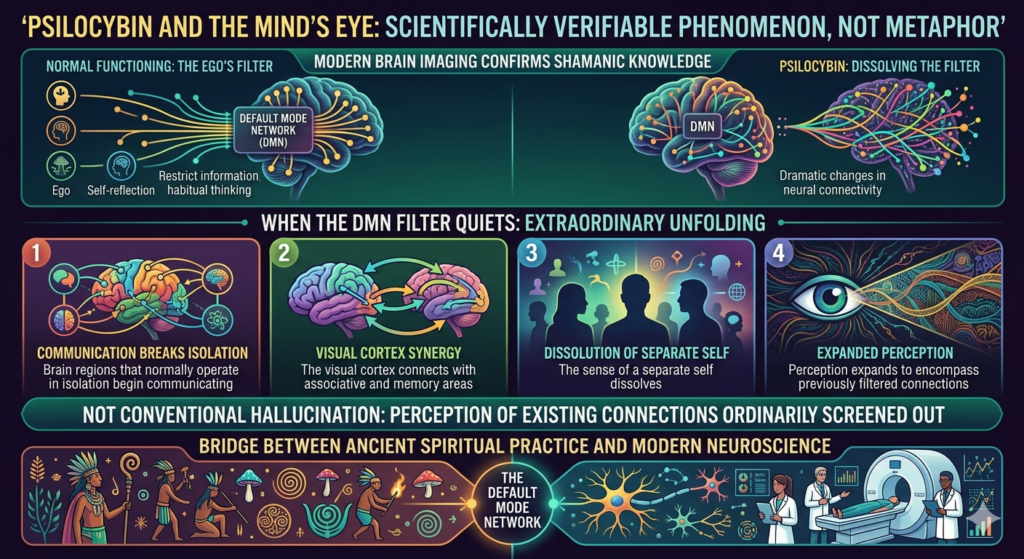
When the DMN filter quiets, four shifts unfold:
- ① Brain regions in isolation begin communicating
- ② The visual cortex connects with associative and memory areas
- ③ The sense of a separate self dissolves
- ④ Perception expands to encompass previously filtered connections
This is not hallucination in the conventional sense. This is psilocybin and the mind’s eye in action — perception of connections that always exist but are ordinarily screened out by the DMN. The relationship between the nature of the ego and its role in filtering consciousness and the Default Mode Network is one of the most important bridges between ancient spiritual practice and modern neuroscience.
BDNF, Neuroplasticity, and Whole-Body Cellular Regeneration
Psilocybin stimulates Brain-Derived Neurotrophic Factor (BDNF), a protein that promotes synaptogenesis — the formation of new neural connections. This is the biological engine behind learning, adaptation, and cognitive flexibility. For our ancestors, it meant accelerated adaptation to shifting climates. For us, it means escaping rigid thought patterns and rewiring the brain toward greater creative resilience.
The cellular effects extend far beyond the brain. A groundbreaking Emory-Baylor study demonstrated that psilocin — the active form of psilocybin — extends the lifespan and improves the metabolism of fibroblasts, which are cells with no nervous system at all. The same serotonin receptors activated in the brain exist throughout our metabolic organs, immune cells, and skin.
Psychedelic consciousness is not merely a brain event. It is a whole-organism upgrade — activating the same serotonin receptors present in every organ, immune cell, and layer of skin in the body.
Psilocybin also improves mitochondrial efficiency — the energy-generating capacity of every cell in the body. This connects directly to vital energy and the bioelectric field of the human body, a dimension of health that ancient traditions recognized centuries before modern biology had language for it.
The Pineal Gland, Sacred Symbolism, and Ancient Shamanic Knowledge
As explored in the guide on the chakra system, the pineal gland — a pinecone-shaped organ deep within the brain — produces melatonin and endogenous DMT. Ancient cultures across Egypt, Greece, Sumer, and India revered it as the seat of the soul and the biological gateway to visionary experience.
The symbolism of the pinecone and the Tree of Life across ancient traditions — from the staff of Osiris to the thyrsus of Dionysus — encodes a preserved, cross-cultural knowledge of these activated states. The Shasu nomads of the Levant acted as conduits for entheogenic sacraments. The Eleusinian Mysteries of ancient Greece initiated thousands through a psychedelic drink called kykeon for nearly two millennia.
These are not separate phenomena. They form a single, unbroken current of psychedelic consciousness flowing from the first cave artists through every major ancient civilization. The evolution of psychic and intuitive faculties in the human mind follows the same biological pathway that these traditions mapped tens of thousands of years ago.
Gnosticism, Ego Dissolution, and the Ethics of Expanded Awareness
Gnosticism represents the urbanized evolution of ancient shamanism. The Gnostics identified the “archons” — parasitic constructs of the lower mind — as precisely what neuroscience now identifies with the DMN’s filtering function. Their goal was silencing the internal monologue to access what they called the pleroma: the fullness of being. Their central ritual, the chrysm anointing, used psychoactive botanical preparations to achieve this state directly.
This was not theology. This was a practiced technology of consciousness. Understanding spiritualism as a moral framework for expanded consciousness reveals that these traditions always embedded visionary practice within an ethical structure — because expanded awareness carries expanded responsibility.
The Modern Crisis and the Path Back
We live in a state of collective amnesia. The average person spends more than seven hours daily on screens. We have traded the mind’s eye for dopamine feedback loops, and our mental and biological health reflect that exchange. Environmental toxins, nutrient-depleted diets, and chronic digital overstimulation actively suppress the biological systems that psychedelic consciousness evolved to activate.
But the resurgence of psychedelic research, university-led clinical trials, decriminalization movements, and indigenous rights campaigns signals a genuine turning point. Restoring psychic and energetic health in a fragmented world begins with reclaiming the biological inheritance that our Sulawesi ancestors documented on stone 67,800 years ago. Psychedelic consciousness is not a relic. It is a map — drawn by our ancestors, confirmed by our scientists, and waiting to guide us forward.
Final Thought
Conclusion
The science is no longer asking whether consciousness and biology are connected — it is asking how deeply. Just as mycelial networks pulse with intelligence beneath every forest floor, your internal systems are designed to thrive on relational feedback, not isolation. Extending your lifespan without expanding your aliveness is not longevity — it is a slow, mechanical countdown.
The Mind’s Eye changes that equation entirely. It is the biological bridge where metabolism meets meaning, where the chemistry of your cells answers to the quality of your awareness. The ancient cave artists of Sulawesi understood this. Modern neuroscience is now catching up.
The only question left is whether you will.
Common Questions
Frequently Asked Questions About Psychedelic Consciousness
What is psychedelic consciousness and how does it differ from ordinary awareness?
Psychedelic consciousness refers to a distinct neurological state defined by reduced Default Mode Network activity, dramatically increased inter-regional brain connectivity, and temporary dissolution of the ego boundary. Unlike ordinary waking awareness — which filters sensory input through habitual, survival-oriented patterns — this expanded state allows information to flow freely across brain regions that do not normally communicate.
Researchers document measurable increases in BDNF, improved mitochondrial efficiency, and neural connectivity changes that persist long after the acute experience ends. In short, it is the brain operating at a higher range of its natural capacity, not outside it.
What is the stoned ape hypothesis and does modern science support it?
The stoned ape hypothesis, proposed by Terence McKenna, argues that psilocybin mushroom consumption on the African savanna catalyzed the rapid expansion of the human brain and the birth of symbolic language. While researchers continue to debate its scope, modern neuroscience supports its core claims: psilocybin enhances precisely the cognitive traits — pattern recognition, social bonding, symbolic thinking — that gave early humans their evolutionary edge.
The 67,800-year-old cave art of Sulawesi, featuring deliberate therianthropic imagery, provides compelling physical evidence that altered states shaped human creative expression from the very beginning of recorded culture.
How does psilocybin and the mind’s eye connect to ancient spiritual traditions?
Psilocybin and the mind’s eye provide the scientific framework for what ancient traditions described as visionary or mystical experience. Brain imaging confirms that psilocybin quiets the ego-filter and opens perception to connections that the DMN ordinarily suppresses. Ancient shamans, Gnostic practitioners, and Eleusinian initiates all accessed this same neurological state through botanical sacraments. The convergence of modern neuroscience and ancient tradition is not coincidental — it reflects a single, consistent biological reality that human cultures have mapped, preserved, and transmitted across millennia.
Can psychedelic consciousness support mental health and cellular longevity?
Yes, and the evidence is growing rapidly. Psilocybin stimulates BDNF-driven neuroplasticity, improves mitochondrial efficiency, and extends cellular lifespan even in cells that contain no nervous system, as the Emory-Baylor fibroblast study demonstrates. Clinical trials at Johns Hopkins, NYU, and Imperial College London report lasting reductions in depression, anxiety, and addiction following psilocybin-assisted therapy — with effects persisting for months or years after a single session. Psychedelic consciousness activates the same serotonin receptors present not only in the brain but throughout the immune system, gut, and skin, producing whole-body effects that ancient healing traditions recognized long before modern medicine.