
Soul Reflection: The Nature of the Ego, Ego Versus the True Self, and the Journey Toward Soul Realization
Many people misunderstand the nature of the ego, mistaking it for their true identity rather than seeing it as reflected consciousness. This confusion arises from identifying with the persistent sense of “I,” creating tension between ego versus true self. Soul Reflection begins when this “I” is observed rather than claimed, revealing that thoughts, emotions, and the body are experiences—not identity.
Through this awareness, the ego is recognized as a reflection of the soul, not the source of being. As intuition develops through meditation, this distorted self-image softens, opening the path toward Soul Realization. This inner shift does not remain abstract; it directly influences physical and emotional well-being, as shown in how emotions affect your body when consciousness is rooted in ego instead of soul.
Soul Reflection and the Nature of the Ego
The nature of the ego resembles a mirror placed before a flame. The flame represents your soul—pure, unchanging consciousness. The ego is the reflection you see in the mirror, mistaking it for the original light source. This reflected consciousness creates your sense of “I-ness,” the subjective feeling that you exist as a separate individual experiencing thoughts, sensations, and emotions.
You might wonder: if everything can be removed from your identity—your body parts, your memories, your possessions—what remains? Imagine losing a hand. You wouldn’t say “I am gone,” only that your hand is gone. The “I” observing this loss persists unchanged. This observer is what you experience as ego, but it’s actually Soul Reflection—the soul’s light bouncing through the crystal of undeveloped intuition.
Think of the ego as a pseudosoul, a shadow that moves when the real substance shifts. Your thoughts, feelings, and experiences cluster around this nucleus of “I-ness.” They change constantly—childhood transforms into youth, youth into adulthood—yet you maintain a continuous sense of being the same person throughout these metamorphoses. This paradox defines the ego: changeless consciousness of sameness amid perpetual change.
Ego Versus True Self—The Illusion of Identity
The fundamental difference in ego versus true self lies in what can be eliminated. You cannot subtract the “I” from your experience, but you can remove everything the “I” thinks it possesses. Your body changes, your thoughts shift, your emotions fluctuate—yet something remains constant, witnessing these transformations.
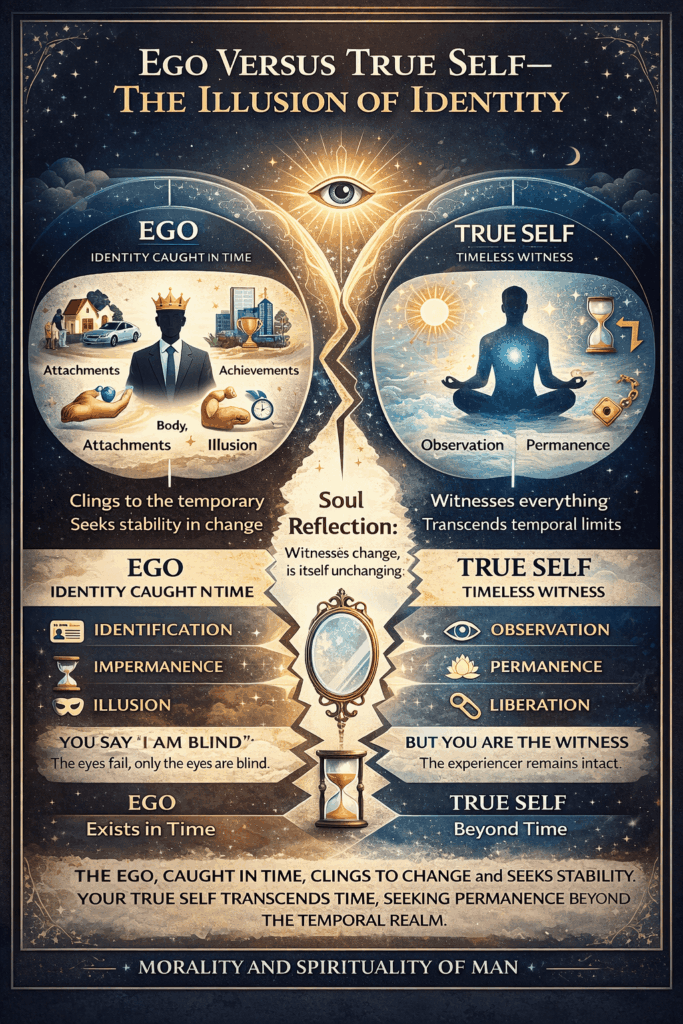
This creates a powerful delusion. You identify the experiencer with the experience itself. When your eyes fail, you say “I am blind,” but technically, only the eyes are blind. You, the experiencer, remain intact.
Through Soul Reflection, you begin recognizing this distinction. You observe that the subject lording over experiences differs entirely from the objects of experience.
The ego exists in time, subject to impermanence and change. Your true Self transcends temporal limitations entirely. This relationship between consciousness and time reveals why the ego versus true self creates such profound confusion.
The ego, caught in time’s flow, constantly seeks permanence through identification—with your body, your achievements, your relationships. Yet none of these provides the stability you seek because they all exist within the realm of change.
Intuition as the Soul’s Light
Intuition functions as a flame of knowledge emanating from your soul. It possesses all-sided power to perceive reality directly, without the distortions of thought and sensation. Every person carries this potential, but in most, it remains undeveloped—like a diamond buried under layers of sediment.
When your intuition remains undeveloped, it acts like a flawed crystal placed before your soul. The soul itself shines as the real image, but the reflection creates the ego—a distorted double image. The less developed your intuition, the more warped this reflection becomes. You then navigate life guided by this false identity, subject to limitations and delusions that don’t actually bind your true nature.
This explains the chaos you may experience when living from ego-identification. The nature of the ego, shaped by undeveloped intuition, leads you into error and its inevitable consequences. Yet this same ego preserves you from falling into purely animal consciousness. Without it, you’d function only through sensation and instinct, lacking the discriminative capacity that characterizes human awareness.
Developing intuition through practices like meditation transforms this relationship. As explored in psychic development and evolution, refining your intuitive faculties gradually clarifies the reflection until Soul Realization becomes possible.
Pure Ego and Impure Ego
Understanding ego versus true self requires distinguishing between pure and impure ego. The ego you normally experience isn’t pure—it’s entangled with intellect, mind, and sensory impressions. This impure ego gets perverted by thought waves, mental vibrations, and external stimuli, creating the suffering and confusion that characterize ordinary consciousness.
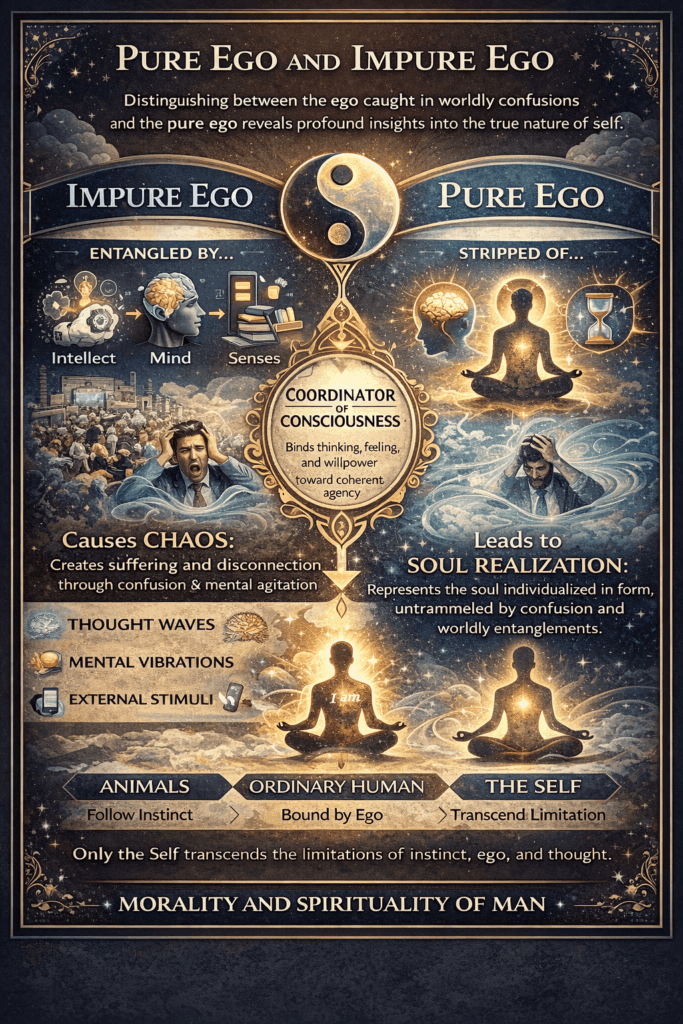
Think of a factory with thousands of workers but no coordinator. Chaos would reign. The ego serves as that principal, that quality of “I-ness” allowing different phases of consciousness—thinking, feeling, willing—to cooperate toward intended ends.
Without it, you couldn’t relate coherently to your thoughts and experiences. You’d have no sense of continuity or agency.
Consider insanity: the ego becomes so affected that it forgets its proper relationship with thoughts and experiences, producing uncoordinated, irresponsible behavior. This demonstrates the ego’s necessary function as coordinator.
Pure ego, however, represents something entirely different. When you become conscious of the pure ego—untrammeled by its evolutionary entanglements—you stand very near Soul Realization. At this level, the pure ego reveals itself as nothing other than the soul, the individualized Self incarnated in form.
Animals follow instinct with limited intelligence. Ordinary humans, guided by ego, possess greater power and intelligence but remain bound by thoughts and sensations. Only those united to the Self transcend these limitations.
Sleep, Meditation, and Soul Reflection
Every night in sleep, you unconsciously practice Soul Reflection. When the ego sleeps, it releases its grip on titles, possessions, name, and form. Your senses absorb into mind, mind into intellect, intellect into ego. In the deepest dreamless sleep, you contact the blissful pure ego or soul directly.
But you enter this state unconsciously, losing its spiritual benefit. You become a renunciant each night, sloughing off sham identities, occasionally even touching the consciousness of a saint. Yet because of ingrained sense habits during waking hours, you cannot preserve that nonattachment while actively engaged in daily life.
Meditation offers conscious entry into this same state. If you can remain unidentified with thoughts and sensations for sufficient time—without falling into blankness or unconsciousness—you’ll know your true Self through undistorted pure intuition. The absolute calmness of deep meditation removes the barrier of undeveloped intuition that was reflecting the soul distortedly. Learn more from our meditation guide and understand how to start practicing.
This Soul Reflection through meditation eliminates conflict about your true identity. You’re no longer torn between competing self-images. The spiritual ascension path requires this conscious practice, transforming what sleep accomplishes unconsciously into deliberate Soul Realization.
The Ego’s Defeat Through Conscious Cooperation
Here’s a crucial truth about ego versus true self: the ego cannot be killed against its will. You cannot destroy the “I” without its consent and cooperation. Attempting to violently suppress the ego only strengthens its resistance, creating internal warfare that depletes your spiritual energy.
The ego serves both good and evil equally, keeping consciousness bound to bodily identification regardless of whether your desires and actions are virtuous or harmful. When sense-driven impulses dominate, the ego supports them. As discriminative qualities grow stronger, the ego gradually shifts allegiance, wearying of supporting delusion.
Yet Soul Realization cannot complete while ego maintains its separate identity. The solution emerges through conscious cooperation. In profound meditation, you render the ego powerless and benign—not by destruction but by transformation. The pure sense of “I-ness” remains even as identification with limitation dissolves.
This process requires patience and skillful means. Forcing spiritual experiences through unethical methods, as discussed in spiritualism misuse and dark practices, corrupts the natural unfolding of Soul Reflection. The ego surrenders only when divine consciousness moves upward to the finest forces in the brain, merging with Spirit in formless meditation.
Moral Discernment Before Soul Rule
Before attempting to transcend the ego, you must develop strong moral discernment. The nature of the ego includes its capacity for self-deception. Without ethical grounding, you might mistake spiritual bypassing for genuine Soul Reflection, or confuse dissociative states with authentic transcendence.
Establishing moral clarity between good and evil creates the foundation for safe spiritual practice. You need discriminative wisdom to recognize when the ego disguises itself as spiritual insight, when desire masquerades as intuition, when fear poses as divine guidance.
The pure ego or soul cannot rule your consciousness while the impure ego remains entangled with intellect waves, mental vibrations, and sense impressions. You must first purify these faculties, not through suppression but through understanding and conscious cooperation. Only then does the possibility of ego’s disturbance get genuinely removed.
CONCLUSION
Soul Reflection offers you a path beyond the confusion of ego versus true self. You’ve discovered that the ego serves as both coordinator and obstacle—necessary for human functioning yet preventing direct contact with your true nature. Through Soul Reflection in meditation, you consciously enter the state you touch unconsciously in sleep, transforming the ego from opponent into willing participant.
Soul Realization doesn’t destroy the ego but reveals its proper relationship to the soul. The “I” that seemed so solid dissolves into reflected light, and you recognize the original flame behind all reflections. This recognition doesn’t require renouncing the world but seeing through the world’s seeming solidity.
Let Soul Reflection guide you beyond intellectual understanding into direct experience. In the stillness of deep meditation, the ego finally rests, and what remains is what you’ve always been.