
Spiritual Awakening Healing: How Trauma Awakens Inner Transformation
Have you been wondering about life and your true purpose recently? Perhaps a loss, a relationship ending, or an unexpected crisis has left you questioning everything you once believed. These moments of disruption often mark the beginning of spiritual awakening healing—a profound process where emotional wounds surface and transform as consciousness expands.
Spiritual awakening healing rarely arrives as a dramatic, singular event. It unfolds gradually, often triggered by trauma, grief, or significant life changes. When pain cracks open the structures we’ve built around ourselves, deeper awareness emerges. The questions that follow aren’t signs of confusion—they signal the beginning of transformation.
This article explores how trauma and spiritual awakening intersect, the signs that indicate you’re experiencing this shift, and why healing requires both psychological understanding and emotional safety. You’ll discover how identity dissolution, nervous system regulation, and consciousness expansion work together in the journey toward wholeness.
Awakening Begins When Life Disrupts Our Certainty
Spiritual awakening healing often begins when something significant changes the landscape of your life. A loved one dies. A marriage ends. A career unravels. You move across the world, or an identity you relied on suddenly no longer fits.
These disruptions force you to question beliefs you once carried without hesitation.

Grief opens spaces you didn’t know existed. In those spaces, reflection naturally follows. You begin noticing patterns in your relationships, in your choices, in the ways you shaped yourself to belong.
Carl Jung described this as our third birth—the formation of spiritual consciousness that occurs when we step back from ourselves and see the bigger picture.
The questions arise on their own: Who am I beyond these roles? What do I truly believe? Why have I made the choices I’ve made?
This stage isn’t comfortable. Everything feels open for examination. You may wonder if something is wrong with you for questioning so much. But this uncertainty signals something meaningful unfolding. Your consciousness is expanding beyond the boundaries that once contained it.
Understanding the nature of the ego and self-reflection becomes essential during this phase, as old identities begin to loosen their grip.
Trauma and Spiritual Awakening: Why Pain Often Opens the Door
Many people going through a spiritual awakening don’t realize that trauma healing activates at the same time. Both processes involve increased self-awareness, old emotional wounds resurfacing, and heightened nervous system sensitivity.
This overlap isn’t coincidental. When awareness grows, the body no longer needs to hold onto what once kept you safe. What you buried to survive now rises to be healed. The nervous system releases stored survival patterns as consciousness expands.
Trauma and spiritual awakening intersect because both demand that you look at what you’ve avoided. The mind that once protected you through denial or suppression can no longer maintain those defenses. Your expanding awareness makes emotional bypassing impossible.
This is why spiritual awakening can feel intense, confusing, or even destabilizing. Nothing is wrong. Your system is simply integrating what it previously held at bay. The pain that surfaces isn’t failure—it’s integration trying to happen.
Research shows that spiritual awakening experiences often involve painful phases termed “dark nights of the soul,” where repressed emotional trauma and memories emerge into consciousness. Understanding how emotions influence the body and healing process helps you navigate this terrain with greater awareness.
Signs of Spiritual Awakening During Emotional Healing
The signs of spiritual awakening during healing appear differently for everyone, but common patterns emerge. You may notice heightened self-awareness that makes you suddenly conscious of behaviors and patterns you once operated from unconsciously.
Emotional sensitivity intensifies. You feel things more deeply, sometimes overwhelmingly. Old beliefs no longer satisfy you. You question assumptions about religion, success, relationships, and identity that you previously accepted without examination.
Other common indicators include:
- A desire for solitude and quiet reflection
- Difficulty engaging in superficial conversations
- Synchronicities and meaningful coincidences
- Increased intuitive awareness
- Physical sensations like energy moving through your body
- A sense of disconnection from your former life
You may feel “out of phase” with the world around you. Familiar motivations feel hollow. Relationships strain or fall away. This doesn’t mean something is wrong—your psyche is recalibrating to a higher coherence.
A complete meditation guide for developing inner awareness can support you in working with these intensified states of consciousness.
The Psychology of Spiritual Awakening and Identity Dissolution
Spiritual awakening healing is not only a spiritual process—it’s a psychological initiation. The mind transforms just as profoundly as the soul awakens. Old identity structures collapse, belief systems dissolve, and the mind itself enters a new role.
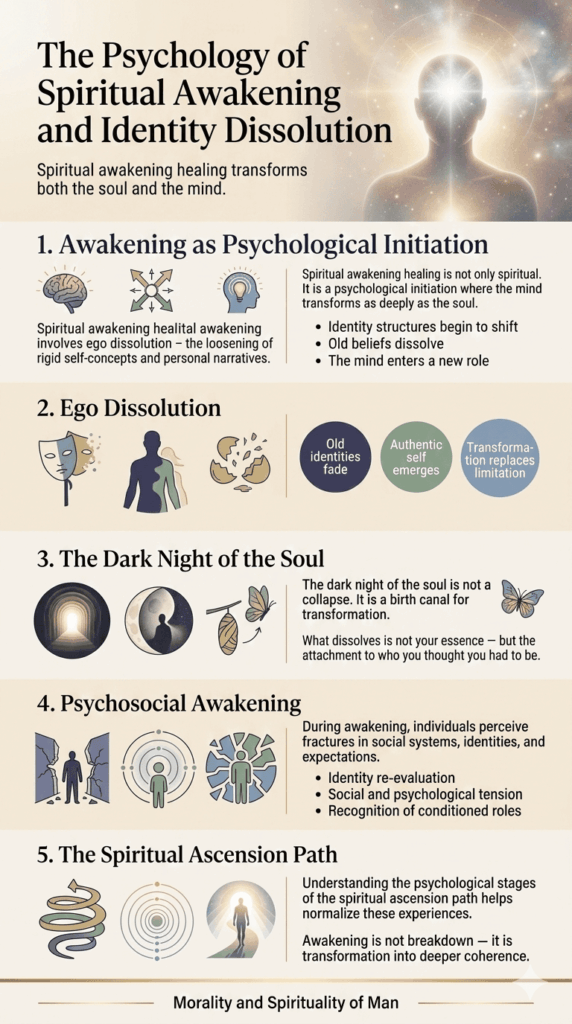
The psychology of spiritual awakening involves what researchers call “ego dissolution”—the loosening of rigid self-concepts and the narratives you’ve used to define yourself.
This isn’t pathology. It’s transformation. The self you thought you were dissolves so a more authentic self can emerge. This phase often includes what spiritual traditions call the “dark night of the soul.” Rather than something to escape, this period serves as a birth canal
No new life emerges without pressure, contraction, and surrender. What collapses during this phase isn’t your essence—it’s your attachment to who you thought you had to be.
The awakening individual experiences profound psychosocial tension during this time. You perceive fractures in systems and structures that once seemed solid. You recognize how much of your identity was constructed to belong, to achieve, to be acceptable.
Understanding the psychological stages of the spiritual ascension path provides context for these disorienting experiences and helps normalize what many navigate in silence.
Healing Integration — Why Spiritual Growth Requires Emotional Safety
Spiritual awakening healing without integration leads to instability. You can have profound insights, mystical experiences, and expanded awareness, but if your nervous system doesn’t feel safe, transformation cannot stabilize.
Integration is where insight becomes embodiment. Awareness moves from concept into your nervous system, language, relationships, and daily life. This requires pacing. You cannot force healing, and you cannot rush awakening.
True spiritual growth happens when the body feels safe enough to let go. Your nervous system must regulate before deeper releases can occur. This means honoring your need for rest, setting boundaries, and allowing the process to unfold at its own pace.
Trauma surfacing during spiritual awakening demands that you create conditions for safety. This might include therapy, somatic practices, nature time, or simply slowing down. You’re not bypassing the awakening—you’re giving it the container it needs to integrate fully.
Understanding how the law of vibration shapes emotional states helps you recognize how your energetic and emotional state affects your capacity for integration.
Consciousness Expansion and Psychic Sensitivity
As spiritual awakening healing progresses, many people notice expanded perception. Intuition strengthens. You sense energy more acutely. Emotional resonance with others intensifies, sometimes to the point of feeling overwhelming.
These signs of spiritual awakening indicate that your consciousness is accessing information beyond the five physical senses. You may experience increased empathic awareness, knowing things without knowing how you know them, or sensing energy in spaces and people.
This heightened sensitivity isn’t imagination—it’s a natural expansion of perception that occurs as rigid ego boundaries soften. Your awareness becomes less confined to your individual identity and more attuned to the interconnected field of consciousness.
Navigating this expansion requires discernment and grounding. Not every intuitive hit is accurate. Not every energetic sensation requires interpretation. The psychology of spiritual awakening includes learning to work skillfully with expanded perception without becoming destabilized by it.
Resources like this guide to psychic development and spiritual evolution and information about psychic energy transmission in spiritual practice can help you understand and work with these emerging capacities.
Frequently Asked Questions About Spiritual Awakening Healing
What is spiritual awakening healing and how does trauma trigger it?
Spiritual awakening healing is the process where emotional wounds, trauma, and identity patterns surface and transform as consciousness expands. Trauma triggers awakening because pain cracks open the psychological defenses we’ve built, forcing deeper self-awareness. When survival patterns can no longer contain expanding consciousness, healing and awakening unfold together.
What are the most common signs of spiritual awakening during healing?
Common signs include heightened self-awareness, emotional sensitivity, questioning old beliefs, desire for solitude, identity shifts, and increased intuition. Physical sensations like energy moving through the body, difficulty with superficial conversations, and a sense of disconnection from your former life also indicate awakening. These experiences reflect consciousness recalibrating to a higher coherence.
How does the psychology of spiritual awakening affect emotional healing?
The psychology of spiritual awakening involves ego dissolution, identity restructuring, and nervous system recalibration. This psychological transformation allows repressed emotions and trauma to surface for healing. As rigid self-concepts dissolve, authentic emotional processing becomes possible. Integration requires emotional safety, which allows the nervous system to release stored survival patterns while maintaining stability.
Conclusion
Spiritual awakening healing begins when life disrupts the certainty you once relied on. Trauma and significant loss crack open the structures that contained your consciousness, allowing deeper awareness to emerge. Healing and awakening aren’t separate processes—they unfold together, each supporting the other as you integrate what was fragmented and reclaim what was lost.
This journey asks you to trust what you cannot yet see clearly. Awakening rarely announces itself with dramatic clarity. More often, it arrives as a whisper—a question that refuses to disappear, a pattern you suddenly recognize, a knowing that rises from somewhere deeper than thought.
Explore related guides on consciousness and meditation to support your journey. Understanding the spiritual ascension path and its stages can provide clarity as you navigate transformation. Reflect on your own experiences with awakening, and remember that healing unfolds at its own pace. The questions you’re asking matter. The discomfort you feel signals transformation, not failure. You’re not breaking down—you’re breaking through.