
Spiritualism Ethics and Moral Responsibility: Understanding Progression, Natural Law, and Accountability After Death
What makes a religion truly ethical? Can moral accountability exist without external judgment or divine punishment? These questions challenge conventional religious thought, yet spiritualism ethics offers a compelling answer rooted in natural law and personal responsibility.
Unlike faiths dependent on divine favor or eternal damnation, Spiritualism presents an evolutionary moral framework. It centers on three transformative concepts: spirit survival beyond death, continuous ethical progression, and self-determined spiritual development. The principles of Spiritualism align remarkably with scientific understanding while addressing humanity’s deepest ethical concerns.
This moral system requires no intermediary for divine forgiveness. Instead, it places each individual’s spiritual growth in their own hands. Understanding what happens after death spiritually reveals how spiritualism ethics transforms accountability from external judgment to internal evolution. The implications reshape our understanding of moral responsibility entirely.
Spiritualism as an Ethical System
The principles of Spiritualism establish a remarkably consistent ethical foundation. Unlike religions promising reward or punishment from external deities, Spiritualism teaches that moral development follows natural law. Personal growth determines spiritual progression—no exceptions exist.
Dr. Alfred Russel Wallace, co-founder of evolutionary theory, observed in his work on Spiritualist philosophy that this system presents “a theory of a future state of existence which is the only one yet given to the world that can at all commend itself to the modern philosophical mind.”
Core Ethical Doctrines
The fundamental principles of Spiritualism include:
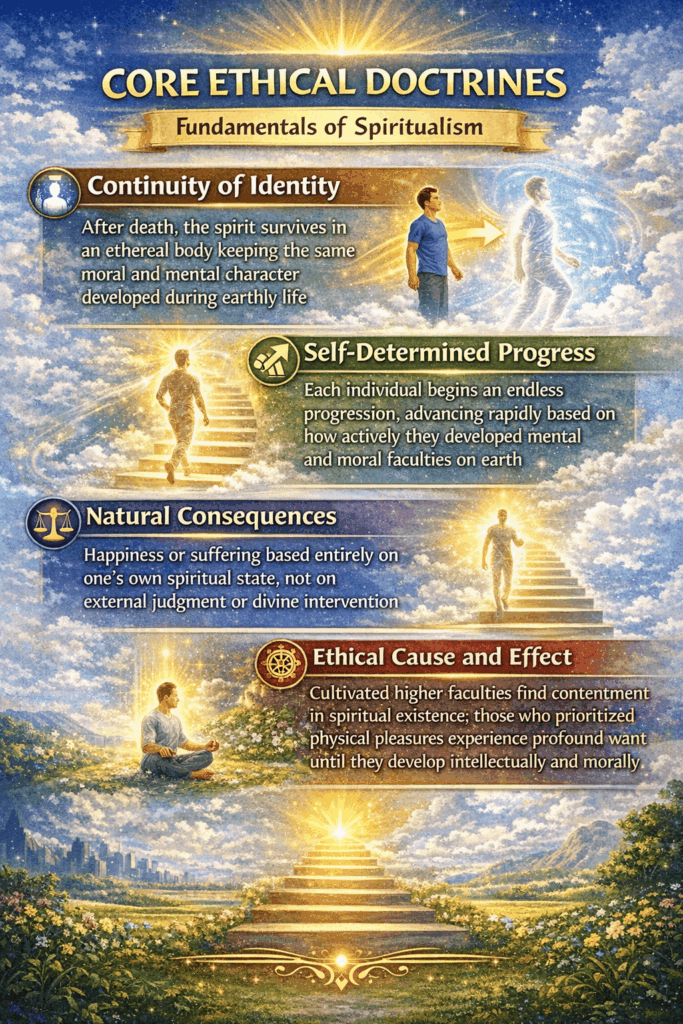
Continuity of Identity: After death, the spirit survives in an ethereal body, maintaining the same moral and mental character developed during earthly life
Self-Determined Progress: Each individual begins an endless progression, advancing rapidly based on how actively they developed mental and moral faculties on earth
- Natural Consequences: Happiness or suffering depends entirely on one’s own spiritual state, not on external judgment or divine intervention
- Ethical Cause and Effect: Those who cultivated higher faculties find contentment in spiritual existence; those who prioritized physical pleasures experience profound want until they develop intellectually and morally
This framework eliminates arbitrary punishment. Instead, each person’s afterlife condition becomes the natural, inevitable result of their earthly development. No external power distributes rewards or penalties. Each spirit resumes from precisely the moral and intellectual level achieved during physical life.
The ethical implications prove profound. Spiritualism ethics demands present-moment accountability. Every choice shape future spiritual existence. This eliminates deathbed conversions or last-minute repentance as escape routes. Moral development becomes continuous work, not emergency salvation.
Moral Progression Beyond Death
Spirit communication and progression form the philosophical heart of Spiritualist moral teaching. Unlike theologies emphasizing static heavens or hells, Spiritualism describes dynamic ethical evolution continuing eternally.
The deceased maintain conscious awareness and moral agency. They recognize their spiritual state immediately. Those who neglected ethical development face neither divine punishment nor demonic torment. Instead, they confront the natural consequence of underdeveloped spiritual faculties.
The Mechanics of Spiritual Growth
Progress operates through cause and effect rather than judgment:
- Spirits possessing well-developed moral and intellectual capacities advance rapidly
- Those dependent on physical pleasures struggle initially, lacking spiritual resources for contentment
- Development continues through conscious effort and learning
- No permanent damnation exists—only temporary states reflecting current spiritual maturity
This differs radically from punishment-based theologies. Traditional religions often threaten eternal suffering for finite sins. Spiritualism ethics recognizes only natural developmental stages. A morally underdeveloped spirit resembles a child learning to walk, not a criminal deserving punishment.
The focus shifts from divine approval to personal growth. Spirits work toward their own advancement rather than appeasing external judgment. This creates intrinsic motivation for ethical behavior. People develop morally because it serves their eternal progression, not from fear of punishment.
Understanding psychic development and spiritual evolution clarifies how spirit communication and progression operates practically. Spirits continue learning, growing, and refining their moral understanding indefinitely.
This endless progression ensures no soul remains forever stagnant. Even those beginning from low spiritual development eventually advance through persistent effort. The system proves both just and hopeful—acknowledging current limitations while affirming unlimited future potential.
Is Spiritualism Healthy and Normal?
Critics argue that spiritualism ethics encourages unhealthy psychological states or even induces mental instability. This objection deserves serious examination rather than dismissal.
The concern contains partial validity. Some individuals practicing Spiritualism without proper understanding have experienced psychological distress. However, this results from misuse rather than inherent danger in the practice itself.
Distinguishing Use from Abuse
The key distinction lies between conscious abuse and informed practice:
- Early experimental approaches sometimes caused harm to unprepared individuals
- Proper understanding of psychic laws renders practices safe and beneficial
- Neglecting established principles creates risk, just as ignoring any natural law produces consequences
- Education and responsible practice eliminate dangers
Those exploring ethical versus harmful spiritual practices discover clear guidelines distinguishing safe engagement from risky experimentation. Once practitioners understand governing principles, spiritualism ethics provides structure for healthy spiritual development.
The Naturality Argument
Another objection claims spirit communication proves “unnatural” and therefore wrong. This reasoning fails logical scrutiny. The abundance of documented spirit-return cases demonstrates these phenomena occur far more commonly than skeptics acknowledge.
Rather than exceptional miracles, such experiences reflect natural law. If spirit communication operates through natural principles, it cannot be unnatural by definition. Nature’s laws express what is natural.
The ethical framework supports rather than opposes natural human development. Spiritualism ethics aligns with humanity’s innate drive toward understanding death, consciousness, and moral progress. Exploring these questions through Spiritualist principles simply applies rational inquiry to spiritual matters.
Far from encouraging morbidity, properly understood Spiritualism promotes psychological health through clarity about existence, death, and ethical accountability.
Does Spirit Communication Retard Progress?
Critics suggest that spirit communication and progression proves mutually exclusive—that contacting deceased spirits somehow impedes their spiritual development. This concern requires careful analysis.
Evidence contradicts this assumption entirely. Multiple documented cases demonstrate spirits actively seeking communication with the living. Rather than interfering with development, such contact often facilitates it.
Why Spirits Initiate Contact
Departed individuals frequently return with specific purposes:
- Requesting assistance completing unfinished earthly matters weighing on their consciousness
- Seeking prayers or help from living individuals to aid their spiritual advancement
- Providing guidance or comfort to loved ones struggling with grief
- Learning from continued interaction with physical-world experiences
Many spirits explicitly state they cannot find rest until certain missions reach completion. Living friends or family members who fulfill these requests directly assist spiritual progression rather than hindering it.
The Service Aspect
Numerous Spiritualists dedicate themselves to helping earthbound spirits. This work involves assisting confused or struggling souls who require guidance navigating their new existence. Far from retarding progress, such assistance accelerates development for spirits needing direction.
The complete guide to modern Spiritualism explains how spirit communication and progression work together beneficially. Communication serves mutual benefit—living individuals gain wisdom and comfort while spirits receive assistance and continued growth opportunities.
This mutual exchange reflects natural law. Cooperation benefits all parties involved. Spiritualism ethics therefore encourages appropriate spirit communication as morally beneficial rather than spiritually dangerous.
The notion that contact harms departed souls lacks supporting evidence and contradicts reported experiences from spirits themselves.
Ethics of Mediumship and Compensation
Should mediums accept payment for spiritual services? Critics argue that charging fees for divine gifts proves inherently unethical. This objection requires examination through the lens of spiritualism ethics.
Consider parallel situations. Ministers, priests, rabbis, and religious leaders across all traditions receive compensation. Churches pay clergy salaries. Religious professionals need material support while performing spiritual work.
The Practical Reality
Mediums inhabit physical bodies requiring:
- Food, shelter, and basic necessities
- Time dedicated to developing and maintaining abilities
- Energy expended serving others through readings and guidance
- Material resources for conducting sessions
The principles of Spiritualism recognize material reality. Mediums living in the physical world face identical survival needs as any other profession. Denying them fair compensation while expecting extensive service proves unrealistic and arguably exploitative.
Ethical Service Standards
Genuine mediumship assists people profoundly. Mediums provide comfort to the grieving, guidance to the confused, and evidence of continuity beyond death. This service carries comparable or greater value than many paid professions.
Spiritualism ethics supports fair compensation for legitimate spiritual work. The moral standard concerns honesty and service quality, not whether payment occurs. Fraudulent mediums violate ethical principles. Genuine practitioners providing real assistance deserve reasonable compensation.
This position aligns with balanced ethics—acknowledging spiritual values while respecting material needs.
Why Mediums Cannot Help Themselves
Skeptics often ask: “If mediumship works, why don’t spirits provide constant financial or personal advantages to mediums?” This question reveals misunderstanding about spiritual mechanics.
Mediums serve as instruments, not creators. A knife cuts bread, not itself. A soldier fights battles without fully understanding the war’s purpose. The medium functions similarly—channeling power for others’ benefit rather than personal advantage.
The Nature of Spiritual Gifts
Several principles explain these limitations:
- Psychic abilities benefit third parties, not practitioners directly
- Power flows through mediums toward intended recipients
- Attempting to pervert abilities for selfish gain consistently results in losing the gift entirely
- Natural law ensures spiritual powers serve broader purposes
Understanding moral clarity between selfless service and exploitation reveals why this limitation proves ethically sound. It prevents corruption and ensures spiritual gifts remain directed toward helping others.
Imperfect Judgment
Spiritualists may err selecting spirit advisors, just as people misjudge earthly advisors—doctors, lawyers, financial consultants, or friends. Even exceptional spiritual figures made selection errors. Jesus chose Judas among his twelve disciples.
Spiritualism ethics claims no perfection—only the right to make independent spiritual choices. Learning from mistakes forms part of moral development. The framework accepts human fallibility while encouraging responsible spiritual engagement.
Frequently Asked Questions
Is Spiritualism an ethical religion?
Yes. Spiritualism ethics centers on personal moral responsibility and natural law rather than external judgment or divine favoritism. The principles of Spiritualism establish accountability through cause and effect—each individual’s spiritual condition results directly from their choices and development. This creates intrinsic motivation for ethical behavior.
Do the principles of Spiritualism support moral responsibility?
Absolutely. Unlike religions offering deathbed salvation or external forgiveness, Spiritualism teaches that moral development determines spiritual progression. No shortcuts exist. Each person bears complete responsibility for their ethical growth, both during physical life and beyond death.
Does spirit communication and progression harm the departed?
No evidence supports this concern. Documented cases show spirits actively seeking communication for assistance, guidance, or completing unfinished matters. Proper spirit communication and progression frequently benefits both living and departed individuals through mutual support and learning.
Are mediums ethically justified in charging fees?
Yes, when providing genuine service. Mediums face identical material needs as other professionals. The principles of Spiritualism support fair compensation for legitimate spiritual work, just as all religions compensate their ministers and leaders. The ethical standard concerns honesty and service quality, not payment itself.
CONCLUSION
Spiritualism ethics presents a moral framework remarkably different from conventional religious thought. It replaces external judgment with natural law, divine punishment with logical consequence, and arbitrary salvation with earned spiritual development.
The principles of Spiritualism demand present-moment accountability. Every choice shapes eternal progression. This system proves both just and hopeful—acknowledging human imperfection while affirming unlimited potential for growth.
Spirit communication and progression operate through natural law rather than supernatural intervention. Understanding these principles transforms death from fearful mystery to comprehensible transition. Moral responsibility shifts from avoiding divine wrath to cultivating personal development.
This ethical system empowers individuals completely. No external authority grants or denies spiritual advancement. Each person controls their moral trajectory through conscious choices and continuous growth. Spiritualism ethics ultimately offers what every rational mind seeks—a moral framework grounded in observable natural law, personal responsibility, and endless possibility for ethical evolution.