How to Cultivate Morality in a Modern World: A Science-Based Approach to Living Ethically
“But words are things; and a small drop of ink, Falling, like dew, upon a thought, produces That which makes thousands, perhaps millions, think!” — Byron
The question of how to cultivate morality isn’t just philosophical—it’s urgent and practical. We live in a world where millions question traditional religious frameworks while desperately seeking genuine ethical guidance. If you’ve ever felt the disconnect between dogmatic teachings and observable reality, you’re not alone. Today’s moral seekers need a foundation built on natural law, not ancient myths that contradict what we know to be true.
This guide explores how modern individuals can develop authentic morality by aligning with universal principles grounded in nature, science, and personal responsibility.
Why Traditional Approaches to Moral Development Are Failing
Many earnest people drift into indifference or skepticism—not because they lack character, but because orthodoxy itself has become the stumbling block. When intelligent seekers encounter rigid dogmas that contradict observable facts, they face an impossible choice: believe what seems untrue or abandon the quest for spiritual meaning altogether.
The result? We’ve become a society where religion is a “Sunday coat” worn occasionally for appearances, while other cultures demonstrate deeper conviction through daily practice. Our professions of belief ring hollow because we lack the foundation to make morality inevitable rather than optional.
The Core Problem with Modern Morality
The issue isn’t that people don’t want to be moral. It’s that our religious and educational frameworks operate on outdated premises:
- Teaching the Fall instead of acknowledging human evolution and development
- Promoting arbitrary miracles over consistent natural law
- Building theology on ancient myths rather than observable facts
- Emphasizing passive faith instead of active understanding and deeds
This disconnect creates a generation unable to reconcile their conscience with conventional teaching, leading them to abandon the pursuit of morality altogether.
The Philosophical Shift: From Myth to Natural Law
To cultivate morality authentically, we must alter the very foundation of how we understand the divine and our place in the universe. This isn’t about abandoning spirituality—it’s about deepening it through direct understanding of creation’s principles.
The Essential Substitutions for Moral Clarity
Instead of the Fall → Consider Evolution
Rather than viewing humans as inherently sinful from birth, recognize that we’re developing beings capable of continuous moral growth. Our nature isn’t corrupt; it’s evolving toward higher consciousness through experience and learning.
Instead of Arbitrary Miracles → Embrace Unvarying Natural Law
The universe operates through consistent, understandable principles—the same at the beginning, now, and forever. These laws govern physical health, mental wellbeing, and moral consequences with perfect reliability.
Instead of Speculative Theology → Study Observable Facts
Base your understanding on what you can observe, test, and verify about human nature and the natural world. The operations of Nature are understandable by human intelligence—we’re meant to comprehend them.
Making Morality Inevitable Through Understanding
When you understand the universe as a system of intelligent, lawful cause and effect, moral action becomes the rational choice. This shift moves us from passive faith to active deeds grounded in comprehension. As the poet wrote: “Let the enlightening of my mind, Remove the shades that keep me blind.”
As the article on stages of moral development outlines, true moral development occurs when you’re brought into intelligent communion with the Creator by comprehending divine wishes through knowledge of natural works. This produces lives of genuine integrity rather than superficial religious performance.
Practical Implementation: Daily Practices for Ethical Living
Understanding principles means nothing without application. Here’s how to translate this philosophy into daily life.
Master Your Inner Compass: The Kingship Within
The greatest moral battle occurs within your own consciousness. As portrayed in Tennyson’s “Idylls of the King,” true kingship means subordinating passions and powers to the voice of duty. To cultivate morality effectively:
Do the duty which lies nearest you. Don’t overwhelm yourself with abstract ideals. Identify the specific obligation before you right now—the one you clearly recognize as your responsibility—and fulfill it. Your second duty will then become clearer.
This principle of moral clarity helps you master your inner compass against good and evil through concrete action rather than endless contemplation.
Judge by Character, Not Status
Society must shift its values to cultivate morality collectively. Look straight through the superficial trappings—wealth, birth, social position—to the real person within. The true measure of worth isn’t what people have, but:
- How they acquired it
- What they do with it
- How they treat others in the process
This means shunning with contempt those who gain status through immorality, regardless of their social position. Genuine moral earnestness requires maintaining that instinctive honor that makes exploitation and dishonesty shameful.
Treat Health as Sacred Duty
One of the most revolutionary aspects of cultivating morality through natural law is recognizing physical and mental wellness as ethical obligations.
The Old Theory: “We cannot help dying when death comes.”
The New Understanding: Death never comes unless summoned by violated natural laws. With proper knowledge and care, we decline gradually in old age without suffering or fear.
Consider how different the world would be if religious authorities had demonstrated that preserving health was humanity’s “glorious privilege and imperious duty.” If being unwell were recognized as the result of violated law—leading to repentance and reform rather than passive acceptance.
This makes learning how to control your mind essential, as mental discipline directly affects physical health and moral capacity.
Making Health Your Moral Priority:
- Study the laws of health with the same seriousness as ethical principles
- Make obeying health laws a matter of conscience
- Understand that misery results wholly from violating Nature’s requirements
- Recognize you were intended for happiness—if you’re miserable, you’re living in opposition to divine design
The Power of Knowledge in Moral Development
Some argue that habits aren’t changed by books or teaching. I disagree. The “right book at the right time” can divert minds from evil tendencies to good, providing the ballast and compass needed to navigate life’s dangers safely.
Why Self-Knowledge Is Essential
“The proper study of mankind is man.” Yet of themselves, humans know least. We present an anomalous appearance—capable of inventing destructive weapons while simultaneously creating works of charity, scientific discovery, and vast combinations for human benefit.
To cultivate morality effectively, your intelligence must be awakened to evidence of divine order by contemplating natural arrangements and laws. This means:
- Observing phenomena systematically
- Tracing causes and effects rigorously
- Modifying opinions and conduct according to discoveries
- Using your God-given faculties of reason and observation
Learning from Nature’s Lessons
While ignorant, humans remain helpless creatures. But every step in knowledge brings augmented command over our condition. Consider how railway development transformed society—proving that understanding and harnessing natural forces brings comfort and happiness, prosperity and plenty to everyone.
If we can revolutionize transportation and industry through applied knowledge, can’t we also transform moral life by understanding the laws governing human nature and wellbeing?
The Vision: Humanity’s Moral Potential
Humans embody profound paradox. We create torpedoes to destroy thousands yet simultaneously perform acts of sublime charity and genius. This dual nature reveals our current state—not our inevitable destiny.
When intelligence awakens to law-based spirituality, we fulfill our highest potential as moral beings. This isn’t utopian fantasy—it’s the logical result of aligning human consciousness with natural principles.
What Morality Looks Like When Grounded in Natural Law
A society that cultivates morality through understanding rather than dogma would feature:
- Health regarded as the highest duty and business of life
- Education focused on human constitution and its relation to external nature
- Reverence for the Supreme Being based on observable wise and just laws
- Religion proven by daily acts rather than Sunday professions
- Youth prepared for life’s realities without crushing their romantic spirits
- Social systems judging worth by character and contribution, not wealth or birth
The Path Forward for Moral Seekers
If you’ve felt frustrated by religious hypocrisy and hollow professions, understand that the fault lies not in you but in frameworks built on untenable foundations. The solution isn’t abandoning moral pursuit but rebuilding it on solid ground.
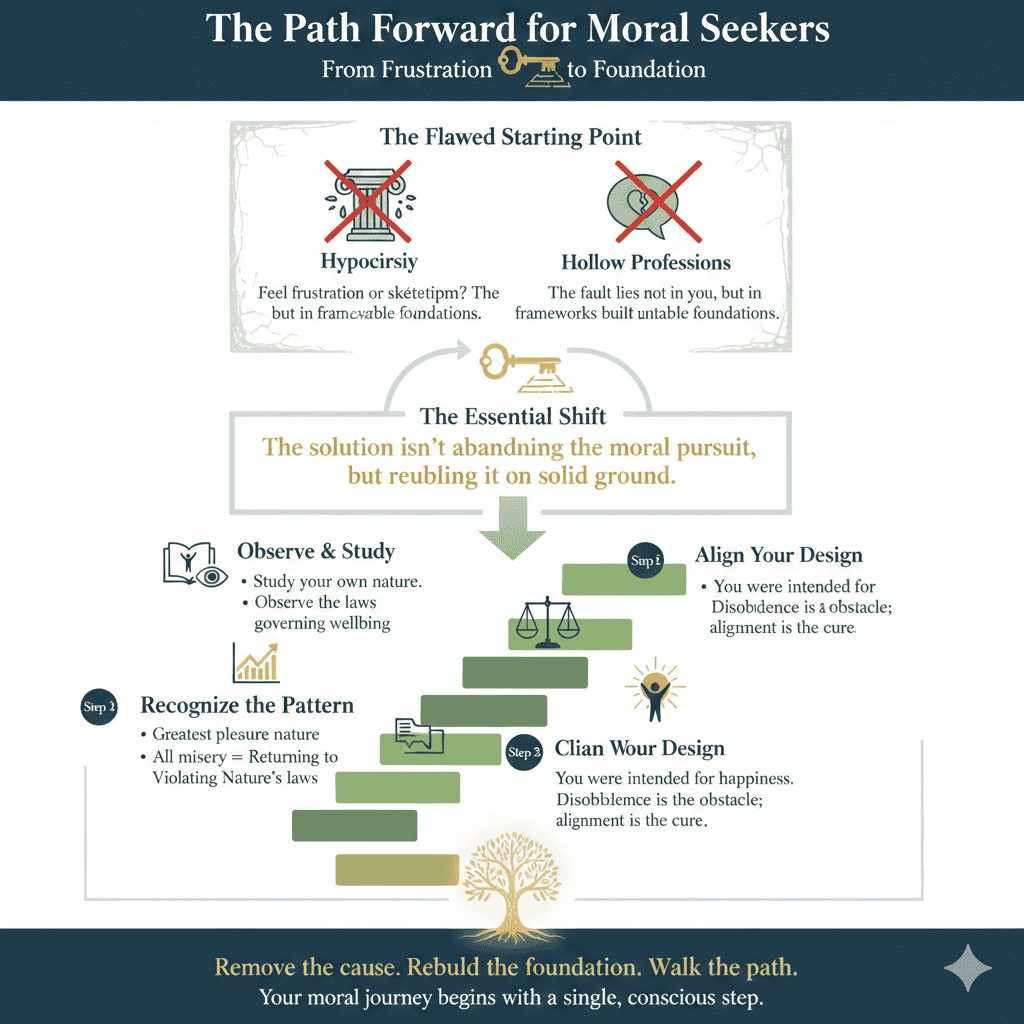
Start where you are. Study your own nature. Observe the laws governing wellbeing.
Recognize that the greatest pleasure comes from returning from transgression to obedience, and that all misery results from violating Nature’s requirements.
Most importantly, understand that you were intended for happiness. If you’re not experiencing it, you’re living in opposition to divine design—and you can change that by removing the cause: disobedience to natural law.
Frequently Asked Questions About Cultivating Morality
How can I become more moral without traditional religion?
Morality doesn’t require traditional religious dogma—it requires understanding natural law. Study how the universe operates through consistent principles, observe cause and effect in human behavior, and align your actions with these observable laws. Focus on developing moral clarity through direct experience rather than accepting inherited beliefs.
Why do good people become skeptical about morality?
Earnest, intelligent people often drift into skepticism because conventional religious teachings contradict observable reality. This creates cognitive dissonance—they can’t conscientiously believe things that seem untrue. The solution isn’t stronger faith in dogma but a foundation based on verifiable natural principles.
Is physical health really connected to moral development?
Yes, profoundly. Violating natural health laws affects your mental clarity, emotional stability, and capacity for ethical reasoning. When you treat health as a sacred duty—understanding illness as often resulting from violated laws—you develop the discipline and self-knowledge essential for moral development. Learning to control your mind directly impacts your physical wellbeing.
Can reading books actually change my moral character?
The “right book at the right time” can absolutely transform moral development. Knowledge provides the ballast and compass to navigate life’s challenges safely. While experience teaches powerfully, learning from others’ wisdom allows you to avoid unnecessary pain while developing principles that guide your choices.
What’s the first practical step to cultivate morality?
Start with “the duty which lies nearest thee”—the specific obligation you clearly recognize right now. Don’t overwhelm yourself with abstract ideals. Complete that immediate duty, and your next responsibility will become clearer. This builds moral muscle through concrete action rather than endless contemplation.
Final Thought: The path to cultivating morality in a modern world requires courage to question outdated frameworks and intelligence to recognize the natural laws governing human flourishing. When we build ethics on observable truth rather than inherited dogma, moral living becomes not a burden but the logical expression of understanding reality.
What would your life look like if you treated knowledge, health, and natural law as sacred duties? Share your thoughts in the comments below.