
How to Control Your Mind: Practical Ways to Master Your Emotions
Control Your Mind before it controls you. Have you ever promised yourself you’d stay calm, only to find your thoughts racing, emotions taking over, and your reactions happening before you even realise it? Most people don’t struggle because they lack willpower—they struggle because they have never learned how to understand and direct their own minds.
Every day, your mind generates thousands of thoughts that influence your emotions, decisions, relationships, and overall well-being. Without awareness, it’s easy to become trapped in cycles of stress, anxiety, anger, or overthinking. Learning to control your mind isn’t about suppressing thoughts or eliminating emotions—it’s about recognising them, creating space before you react, and responding with greater clarity. Understanding how emotions affect your body also reveals why mastering your thoughts is essential for both mental and physical well-being.
In this guide, you’ll discover practical, evidence-informed techniques to control your mind, strengthen emotional resilience, improve focus, and develop habits that help you respond thoughtfully instead of reacting automatically. These are skills that anyone can build through consistent practice.
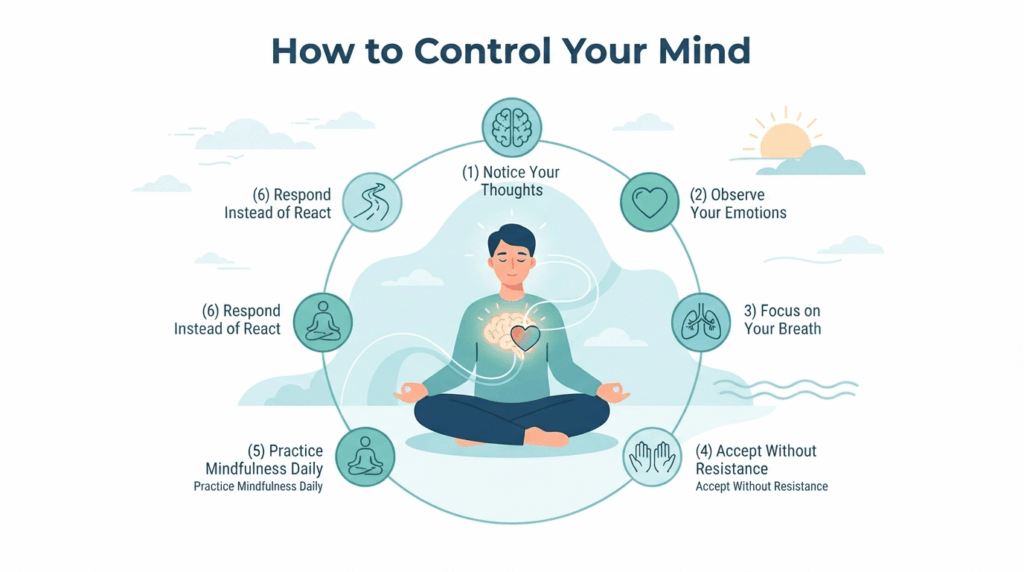
How Do You Control Your Mind?
You can control your mind by:
- Noticing your thoughts without immediately reacting to them
- Observing emotions as they arise, rather than being swept away by them
- Returning attention to your breath whenever your mind wanders
- Accepting what you feel instead of pushing it away
- Practising short mindfulness exercises every day
- Responding deliberately instead of reacting automatically
What Does It Mean to Control Your Mind?
Controlling your mind does not mean achieving perfect silence in your head or never feeling anxious or angry again. It means you are no longer at the mercy of every thought that arises. You become the observer rather than the prisoner of your thoughts.
Think of your mind as a busy road. You cannot stop the traffic, but you can step back onto the pavement and watch it pass without walking into it. That distance — that brief moment of awareness before you react — is what mental control actually looks like in practice. This perspective becomes clearer when you start distinguishing the ego from your true self, because it helps you understand that you are not your thoughts, but the awareness observing them.
Why Thoughts and Emotions Are Connected
Before you can manage your mental state, it is essential to understand how thoughts and emotions interact. They are not separate systems; rather, they constantly influence each other.
A single thought, such as “I’m going to fail,” triggers a wave of anxiety. That anxiety then generates more worried thoughts, which intensifies the feeling. The cycle feeds itself quickly and quietly, often without your awareness.
This connection also plays out physically. Understanding how emotions affect your body shows that sustained emotional states — especially chronic anger or anxiety — can lead to real physical consequences, including headaches, digestive problems, and disrupted sleep. Anger, for example, can compromise the neurons in the hypothalamus, the brain’s stress-response centre, making it harder for the brain to slow down and recover.
Understanding this connection is the first step in learning how to control emotions, because thoughts often trigger emotional reactions long before you consciously notice them. When you catch the thought early, you can interrupt the cycle before it gains momentum.
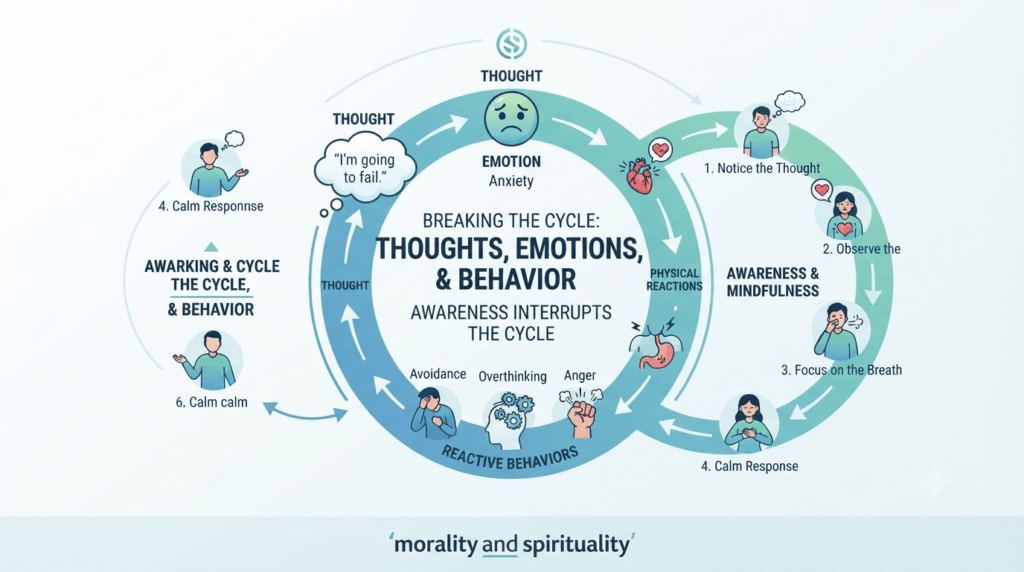
1. Build Self-Awareness
Awareness is the foundation of mental control. Without it, you react on autopilot — moved by thoughts and feelings you have not even noticed yet.
Building awareness is simpler than it sounds. Several times throughout your day, pause and ask yourself two questions:
- “What am I thinking right now?”
- “What am I feeling in my body?”
You are not trying to change anything at this stage. You are simply observing. You might notice a looping worry, a tightness in your chest, or a background sense of irritation. Just naming what is there creates a small but significant gap between you and the experience.
Over time, this practice shifts your relationship with your own mind. You begin to recognise that you are not your thoughts, but you are the awareness watching them. That realisation alone reduces a great deal of unnecessary suffering.
Structured meditation techniques can deepen this awareness significantly. Research also shows that mindfulness improves attention and memory, making the practice valuable well beyond emotional regulation.
2. Stop Fighting Your Wandering Thoughts
When your mind drifts — to worries, to distractions, to things you said three years ago — the instinct is to force it back. “Focus,” you tell yourself. “Stop.” But trying to control your thoughts through force usually creates more mental resistance, not less.
Fighting a thought is like pushing a beach ball underwater. The harder you push, the more forcefully it resurfaces.
The more effective approach is to stop treating wandering thoughts as problems. When you notice your mind has drifted, gently ask: “Who is noticing this?” That question shifts your focus from the content of the thought to the awareness behind it. You are no longer inside the thought — you are watching it. From that position, it has far less power over you.
You do not need to resolve every thought that arises. Most of them simply need acknowledgement, not engagement.
3. Use Your Breath as an Anchor
Once you start observing your thoughts, you need something stable to return to. Your breath is one of the most reliable anchors available to you — it is always present, always accessible, and it directly influences your nervous system.
The practice is straightforward:
- Notice that your mind has wandered.
- Gently shift your attention to your breathing.
- Observe the cool air entering through your nose, the rise of your chest and abdomen, and the warm air leaving your body.
- Do not try to control your breath — simply observe it.
- When your mind drifts again (and it will), calmly return your focus without frustration.
That repeated return is the actual training. Each time you bring attention back, you strengthen your ability to focus. Over weeks of consistent practice, your breathing naturally slows, your nervous system settles, and your thoughts lose their urgency.
Understanding living in the present moment deepens this practice further, showing how present-moment awareness builds lasting emotional stability.
Scientific Evidence That You Can Train Your Mind
Learning to control your mind is not only a philosophical idea — it is supported by research. Studies comparing different attention-training practices have found that techniques such as focused breathing exercises, mantra meditation, and moderate physical activity can improve concentration by helping the brain process information more efficiently.
One comparison of mind control techniques and reaction time assessment found that focused mental practices reduced reaction times, indicating measurable improvements in attention and mental alertness. These findings suggest that the brain responds to consistent practice the same way a muscle responds to exercise — it becomes stronger, more focused, and more resilient over time.
This evidence is worth holding onto on difficult practice days. The work is not abstract — it produces real, measurable changes in how your brain functions.
4. Observe Your Emotions Without Reacting
Learning how to control emotions does not mean suppressing them — it means observing them before you act on them. There is a crucial difference between the two.
Suppression pushes feelings underground, where they tend to intensify and surface later in less controlled ways. Observation, on the other hand, gives emotions space to exist without letting them dictate your behaviour.
The key is to catch emotions early. Every strong reaction carries a warning sign — a flash of heat before anger, a knot in the stomach before anxiety, a sudden heaviness before sadness. When you notice one of these signals, silently name what you feel: “This is anger.” “This is anxiety.” “This is hurt.”
That naming creates immediate distance. You move from being inside the emotion to watching it from a slight remove. From that position, you can breathe, assess the situation, and choose how to respond rather than simply reacting.
For a deeper understanding of this process, explore this guide on how to control emotions and the practical steps involved.
5. Let Go of Anger Quickly
Anger deserves particular attention because it escalates faster than most other emotions and tends to cause the most immediate damage to relationships and decision-making.
Anger almost always begins with a thought that insists something should not be happening — a driver who should not cut you off, a colleague who should not behave that way, a situation that simply should not exist. That resistance is what fuels the fire. Arguing with reality does not change the situation; it only keeps you trapped in it.
One of the most practical ways to control your mind when anger arises is to apply this three-step process:
- Stop the story. Resist the urge to replay what happened or rehearse what you will say. The narrative sustains the anger.
- Focus on the facts. Strip away interpretation and judgment. What actually happened, as plainly as possible?
- Accept what already is. The event has occurred. Resisting it does not undo it — it only prolongs your suffering. Acceptance does not mean approval; it means you choose not to let what has already happened continue to control you.
For more practical tools on managing this emotion, this guide on practical ways to control anger and desire offers valuable, grounded approaches.
6. Practise Mental Control Every Day
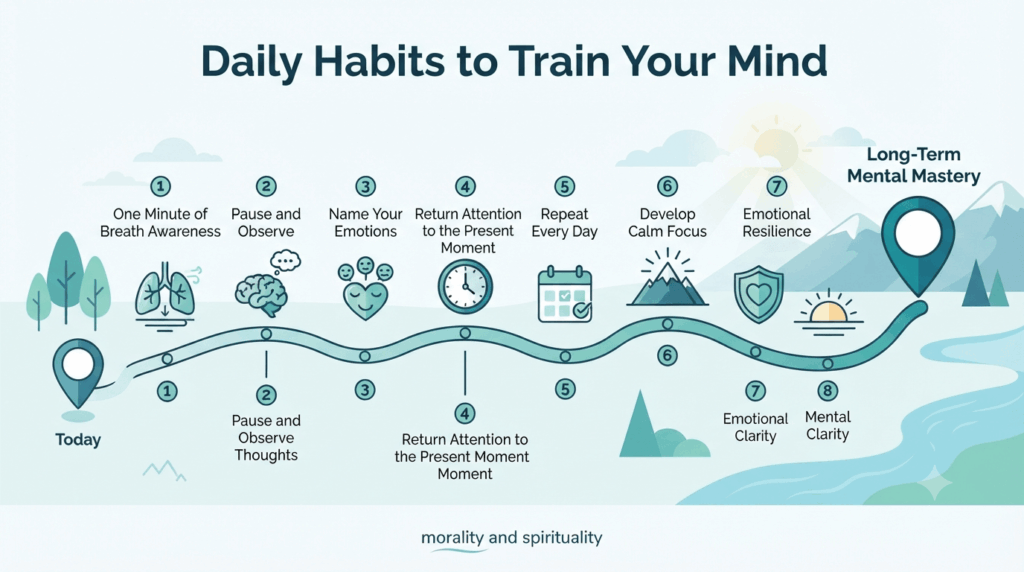
The techniques above only become reliable when you practise them consistently — not just in moments of crisis, but in ordinary, unremarkable moments throughout the day.
The more consistently you practise, the easier it becomes to control your mind during stressful situations. Think of it as training for a mental reflex. When calm becomes your default state, it remains more accessible under pressure.
Start small:
- Today: Spend one minute focusing on your breath. Simply notice what your mind is doing without judging it.
- This week: Practise the awareness check — two questions, three times a day — at moments you already pause naturally (morning coffee, lunch break, before bed).
- Going forward: When a strong emotion arises, name it. One word. That pause is enough to change what happens next.
Understanding the power of thought can also shift how you relate to your own mental habits, showing how thought patterns shape behaviour and perception over time. And for readers interested in the longer-term effects, the mind-body connection shows how sustained mental habits — positive or negative — eventually influence physical health.
Common Mistakes When Trying to Control Your Mind
Many people start well but plateau because of a few avoidable errors:
- Trying to force thoughts to stop. This intensifies them. Observation works; suppression does not.
- Expecting quick, permanent results. Mental discipline builds gradually. A week of practice creates a different mind than a single session.
- Practising only when stressed. The techniques work best when they are already familiar. Build the habit in calm moments so it is available when you need it most.
- Confusing control with detachment. The goal is not to feel nothing — it is to feel without being controlled by what you feel.
- Judging yourself for wandering thoughts. The wandering is not failure. The returning is the practice.
Benefits of Learning to Control Your Mind
When you build this capacity consistently, the changes extend beyond stress reduction:
- Clearer thinking: You make decisions from a calmer, less reactive state.
- Better relationships: You respond thoughtfully rather than saying things you will later regret.
- Greater resilience: Setbacks affect you without defining you. Success does not inflate your confidence; failure does not collapse it.
- Improved focus: You direct your attention intentionally rather than being pulled by every distraction.
- Stronger emotional intelligence: You understand what you are feeling and why, which helps you understand others more accurately.
Conclusion
Control your mind by remembering that lasting mental strength isn’t about achieving constant peace—it’s about developing the awareness and discipline to respond thoughtfully, even when life becomes challenging. With consistent practice, you can strengthen your focus, regulate your emotions, and gradually learn how to control your thoughts instead of being controlled by them.
Start with one simple habit today: spend sixty seconds observing your breath without judgment. Small, consistent moments of awareness create the foundation for lasting change. As you continue your journey, learning how to control your emotions will further strengthen your ability to remain calm and resilient, while building a regular mindfulness practice can help transform these techniques into lifelong habits that support greater mental clarity and emotional balance.
Frequently Asked Questions
How do you control your mind when overthinking?
When you notice overthinking, name it: “I am overthinking.” Then return your attention to your breath for thirty seconds. You are not solving the problem — you are interrupting the loop. Repeat this each time the thoughts resume. Over time, the loops become shorter and less intense.
Can breathing exercises help control emotions?
Yes. Breathing exercises directly activate the parasympathetic nervous system, helping counteract the body’s stress response. Even a few slow, deliberate breaths can reduce the physiological intensity of an emotion, creating enough space to observe rather than react. If you’re looking for a simple technique to get started, this guide on throat breathing techniques explains a practical breathing method that can help promote relaxation, improve focus, and support better emotional regulation.
How do I control my thoughts during stress?
The key is to practise the techniques before stress arrives, so they are familiar when you need them. In the moment, focus on the breath, name what you feel, and avoid trying to think your way out of the emotion. Observation is more effective than analysis when stress is high.
What is the fastest way to control your mind?
The fastest immediate technique is breath focus — three to five slow, deliberate breaths with attention on the physical sensation. It will not resolve the underlying issue, but it creates enough calm to prevent an automatic, reactive response.
How long does it take to see results?
Most people notice subtle shifts within one to two weeks of consistent daily practice. Significant changes in emotional reactivity typically emerge after a few months. Progress is rarely linear — some days feel harder than others — but the overall trajectory improves with time.
Pingback: How to Remember Your Dreams Better: Complete Guide 2025
Pingback: How Emotions Affect Your Body: Complete Guide 2025