
Automatic Writing: Essential Steps to Begin Safely
What if your hand could write messages you never consciously planned? What if wisdom beyond your everyday awareness could flow directly onto paper through unconscious movement?
Automatic writing represents one of the most accessible yet profound psychic abilities. This can be defined as writing performed without conscious mental control, instead guided by subconscious muscular energies. Your hand moves independently, creating scrawls that evolve into letters, words, and eventually complete sentences containing information you couldn’t consciously know. This isn’t fiction or parlor trick—it’s a documented phenomenon that bridges conscious and unconscious minds.
In this comprehensive guide, you’ll discover the exact techniques for performing automatic writing, understand the critical automatic writing rules that ensure safety, and learn how to interpret the messages your subconscious mind reveals. Whether you seek spiritual guidance, creative inspiration, or deeper self-knowledge, these proven methods will help you develop this remarkable skill.
What Is Automatic Writing?
Automatic writing occurs when your hand writes without conscious direction, driven by unconscious muscular action rather than deliberate thought. You hold a pencil over paper and allow your hand to move freely, initially creating random scrawls that gradually organize into circles, hooks, letters, and finally coherent words and sentences.
This process accesses information channels beyond your conscious awareness. The writing emerges from what neuroscience identifies as motor channels (efferent pathways)—nerve signals flowing from your central nervous system outward to muscles—rather than sensory channels (afferent pathways) that carry information inward from your environment. If the same subconscious content emerged through sensory channels instead, you’d see visions or hear voices rather than write messages.
Understanding how consciousness relates to time helps explain why automatic writing can access information seemingly unavailable to your present conscious mind.
How to Begin Performing Automatic Writing
Starting automatic writing requires specific positioning and mental preparation that facilitate unconscious control while minimizing conscious interference.
Optimal Physical Setup
Hold your arm completely clear of the table—neither wrist, elbow, nor any arm section should touch the surface. This suspended position induces mild fatigue quickly, which paradoxically helps automatic writing begin.
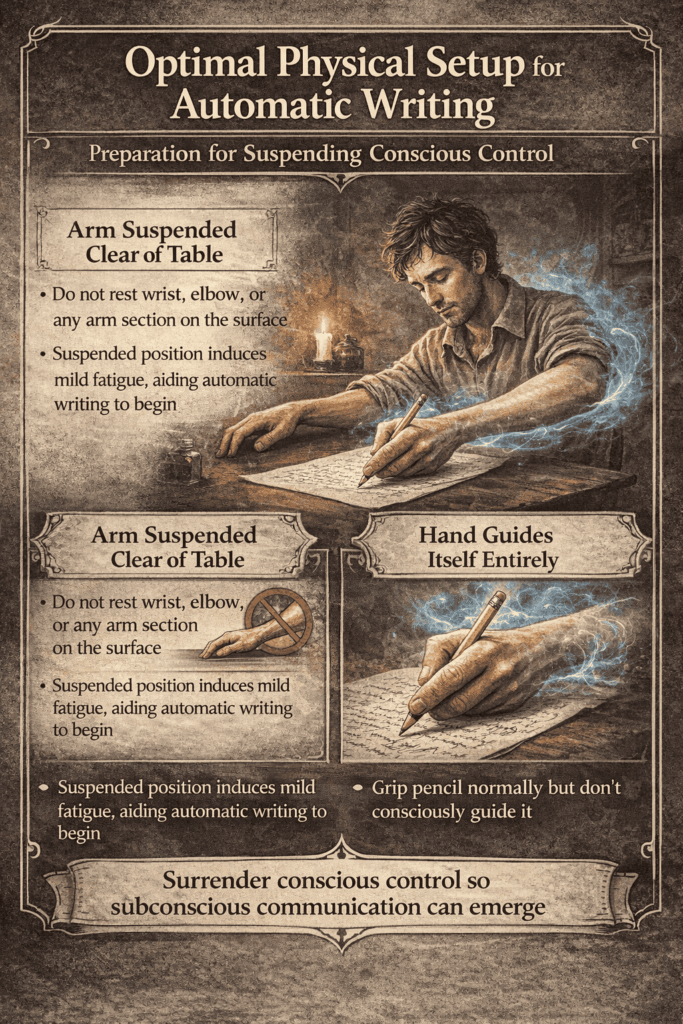
The slight physical strain occupies your conscious attention while allowing unconscious processes to take control of the writing hand.
Take your pencil normally but avoid any conscious guidance. Don’t attempt to write anything deliberately. Let your hand guide itself entirely, even when it produces apparent nonsense initially.
This surrender of conscious control creates the opening through which subconscious communication emerges.
Creating Conducive Conditions
Choose consistent times and locations that suit your schedule. Sit comfortably in a semi-darkened room, though full light works if preferred. The key isn’t darkness but mental receptivity—make your mind as blank as possible, free from preoccupations and distracting thoughts.
Initially, you’ll need complete mental focus on maintaining this blank state. With practice, you may eventually think about other things, carry conversations, or even read while your hand writes independently. However, expecting this dual-consciousness too early disrupts the learning process. Start simple—just create mental stillness and observe what emerges.
Learning how to control your mind strengthens your ability to maintain the receptive mental state essential for performing automatic writing successfully.
Critical Automatic Writing Rules for Safety
Developing this ability safely requires strict adherence to protective guidelines. These automatic writing rules prevent the psychological and energetic vulnerabilities that unstructured practice creates.
Rule One: Maintain Regular Schedule
Practice automatic writing at the same time daily whenever possible. This consistency serves dual purposes: it trains your subconscious to expect communication windows at predictable intervals, and it helps any guiding intelligences—whether aspects of your higher self or external spiritual helpers—coordinate their assistance more effectively.
W.T. Stead, the renowned journalist and spiritualist, attributed his automatic writing success entirely to rigorous schedule adherence. He experienced no difficulties or negative encounters throughout decades of practice precisely because he maintained this discipline. Speak aloud when finishing each session: “Good-bye; tomorrow at the same time we’ll sit again for messages.” This verbal boundary reinforces the temporal container around your practice.
Rule Two: Limit Session Duration
Never exceed fifteen to twenty minutes per session, regardless of how fascinating the emerging content becomes. This limitation protects what experts call your “wall of defense”—the natural psychological boundary that shields you from overwhelming or potentially harmful outside influences.
When performing automatic writing produces intriguing revelations, you’ll feel tempted to continue for hours, eagerly watching what your hand writes next and engaging in extended dialogues with whatever consciousness communicates through you. Resist this temptation absolutely. Extended sessions gradually erode your protective boundaries, leaving you psychologically vulnerable and energetically depleted.
These automatic writing rules aren’t arbitrary restrictions—they represent essential safeguards discovered through extensive experimentation and, unfortunately, through witnessing the consequences of ignoring them.
Understanding the mind-body connection in sickness reveals why these protective boundaries matter for maintaining psychological and physical wellbeing during spiritual practices.
The Mechanism Behind Automatic Writing
While automatic writing clearly involves subconscious muscular action moving your hand, this observation doesn’t explain the phenomenon—it merely describes one aspect. The crucial question remains: where does the information come from?
Beyond Simple Explanation
Imagine sitting with pencil ready when your hand suddenly writes: “I am James Valentine. I was killed in a railroad accident this afternoon at four o’clock.” Granting that your own muscles moved the pencil, how did this specific information reach your hand? How could you write about James Valentine’s death without conscious knowledge of the event?
Scientists often acknowledge the muscular mechanism while glossing over this information source question entirely. Yet this represents the phenomenon’s true mystery and significance. The writing itself proves less remarkable than the content it conveys—details you couldn’t possibly access through normal sensory channels.
Research on neural pathways demonstrates that motor and sensory channels process information differently, yet both can transmit content from unconscious sources to conscious awareness.
Information Sources in Automatic Writing
Several potential sources might supply information during automatic writing sessions:
Your deeper subconscious mind contains vast knowledge your conscious awareness cannot directly access—memories you’ve forgotten, observations you never consciously registered, and intuitive understanding you haven’t yet articulated. Automatic writing provides this hidden knowledge a pathway to surface.
Telepathic reception represents another possibility. Someone else’s thoughts might unconsciously influence your writing, especially during intentional telepathic experiments where friends attempt to transmit specific words, cards, or figures that your hand then reproduces automatically.
Some practitioners believe they receive guidance from external spiritual intelligences—departed human spirits, spirit guides, or higher dimensional consciousness. While controversial, countless automatic writing experiences have produced verifiable information the writer couldn’t have known through any conventional means.
The relationship between thought and consciousness explored in the power of thought consciousness suggests consciousness operates beyond individual brain boundaries, making these various information sources plausible.
Alternative Tools for Performing Automatic Writing
You needn’t limit yourself to pencil and paper when performing automatic writing. Alternative tools often produce results more easily, particularly for beginners.
Planchette and Ouija Boards
Planchette boards and Ouija boards provide simplified entry points. These tools reduce the physical skill required—you simply rest your fingers lightly on the pointer while allowing unconscious movement to guide it across the board toward letters and words.
Most practitioners find these instruments helpful initially but eventually prefer direct pencil work. The immediacy of pencil on paper creates more nuanced communication and eliminates the mechanical intermediary between thought and expression. However, there’s no requirement to progress beyond board tools if they serve your purposes effectively.
Modern Digital Options
Contemporary practitioners sometimes use keyboards for automatic writing, allowing unconscious typing rather than handwriting. This method works identically—you rest fingers lightly on keys and permit unconscious impulses to generate text. Some find typing faster and easier to read than handwritten scrawls, though others feel the direct hand-to-paper connection carries significance that typing diminishes.
Interpreting Your Automatic Writing Messages
Automatic writing often produces content that initially appears meaningless—jumbled letters, fragmented words, or apparently nonsensical phrases. Don’t dismiss these too quickly.
Decoding Symbolic Content
Your subconscious frequently communicates symbolically rather than literally. A jumble of seemingly random letters might form acronyms, phonetic spellings, or coded references that become clear upon reflection. Message meaning often emerges when you review content later with fresh perspective rather than during the writing session itself.
Keep all automatic writing for review. Patterns emerge across multiple sessions that aren’t apparent in isolated messages. Information provided cryptically in early sessions gains clarity as subsequent writings add context and detail.
Maintaining Healthy Skepticism
Approach automatic writing messages with balanced discernment. Not every message contains profound truth or external spiritual guidance. Much content originates from your own subconscious mind—including its fears, desires, and unexamined beliefs.
Verify factual claims when possible rather than accepting all information as absolute truth. If your writing provides testable details—names, dates, events—investigate their accuracy. This verification process helps you distinguish genuine subconscious knowledge or legitimate external communication from imagination and wish-fulfillment.
Progressive Development Strategy
Building automatic writing skill requires patience and persistence. Progress follows predictable stages you shouldn’t try to skip.
Initial Development Phase
Your first sessions will likely produce only random scrawls or gentle pencil movements. This normal beginning frustrates many people into quitting prematurely. Continue practicing daily within your time limits, maintaining the receptive mental state without forcing results.
After several days to a few weeks, small circles or hooks typically emerge. These represent your first unconscious control achievement—celebrate this progress rather than demanding immediate sentences. The subconscious requires practice channeling through motor pathways, especially when conscious interference has dominated your entire life.
Intermediate Advancement
Letters appear next, followed by partial words. This stage tempts you to guess what word your hand attempts to write, then consciously complete it. Resist this interference. Let each letter form entirely through unconscious direction, even when painfully slow. Conscious assistance actually delays progress by preventing your subconscious from developing full control.
Complete words eventually flow, then short phrases. Meaning remains fragmentary, but recognizable communication emerges. At this stage, maintaining the automatic writing rules about duration and scheduling becomes especially crucial—success breeds enthusiasm that tempts longer, less disciplined sessions.
Advanced Practice
With consistent practice, your hand writes complete, grammatically correct sentences at reasonable speed. You may achieve the dual-consciousness state where you think about unrelated matters or engage in conversation while your hand independently writes complex messages.
This advanced level allows extended automatic writing experiments—asking specific questions, requesting guidance on particular issues, or exploring symbolic communication systems. However, even at this stage, maintain protective boundaries through time limits and scheduled sessions.
Frequently Asked Questions
How long does it take to develop automatic writing?
You can expect initial pencil movements within days to a few weeks of daily practice, though developing clear automatic writing typically requires one to three months of consistent fifteen-minute sessions. Individual results vary based on natural psychic sensitivity, mental discipline, and adherence to the automatic writing rules for timing and duration.
Is automatic writing safe?
Automatic writing remains safe when you follow essential automatic writing rules: practice at regular scheduled times, limit sessions to fifteen to twenty minutes, maintain strong protective boundaries, and approach messages with healthy discernment. Extended sessions or irregular practice without boundaries can erode psychological defenses, creating vulnerability to overwhelming influences or energetic depletion.
What if my automatic writing produces only nonsense?
Initial nonsense represents normal development—your subconscious learns to communicate through motor channels just as you once learned to write consciously. Continue practicing patiently without judging content. Additionally, apparent nonsense often contains coded meanings that become clear upon later review or when subsequent messages provide interpretive context.
Can automatic writing access real information I don’t consciously know?
Yes, extensive documentation shows automatic writing frequently produces verifiable information the writer couldn’t consciously access—details about distant events, unknown historical facts, or accurate personal information about deceased individuals. While mechanisms remain debated, the phenomenon’s reality is well-established through countless verified cases throughout automatic writing’s documented history.
Begin Your Automatic Writing Journey
You now possess the complete framework for developing automatic writing safely and effectively. You understand the precise techniques for performing automatic writing, you’ve learned the protective automatic writing rules that prevent common pitfalls, and you know how to interpret the mysterious messages your subconscious mind generates.
Start today with just fifteen minutes in a quiet space, pencil suspended over paper, mind receptively blank. Let your hand guide itself without conscious interference. Within weeks, you’ll witness your first unconscious communications emerging—perhaps simple scrawls initially, but undeniably beyond your conscious control.
Ready to explore deeper dimensions of consciousness? Discover how the power of thought and consciousness extends beyond individual awareness, creating the interconnected field through which automatic writing accesses knowledge your conscious mind cannot directly perceive.