
Polar Opposites Philosophy: Understanding the Unity Between Mind, Thought, and Symbol
Have you ever wondered why certain things seem fundamentally connected, yet opposite? Polar opposite’s philosophy explores one of the deepest metaphysical truths: that opposing forces aren’t actually separate—they’re interdependent. Mind requires thoughts. Thoughts require symbols. Light requires darkness to be visible. This isn’t just philosophical musing; it’s the fundamental structure of reality itself.
The mind and thought relationship reveal something profound about existence. Without understanding polar opposite’s philosophy, we remain trapped in dualistic thinking, treating mind and matter as independent forces locked in eternal conflict. But what if they’re not enemies at all? What if they’re partners in a cosmic dance, each giving meaning to the other?
In this exploration, we’ll uncover why this ancient wisdom matters today—and how it challenges the materialist worldview that has dominated modern thinking.
What “Polar Opposites Philosophy” Really Means in Metaphysics
At its core, polar opposites philosophy describes a relationship where two seemingly opposite concepts are actually reciprocal and mutually dependent. They don’t exclude each other; they define each other. Neither can exist meaningfully without its opposite.
This principle extends throughout the universe. Consider the thought and symbol connection: a mind cannot think a thought without some mental symbol or representation. You cannot conceive of a triangle without your mind constructing a symbol—whether visual, verbal, or abstract. The thought and the symbol are polar opposites that require each other to have any meaning whatsoever.
This isn’t abstract theorizing. It has real implications for how we understand consciousness, reality, and our place in the cosmos.
Understanding the Mind and Thought Relationship in Idealism
The mind and thought relationship is perhaps the most elegant example of polar opposites. Infinite Mind cannot exist without Infinite Thoughts, just as thoughts cannot exist without a mind to conceive them. They’re inseparable.
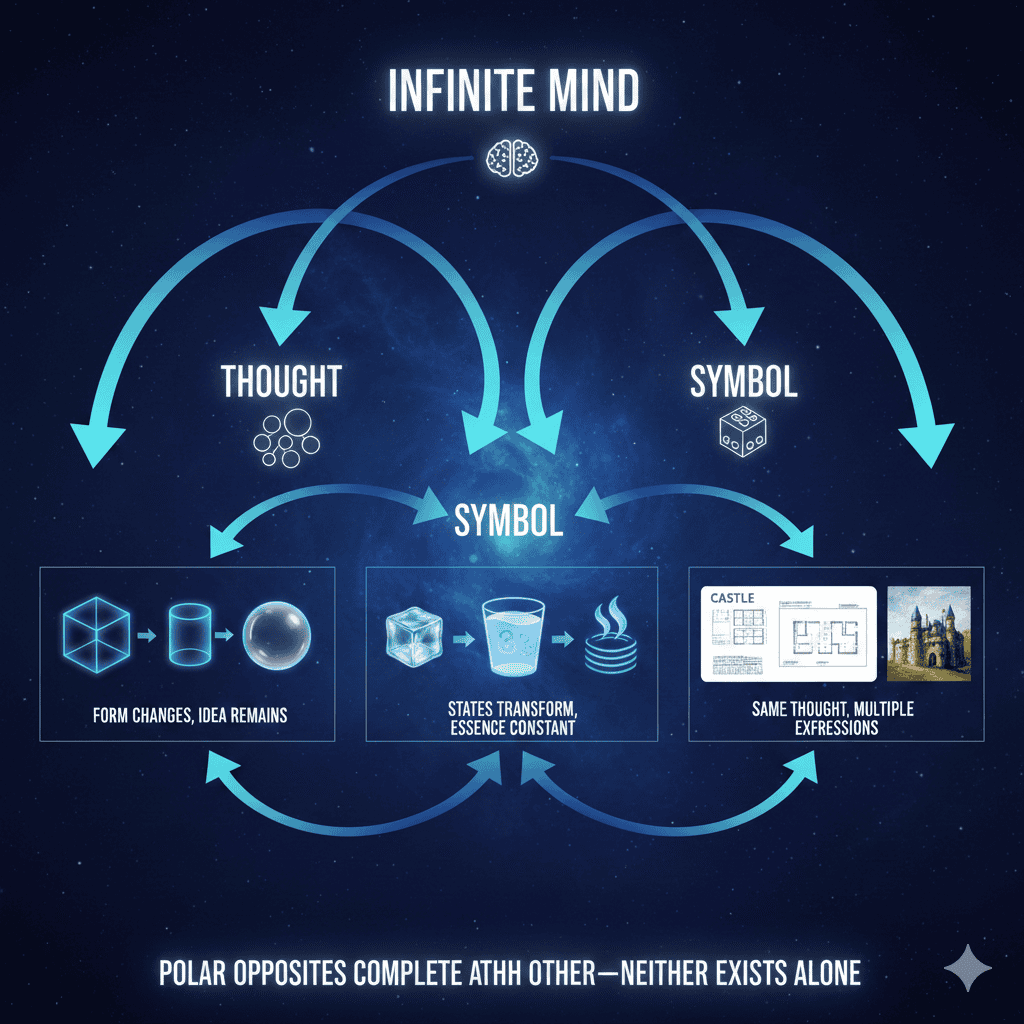
Here’s what this means practically: every thought you’ve ever had requires your mind.
Every idea requires consciousness to exist. This stands in stark opposition to materialism, which claims that thoughts are mere byproducts of matter—that a brain simply produces consciousness the way a liver produces bile.
But consider: if mind and thought are truly polar opposites, then reality as mental expression becomes the natural conclusion. The physical universe isn’t creating consciousness; consciousness is expressing itself through physical forms. Matter is the symbol; mind is the thought behind it.
This reframes everything. You’re not just a collection of atoms contemplating existence. You’re an expression of Infinite Mind, thinking eternal thoughts through the vehicle of a physical body.
The Thought and Symbol Connection: Why They Cannot Exist Apart
The thought and symbol connection reveals a critical truth about knowledge and perception. A symbol is the external representation of an internal idea. The word “castle” is a symbol. A blueprint drawn by an architect is a symbol. A painting on canvas is a symbol. Yet all represent the same, eternal thought: the idea of a castle.
Notice something remarkable: no matter how many different symbols express the same thought, the thought itself never changes. The idea never becomes corrupted or diluted by its representations. This reveals the superiority and permanence of thought over form.
Consider these polar opposites examples philosophy students often overlook: ice, water, and steam appear completely different to our senses. They’re cold, liquid, and gaseous respectively. Yet they’re all expressions of the same molecular reality. The appearance changes; the underlying thought remains constant.
Similarly, a cube and a sphere appear utterly different. But if you rotate a cube precisely at its center, its outline mirrors a cylinder. Rotate further, and it resembles a sphere. The geometric principles—the thoughts—remain identical; only the external forms vary.
This principle extends to abstract concepts too. Virtue doesn’t change into vice; what changes are the circumstances and expressions through which these eternal principles manifest in the physical world.
Polar Opposites Examples Philosophy: From Geometry to Existence
Understanding polar opposites examples philosophy makes this concept tangible. Let’s examine concrete demonstrations:
The Cube-Cylinder-Sphere Transformation: Suspend a cube at the center of one of its sides and rotate it. Watch as its appearance becomes indistinguishable from a cylinder to the observer. Rotate the cylinder at its circular center, and it appears as a perfect sphere. Yet the underlying geometric thought never changes—only the manifestation does. This proves that phenomena (appearances) cannot be identified with reality (eternal thoughts).
Water’s Three States: Ice appears solid. Heat it, and it becomes liquid water. Heat further, and it transforms into steam—a gas. To our senses, these are three different substances. Yet the underlying thought, the molecular structure, remains constant throughout all transformations. We cannot claim the ice we froze is identical to the steam we produced, yet the essential idea never ceases to exist.
Abstract Qualities: Truth doesn’t become falsehood. Justice doesn’t transform into injustice. What changes is how these eternal principles express themselves through human action and circumstance. The thought remains pure, only its symbols shift.
Personification as Abstraction: The Fundamental Philosophical Error
Here’s where things get controversial: personification as abstraction represents perhaps humanity’s greatest philosophical mistake. When we abstract our attention to phenomena—the external world—we naturally personify it, treating appearances as independent realities.
This is the error of treating the mask as the actor. In Latin theater, actors wore masks (persona) to represent characters they weren’t. We do the same with nature: we observe physical phenomena and assume they possess independent reality, forgetting that all appearances are symbols of an underlying thought.
The ego, when it develops knowledge, suddenly finds itself trapped. It has personified Nature as one independent reality. It has discovered Infinite Mind as another. Now it’s stuck with two irreconcilable forces: mind and matter. This fundamental lie leads to endless confusion.
In materialism, this error reaches its absurd extreme: matter becomes omnipotent, and mind becomes merely matter’s reflection. Sensations are “all there is.” John Stuart Mill reduced philosophy to the laughable proposition that feelings equal consciousness—that “I have a headache, therefore I exist.”
But this violates personification philosophical critique: it treats the symbol (matter, sensation) as the reality, while ignoring the truth (mind, consciousness) entirely.
Reality as Mental Expression and Infinite Mind
Once we grasp that the thought and symbol connection is fundamental, reality as mental expression becomes obvious. The phenomenal universe—everything we see, touch, and sense—is the symbolic expression of Infinite Thought.
This doesn’t mean the physical world is illusion. It means the physical world is language—symbols through which eternal ideas express themselves. You are not merely matter thinking about itself. You are Infinite Mind, thinking eternal thoughts through the temporary form of a physical body.
This insight resolves the ancient mind-body problem. It explains why the mind-body connection affects your physical sickness. It clarifies how you can control your mind through understanding its true nature.
And it provides the foundation for moral clarity and understanding good and evil.
Why Personification Violates the Law of Polar Opposites
Personification is idolatry. When we treat the symbol as the reality—matter as fundamental, mind as derivative—we violate the law of polar opposites. We break the reciprocal relationship that gives meaning to existence.
The law of polar opposites is fundamental. It’s not a theory; it’s the structure of reality itself. Pure Being apart from Attributes is as meaningless as Mind without Thoughts. You cannot have a smile without someone smiling. You cannot have appearance without something appearing.
Yet materialism tries precisely this: to eliminate the thought while keeping the symbol, to maintain the appearances while rejecting the mind that produces them. It’s like trying to see the magic lantern’s image on the wall after smashing the lantern itself.
This error generates all philosophical confusion. Until we recognize the reciprocal, interdependent nature of mind and matter, thought and symbol, we’ll remain trapped in false dualism.
Conclusion: The Unity Behind Apparent Opposites
Polar opposites philosophy offers liberation from centuries of confused thinking. It reveals that mind and thought, matter and symbol, are not enemies locked in struggle. They’re partners in an eternal dance, each giving meaning to the other.
You exist because Infinite Mind thinks you. Your thoughts cannot cease as long as Infinite Mind exists. Your body—your symbol—will always have some form because thought requires expression. The mind and thought relationship is unbreakable, eternal, reciprocal.
This is the profound truth hidden within polar opposites philosophy: unity lies not in sameness, but in interdependence. Opposites don’t contradict; they complete each other.
Understanding this transforms everything—from how you understand good and evil to how you recognize your true nature as an expression of Infinite Mind.
For deeper insight into opposing principles in philosophy, explore the theory of opposites.
The question isn’t whether opposites can coexist. The real question is: can you perceive the unity that already exists within them?
Frequently Asked Questions: Polar Opposites Philosophy Explained
Is polar opposites philosophy the same as dualism?
No—and this distinction matters. Dualism treats mind and matter as two separate, often conflicting forces. Polar opposites philosophy, by contrast, shows that mind and matter are reciprocal partners that define and depend on each other. Dualism creates endless philosophical problems (how can non-physical mind affect physical matter?). Polar opposites philosophy solves them by revealing that neither can exist meaningfully without the other. They’re not opposed enemies; they’re complementary truths.
How does the thought-symbol connection apply to my everyday life?
Every time you think a thought, you’re experiencing the thought-symbol connection firsthand. Your internal thought requires a mental symbol—an image, word, or abstract representation. When you communicate that thought to someone else, it becomes a different symbol (spoken words, written text, gestures) yet the thought itself remains unchanged. This explains why you can understand the same idea expressed in multiple languages or through different media. It also reveals why your mind and thought relationship is more fundamental than your brain’s physical structure—the thought persists regardless of how it’s expressed.
Can polar opposites philosophy explain why materialism is incomplete?
Absolutely. Materialism attempts to explain consciousness as a product of matter alone, treating mind as derivative and matter as fundamental. But this violates the law of polar opposites. If mind and matter are truly polar opposites, then eliminating one while keeping the other is logically impossible. It’s like trying to have light without darkness or a smile without someone smiling. Materialism fails because it rejects the reciprocal relationship that’s essential to both concepts. Reality as mental expression recognizes that both mind and matter are necessary—neither can be eliminated. This is why understanding polar opposites philosophy strengthens your ability to comprehend consciousness itself.
How does personification error affect modern thinking?
When we treat symbols (physical appearances) as independent realities, we commit personification error. We see nature and assume it’s autonomous. We observe our sensations and think they define reality. Modern science often falls into this trap, treating matter as primary and consciousness as secondary. But the moment you understand personification as abstraction, you recognize the mask (appearance) for what it is—a representation, not the reality itself. This shift in perspective is revolutionary. It explains why controlling your mind is possible (mind is fundamental, not passive), and why moral clarity emerges from understanding these principles rather than from external rules.