
The Influence of Music on Consciousness, Health, and Human Vibration
Have you ever wondered why one song can instantly calm your mind, while another leaves you restless or drained? The influence of music isn’t just emotional—it’s deeply physiological, shaping your thoughts, your energy, and even your physical state in ways most people never realize.
What feels like simple entertainment is actually a powerful force acting directly on your nervous system. As explored in how emotions affect your body, your internal state is constantly being shaped by external stimuli—and music is one of the most potent triggers of all.
Consider this: groups of people who were once tense, divided, or even hostile can become calm, connected, and unified simply by singing together. No discussion. No negotiation. Just sound. This is the influence of music operating beneath the surface—aligning emotional states and bringing the mind into harmony.
But the real question is: why does this happen?
The answer lies in vibration. Sound isn’t just something you hear—it’s something your entire body responds to. According to the law of vibration and how frequency shapes reality, everything in existence—including your thoughts and emotions—operates at a specific frequency. Music doesn’t just entertain you; it actively shifts that frequency.
In this guide, you’ll uncover the science behind the influence of music, understand why certain sounds heal while others disrupt your system, and learn how to intentionally choose music that strengthens your mind, balances your emotions, and elevates your consciousness.
Because once you understand how music truly works, you stop listening passively—and start using it as a tool to transform your entire state of being.
The Science Behind Music’s Profound Influence on Consciousness
How the Nervous System Responds Instantly to Sound
The influence of music begins with your nervous system, which is exquisitely attuned to sound. Your response to music is immediate and involuntary. This isn’t psychological—it’s physiological. The moment a sound wave enters your ear, your body begins responding before your conscious mind even registers what you’re hearing.
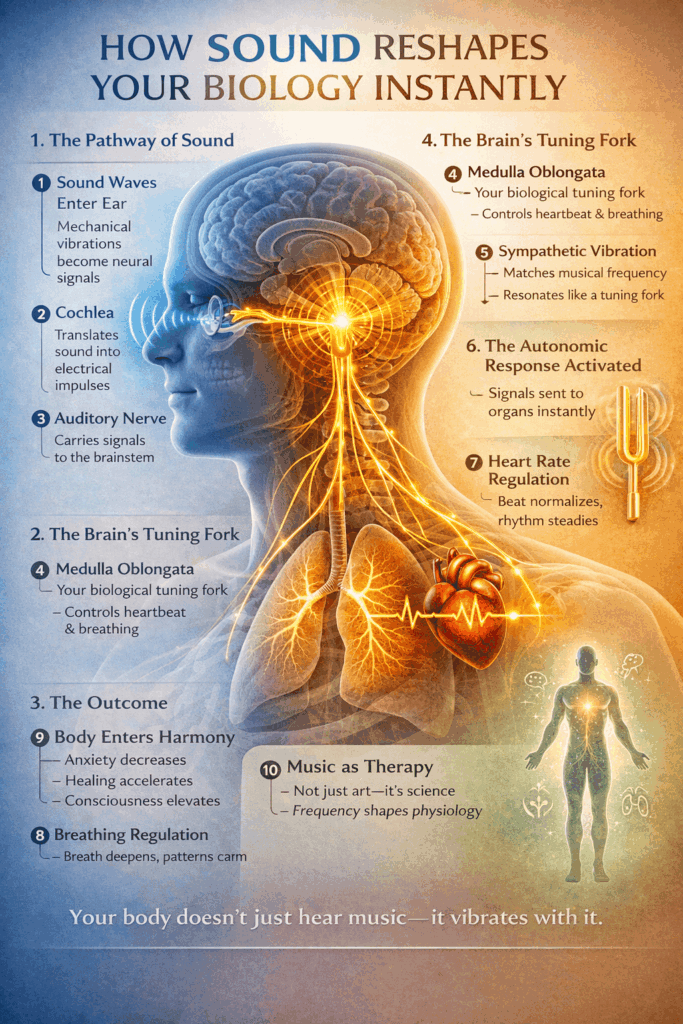
The key to understanding this lies in a small but crucial brain structure called the medulla oblongata. Located at the hindmost and lowest part of the brain as it narrows into the spinal cord, the medulla oblongata functions like a biological tuning fork.
As the article on transformative power of music outlines, when the right sympathetic tone is played—when music matches your personal keynote—the medulla oblongata vibrates in sympathy with that tone, just as a tuning fork vibrates when exposed to matching frequencies.
This isn’t metaphorical. This is how your brain is physically constructed. The medulla oblongata directly controls your heartbeat and breathing.
Therefore, when music resonates with your keynote frequency, it immediately normalizes your heart rate, regulates your breathing, and signals throughout your entire body to adjust and harmonize. Music therapy harnesses this principle by using soothing sounds matched to a person’s natural vibratory signature to induce healing responses throughout the entire body.
The implication is staggering: the influence of music on your consciousness is mediated through direct physical control of your autonomic nervous system. This is why music can soothe anxiety, accelerate healing, elevate mood, or conversely, create tension and disease.
Sound Frequencies and the Deeper Influence of Music
What if the music you listen to is actively reshaping your body and mind?
The true influence of music goes beyond emotion—it operates through vibration. Sound is energy that moves through your nervous system, tissues, and even your cells. Through resonance and entrainment, your body naturally syncs with external frequencies, meaning the sounds you hear directly affect your internal state.
Sound therapy uses tools like tuning forks and specific frequencies to restore balance. Lower tones can reduce stress and pain, while higher frequencies promote clarity and awareness. These vibrations don’t just relax you—they help regulate your entire system.
This process is deeply connected to your energy centers. As explained in this guide to the chakra system and vibrational alignment, different frequencies influence emotional and energetic balance across the body.
At a deeper level, this aligns with the principles in the law of vibration and how frequency shapes reality—everything responds to frequency, including your thoughts and physical state.
The key insight is simple: every sound you absorb is shaping you. Choose wisely.
Healthy Versus Unhealthy Sounds: The Body Cannot Adjust
Here’s a critical distinction: while your mind can learn to adjust to different types of sound, your body cannot. You might consciously enjoy a piece of music, but your body responds to its actual vibratory properties regardless of your mental preference.
Research in music therapy and behavioral kinesiology reveals striking evidence. In studies conducted by behavioral kinesiologist Dr. John Diamond, testing hundreds of participants, approximately ninety percent showed an almost instantaneous loss of two-thirds of their muscle strength when exposed to music with a “stopped anapestic rhythm”—a short-short-long-pause pattern common in rock and pop music. Remarkably, this muscular weakening occurred even when listeners consciously enjoyed the music.
What’s happening? The stopped anapestic rhythm confuses the body’s system. The heartbeat becomes irregular. The nervous system receives contradictory signals. The entire body becomes weakened and dysregulated. Meanwhile, music with healthy rhythmic patterns—particularly classical music and certain types of popular music—strengthens muscles, stabilizes heart function, and promotes coherence throughout the nervous system.
This demonstrates a fundamental principle: the influence of music operates at the level of vibration and frequency, completely independent of your conscious preference or judgment.
The Vibration Foundation: Why Music Shapes Matter and Consciousness
Sound Creates Form: The Physics of Vibration
Centuries before modern technology could measure and visualize it, the ancient philosopher Pythagoras understood a profound truth: form comes into being through vibration. Sound and the intervals produced by sound are the fundamental creative forces that brought the world out of chaos into ordered existence. This wasn’t philosophy to Pythagoras—it was scientific understanding. Music was essential to his school’s curriculum because it taught the principles governing all creation.
Modern science has validated this insight. Ernst Florens Friedrich Chladni, a German physicist, mathematically proved that sound can shape matter into geometric forms. Known as the “Father of Acoustics,” Chladni conducted experiments using sand placed over thin metal plates. By varying the pitch—changing the position of his finger on the plate as though it were a violin’s fingerboard—he caused the sand to arrange itself into different geometric shapes. Each vibration rate produced a unique geometric pattern. No two patterns were identical unless their vibrational rates were exactly the same.
This was revolutionary. It proved visually and measurably that vibration creates form. Later, a device called the tonoscope allowed researchers to photograph music vibrations creating forms in layers of fluid. Even lie detectors (polygraph machines) graphically display the impact music has on human physiology.
The principle is universal: the influence of music extends beyond your ears to fundamentally restructure matter and consciousness through vibrational frequency.
The Universal Law of Vibration Governs All Existence
Understanding the influence of music requires understanding a deeper principle: everything that exists vibrates. The vibrational field of sound, music, color, matter, your words, your thoughts, and even your name all demonstrate form through vibration. This fundamental idea is explored more deeply in the law of vibration and how frequency shapes reality, where you begin to see how all existence operates through measurable energy patterns. All vibrations are measurable.
To measure vibration, we use numbers—a concept closely connected to numerology and the meaning behind vibrational numbers, which reveals how numerical patterns reflect deeper universal order.
This reveals why numbers are so fundamental to understanding reality. Numbers are the keys to all mysteries. As the ancient wisdom teacher Helen P. Blavatsky stated: “Number underlies form, and number guides sound. Number lies at the root of the manifested universe.”
Music is fundamentally mathematical. The intervals between notes, the frequencies of tones, the timing of rhythms—all operate according to precise numerical relationships. When these relationships are harmonious and aligned with natural law, they produce healing, elevation, and coherence. When they’re dissonant and chaotic, they produce tension, confusion, and disease.
This is why understanding the influence of music is essential: you’re not just choosing entertainment, you’re choosing the frequencies that will reshape your consciousness and physical form.
Real-World Evidence: Music’s Impact on Living Systems
Plants Demonstrate the Power of Sound
One compelling study described in “The Secret Life of Plants” by Tompkins and Bird tested plants under controlled conditions, exposing them to different types of music. The results were unmistakable:
When beautiful music—both classical and carefully selected popular music—was played, plants grew toward the sound source, literally reaching toward the speaker. When no sound played, plants grew straight upward in their normal pattern. But when abrasive, dissonant music was played, plants exhibited a remarkable response: they actively moved away from the sound and subsequently died.
This reveals something profound. Plants have no conscious preference for music. They have no mind to be fooled or manipulated. Their response is purely vibrational. The gentle, harmonious vibrations of beautiful music—such as classics like “Love is a Many-Splendored Thing”—nourish and encourage growth. The harsh, frictional air waves created by loud, dissonant music damage the plant at a cellular level.
If music affects plants this dramatically, how much more does it affect human consciousness, which is vastly more complex and attuned to vibrational influence?
The Choir Effect: Transformation Through Harmony
The choir phenomenon observed in schools worldwide offers practical evidence of the influence of music. Students who were difficult to get along with, who carried anger or prejudice, underwent remarkable transformation when singing together in harmony. The anger dissolved. The conflict resolved. A brotherly spirit emerged.
This wasn’t due to the lyrics or the intellectual understanding of the song’s message. It was the vibration. When diverse individuals sing in harmonic unity, their separate frequencies align into one coherent vibration. This coherence transforms not just their musical experience but their consciousness. In that unified frequency state, intolerance and prejudice have no foothold. Only harmony and brotherhood exist.
This reveals the healing power of the influence of music: right music has the power to heal wounds, uplift consciousness from the physical plane to the spiritual one and unite people in ways that transcend ordinary communication.
Understanding the Connection: Vibration and Personal Frequency
How Music Aligns with Your Personal Keynote
Each person has a unique keynote—a personal vibratory frequency that characterizes their consciousness. When music matches this keynote, resonance occurs. The medulla oblongata vibrates in sympathy, the nervous system harmonizes, and healing accelerates. When music contradicts your keynote, dissonance occurs. The body becomes confused, muscles weaken, and disease emerges.
This principle connects to the broader understanding of vibrational law. When you learn to work with your personal frequency and select music that supports your natural vibration, you’re using the influence of music as a deliberate tool for transformation.
Related to this is understanding the law of vibration and how it governs consciousness and reality, which provides deeper insights into why music works at the frequency level.
Music, Emotion, and Consciousness Integration
The influence of music extends to emotional and mental realms as well. When you listen to music that matches your desired emotional state—healing music when you’re suffering, uplifting music when you’re depleted, grounding music when you’re scattered—you’re literally using vibration to reshape your consciousness.
This connects to understanding how mindfulness relates to memory and consciousness, as both involve conscious attention to vibration and frequency.
Practical Guidance: Selecting Music That Elevates Your Consciousness
Criteria for Choosing Beneficial Music
Based on the science of vibration and the influence of music, here are practical criteria for selecting music that genuinely serves your wellbeing:
Rhythmic Integrity: Avoid music with stopped anapestic rhythms (short-short-long-pause patterns). Seek music with natural, flowing rhythms that support rather than confuse your nervous system.
Harmonic Coherence: Choose music with consonant, harmonious intervals rather than harsh, dissonant ones. Classical music, certain world music traditions, and deliberately composed healing music typically demonstrate this quality.
Emotional Resonance: Notice how your body responds. Do you feel more coherent, peaceful, and strong? Or more fragmented, tense, and weakened? Trust your body’s wisdom—it knows the difference between music that serves it and music that depletes it.
Vibrational Match: Consider your current state and your desired state. If you’re anxious, select calming music. If you’re depleted, choose uplifting music. If you’re in conflict, choose music that promotes unity and harmony.
Integrating Music into Your Spiritual Practice
Understanding the influence of music opens possibilities for using it intentionally in meditation, mindfulness practice, and consciousness work. By selecting music specifically matched to your personal keynote and your spiritual intentions, you amplify the effectiveness of your practice.
Similarly, understanding polar opposites in consciousness and vibration—between harmony and discord, elevation and depletion—helps you consciously choose music that moves you toward coherence rather than fragmentation.
Frequently Asked Questions About Music’s Influence on Consciousness
Q: Can music really affect my physical health?
A: Yes. Your medulla oblongata directly controls your heartbeat and breathing through vibrational resonance with sound. Music with healthy rhythmic and harmonic properties stabilizes your nervous system, regulates your heart, and promotes healing. Music with dissonant properties creates the opposite effect. This is measurable physiologically, not just psychological.
Q: Does it matter if I consciously enjoy the music?
A: No. Your body responds to the actual vibrational properties of music regardless of whether your conscious mind likes it. You can enjoy music that weakens your body. Your mind learns to adjust to sounds, but your body cannot. Always prioritize what your body tells you over your mental preferences.
Q: What type of music is best for healing?
A: Classical music, particularly compositions with natural rhythms and harmonic coherence, is consistently beneficial. Gentle, melodic music with flowing rhythms supports healing. Avoid music with stopped anapestic rhythms or harsh, dissonant qualities. Ultimately, the best music is what makes your body feel stronger, more peaceful, and more coherent.
Q: Why did the plants move away from harsh music?
A: The loud, dissonant vibrations created by harsh music generate frictional air waves that damage plants at a cellular level. Plants respond purely through vibrational resonance with no mental filtering. Their response demonstrates that sound vibrations create measurable effects on living systems independent of psychology or interpretation.
Q: How can I find my personal keynote?
A: Your personal keynote is your natural vibratory frequency. You discover it through experimentation—paying attention to which music makes your body feel strongest, most peaceful, and most aligned. Music that produces these responses is resonating with your keynote. Different people may respond differently to the same music based on their unique frequencies.
Q: Can music be used for spiritual development?
A: Absolutely. By understanding the influence of music and selecting music that elevates your consciousness and matches your spiritual intentions, you create a powerful tool for accelerating spiritual development. Combined with meditation, mindfulness, and conscious intention, music becomes a vehicle for transformation at the deepest levels of consciousness.
Conclusion: The Influence of Music as a Transformative Force
The influence of music is not passive—it is a living force shaping your consciousness, your body, and your reality in every moment. What you listen to is not just sound; it is vibration actively organizing your thoughts, emotions, and physiological state.
From ancient wisdom to modern science, the message is clear: the influence of music operates through universal laws of vibration, directly affecting your nervous system, energy, and overall wellbeing. When you begin to understand this, you stop consuming music unconsciously and start using it intentionally.
This is where real transformation begins.
By aligning your listening habits with principles found in the law of vibration and conscious frequency alignment, you take control of the invisible forces shaping your life. As your awareness deepens, you’ll naturally move toward higher states of clarity, balance, and presence—similar to the inner shifts described in this guide to spiritual awakening and healing.
Now the choice is yours.
Start paying attention. Notice how different sounds affect your energy, your thoughts, and your body. Choose music that strengthens, heals, and elevates you. Use the influence of music deliberately—not as background noise, but as a powerful tool for conscious evolution.
Because every frequency you allow into your life is shaping who you become.