
How Your Consciousness Creates Reality: The Science Behind Thought Power
Have you ever noticed how certain people seem to effortlessly attract positive experiences while others constantly struggle? The difference often comes down to one powerful factor: the power of thought and consciousness. Your thoughts aren’t just random mental chatter—they’re actual energy that shapes your reality, influences your health, and determines the quality of your life.
During a college science class at San Diego State in 1957, professors began exploring an intriguing phenomenon: whether thoughts could actually manifest physical form. What they discovered challenged conventional understanding and opened doors to understanding how the power of thought and consciousness works in ways we’re only beginning to comprehend. This wasn’t mysticism—it was measurable, scientific inquiry into the energy generated by human consciousness.
In this guide, you’ll discover the science behind thought power and consciousness, learn why your thoughts are more influential than you realize, and understand practical ways to harness this power for lasting change in your life. Whether you’re dealing with stress, health challenges, or simply want to elevate your mental and emotional wellbeing, understanding the power of thought is the essential first step.
The Scientific Foundation: Understanding Thought as Energy
How Thoughts Generate Measurable Vibrations
The power of thought and consciousness begins with a fundamental truth: thoughts are energy in motion. When you think, your entire body responds—from your muscles to your heart rate to your neurological systems. Scientists have documented this through various measurements and technologies.
One remarkable discovery comes from Dr. Baraduc of Bordeaux, who invented a machine capable of recording the vibrational frequency of thoughts. His research demonstrated that when an intelligent person approaches the instrument, it registers a high-speed, strong vibratory effect. In contrast, when someone of lower mental capacity comes near, the machine shows a feeble, slow rate. This proves that consciousness creates measurable vibrations that vary based on the quality and power of thought.
What’s happening at the physical level is equally fascinating. When you think, your chest movements shift, your larynx tenses slightly, and your muscles engage—even when these movements seem undetectable to the naked eye. Scientists have successfully recorded these movements graphically, proving that each type of thought has its own distinct wavelength.
In 1945, Sir Alexander Cannon, a professor and medical doctor, took this research further by developing a method to compare different types of thoughts using their mathematical interpretation from graphs. His graphs even demonstrated how different types of music influenced individual brainwave patterns and emotional responses. This wasn’t coincidence—it was evidence that thought power and consciousness operate on frequencies that can be measured and tracked.
The Tuning Fork Principle: How Thoughts Transmit Energy
One of the most elegant explanations for how the power of thought works comes from physics: the tuning fork principle. When sound vibrations of a specific frequency are projected onto an object with the same natural frequency, that object will begin to vibrate in harmony with the sound. Objects with different frequencies remain unaffected.
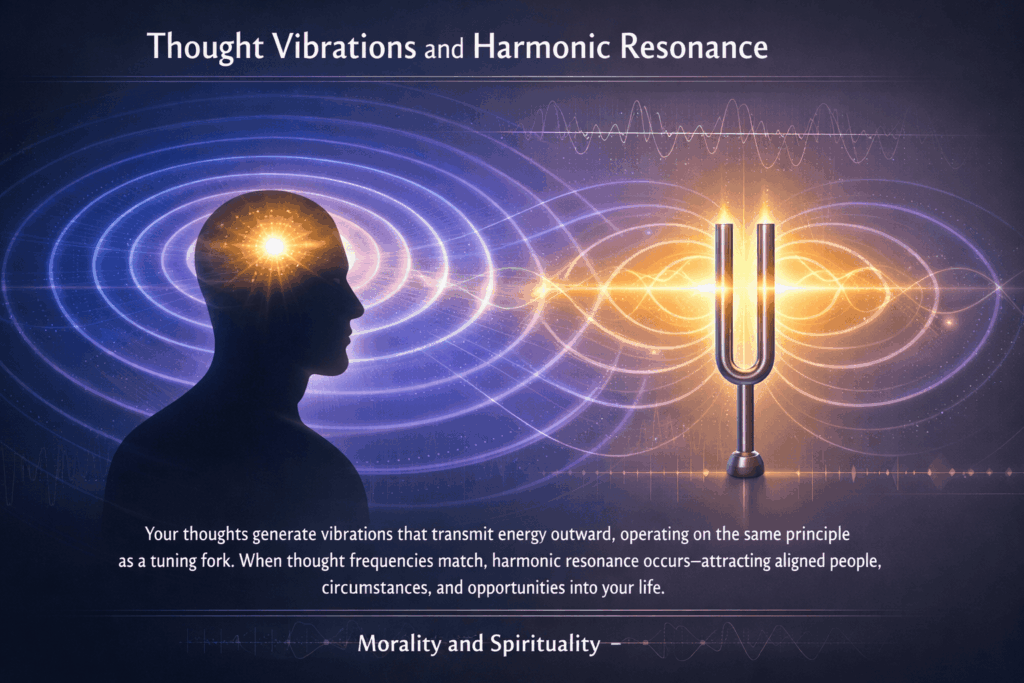
Your consciousness operates identically. Your thoughts generate vibrations that transmit energy outward.
The words you speak leave a thought behind that continues to live in your personal energy field, creating a distinct vibration of its own. This vibratory signature attracts people, circumstances, and opportunities that match your frequency.
Think about moments when you’ve instantly felt a kinship with someone you’d just met, or conversely, when someone repelled you on first sight despite nothing obviously wrong. The science behind this phenomenon is simple: people are made of different chemical elements corresponding directly to their consciousness level.
When you’re “in tune” with someone—literally operating at the same vibratory frequency—you naturally attract and feel comfortable with them. Those operating at completely different frequencies may not appeal to you at all.
How the Power of Thought Impacts Your Health and Wellness
The Mind-Body Connection: Stress, Disease, and Recovery
One of the most consequential ways that thought power and consciousness manifests is through your physical health. Your body cannot distinguish between an actual danger and the act of merely thinking about a stressful situation. When you experience threatening or worrying thoughts, your immune system responds by releasing adrenaline into your bloodstream, your heart beats faster, and acid floods your stomach—just as if you faced real physical danger.
By nurturing thoughts of contentment and positivity, disease can be reversed and healing accelerates. Conversely, inharmonious and worrisome thoughts filled with negativity create disease. This isn’t spiritual bypassing—it’s straightforward biology.
When you persistently engage in stressful thinking patterns, your body continuously releases stress hormones. If this excessive production of hormones continues unchecked, it eventually debilitates your body, making it vulnerable to all kinds of physical problems: weakened immunity, inflammation, autoimmune conditions, and chronic disease.
This is precisely why understanding and controlling your mental state becomes a cornerstone of optimal health. By learning to recognize when you’re spiraling into negative thought patterns and actively shifting toward more constructive thinking, you directly influence your immune function, stress hormone production, and physical resilience. Explore more on our guide to understand the connection between mind and body and how it relates with sickness.
Using Breath and Mindfulness to Recalibrate Your System
The good news? You have immediate access to a powerful tool: your breath. Deep, slow breathing directly counteracts the stress response. As the article on mindfulness and stress reduction outlines, when you breathe slowly and deliberately, you activate your parasympathetic nervous system—the “rest and restore” state. This calms your mind and body simultaneously, demonstrating how consciousness controls physical reality through the simple act of intentional breathing.
Meditation techniques that incorporate deep breathing are so effective because they address both mental and physical dimensions of wellbeing. Similarly, practices like repetition of mantras work because they anchor your consciousness in a specific vibration. The most powerful mantras are those repeated in your own thoughts—in silence—because only in silence can you hear your inner voice clearly. Learn more on how to practice meditation and its associated benefits from our guide.
The Vibratory Nature of Consciousness and Personal Development
How Your Consciousness Level Determines Your Life Experiences
An extraordinary principle emerges when you understand the power of thought: your consciousness level is literally recorded in your energetic field and determines the quality of your experiences. The more advanced a person is in their knowledge and spiritual development, the shorter their wavelength and the higher their frequency. This vibratory level manifests visibly in the tone of your voice, which indicates your level of spiritual and emotional development.
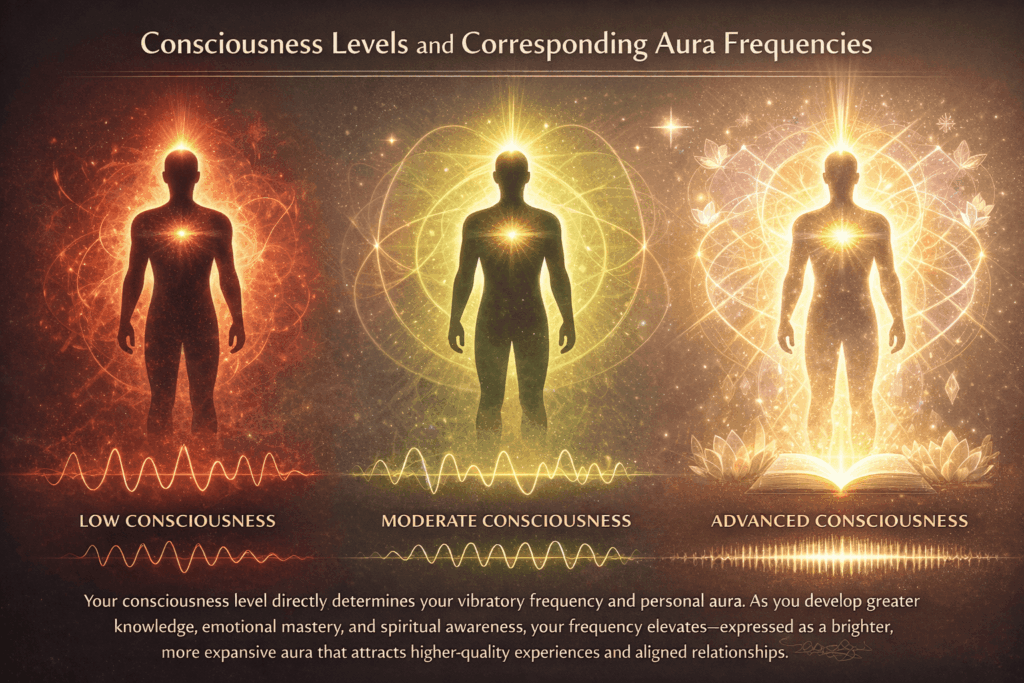
This vibratory level also appears in how you comprehend and process information. When you read with genuine comprehension, you don’t just see the printed word—you form an image of it in your mind’s eye while silently vocalizing and hearing the word internally.
Since each person comprehends at their own level of understanding, no two people can read the same passage and extract identical meaning. Your consciousness literally filters reality.
The broader principle here is fundamental: thought always precedes action. Every experience, belief, reaction, and behavior you have emerges from your repository of thoughts. The strongest influences on your thought patterns come from visual stimuli because they impact your optic nerve and store themselves in your pictorial memory garden. Everything you see and hear is impressed on your brain cells—living tissue that carries meaning and influence forward.
This explains why the environments you spend time in matter so deeply. In places where people of the same mind gather—shopping malls, bars, places of worship—a distinct mental atmosphere accumulates. The thought forms established in these locations become palpable to sensitive people and even affect those who don’t consciously recognize it. You’re absorbing the vibratory signature of collective consciousness in that space.
Building Your Higher Consciousness
Understanding that consciousness creates your reality means recognizing your power to deliberately cultivate higher-quality thoughts. Your words and thoughts don’t vanish—they persist as vibrations in your personal energy field. Over time, this accumulated vibratory pattern becomes your “aura,” the energetic signature that precedes you.
When you engage in deliberate practice—consciously choosing thoughts of gratitude, compassion, understanding, and growth—you’re literally reshaping your consciousness level. You’re raising your frequency. And as your frequency rises, your entire life reflects this elevation. Better opportunities emerge, more aligned people enter your sphere, and your resilience in facing challenges deepens.
Practical Applications: Harnessing the Power of Thought Daily
Recognizing and Redirecting Your Thought Patterns
To harness the power of thought practically, you must first become aware of your habitual thought patterns. Most people move through their day unconsciously, allowing random thoughts and environmental influences to dictate their mental state. The practice of developing awareness breaks this pattern.
Start by regularly pausing to notice what you’re thinking. What narratives occupy your mind? What emotions are you generating through your thought choices? Are you replaying past events? Worrying about future scenarios? Simply observing without judgment creates space between stimulus and response—and in that space lies your freedom to choose different thoughts.
Related to this practice is learning to control your mind effectively, which empowers you to deliberately choose thoughts that serve your wellbeing rather than undermine it.
The Practice of Conscious Creation
One practical example illustrates this principle vividly. An individual once painted a thought form into a piece of furniture. While antiquing a dining room set and watching The Planet of the Apes on television, they were mentally immersed in the film. Years later, whenever they looked at that furniture, they saw apes—the thought form had literally imprinted itself onto the physical object. This same principle applies to artwork: the astral and mental aspects of an artist’s conception remain embedded in their paintings, influencing each viewer who encounters the work.
This demonstrates that you cannot avoid transferring your consciousness into the physical world. The energy of your thoughts goes directly into everything you create, say, and do. Therefore, consciously cultivating quality thoughts becomes an act of creation that shapes not just your internal reality but your external world as well.
Aligning With Polar Opposites for Balance
Interestingly, understanding the power of thought includes recognizing that polar opposites exist in philosophy and nature. Light and darkness, growth and decay, love and fear—these opposing forces create dynamic tension. Rather than trying to eliminate negative thoughts entirely, wisdom lies in understanding their role and choosing consciously which frequency you want to occupy most of the time.
This doesn’t mean pretending negative thoughts don’t exist. It means acknowledging them, understanding what they represent, and deliberately returning your focus to thoughts that align with your highest intentions.
Deepening Your Practice: Mindfulness and Memory
For those wanting to deepen their understanding of how consciousness operates, exploring the relationship between mindfulness and memory reveals how attention shapes what you retain and how you experience life. When you practice mindfulness—present-moment awareness—you literally change which memories become accessible and influential in your consciousness.
Why Understanding the Power of Thought Matters Now
We live in an age of unprecedented mental and emotional stress. The constant digital stimulation, information overload, and social comparison create a mental environment far more chaotic than what previous generations experienced. In this context, understanding that your thoughts are not random and that the power of your consciousness is real becomes revolutionary.
You are not a passive recipient of circumstances. You are an active co-creator of your reality through the quality of your thinking, the frequency of your vibration, and the consciousness you bring to each moment. The science supports what contemplatives have known for millennia: your inner world shapes your outer world.
The good news is that this power is immediately accessible to you. You don’t need expensive equipment, special credentials, or years of study. You need only the willingness to pay attention to your thoughts and the commitment to consciously choose higher-frequency thinking patterns.
Frequently Asked Questions About the Power of Thought
Q: Is the power of thought real, or is it just positive thinking psychology?
A: The power of thought operates on both levels. Scientifically, your thoughts generate measurable vibrations that influence your nervous system, immune function, and even brain structure. Psychologically, your thoughts shape your perception of reality and determine your behaviors and choices. The power is simultaneously neurological, energetic, and practical. It’s not about wishful thinking—it’s about understanding that consciousness is a force that shapes reality at multiple levels simultaneously.
Q: How long before I notice the power of thought working in my life?
A: Some effects are immediate. Within hours of shifting your thought patterns toward more constructive thinking, your stress levels typically decrease and your mood improves. Physical health changes often become noticeable within weeks of consistent positive thinking and stress reduction. Larger life changes—attracting new opportunities, relationships, or circumstances—typically manifest over months as your elevated consciousness becomes established as your baseline frequency.
Q: Can the power of thought really affect my physical health?
A: Yes. The mind-body connection is scientifically documented. Chronic stress thinking patterns suppress immune function and increase inflammation. Conversely, contentment, gratitude, and positive expectation strengthen immunity and facilitate healing. This isn’t mystical—it’s measurable physiology. That said, understanding the power of thought complements rather than replaces medical treatment. Use both intelligently.
Q: What’s the difference between the power of thought and manifesting or visualization?
A: The power of thought is the fundamental principle: consciousness generates energy that influences reality. Manifestation and visualization are specific practices that harness this power. Visualization uses the principle by deliberately creating mental images of desired outcomes. Manifestation applies the principle by coupling focused thought with aligned action. All three are related, with thought power being the foundational force.
Q: How do I stop negative thoughts if the power of thought is so strong?
A: You don’t suppress them—that typically strengthens them. Instead, observe them without judgment, understand what they’re signaling, and deliberately choose to redirect your attention to more constructive thoughts. The power comes not from fighting your thoughts but from becoming conscious enough to choose your focus. Learn more about this in our guide on how to control your mind effectively.
Q: Can I use the power of thought to control other people?
A: Your consciousness affects collective energy fields and how people perceive and respond to you. However, attempting to control others through thought violates their free will and ultimately creates resistance. The more ethical application is to raise your own consciousness and vibration, which naturally elevates those around you through energetic influence rather than control.
Conclusion: Your Consciousness Is Your Most Powerful Tool
The power of thought isn’t metaphorical—it’s a measurable, scientific reality that’s been documented for over a century. From Dr. Baraduc’s vibration-recording machine to Sir Alexander Cannon’s graphical analysis of thought frequencies, the evidence is clear: your consciousness generates energy that shapes your health, relationships, opportunities, and experiences.
You stand at a unique moment in history where ancient wisdom and modern science converge in confirming a simple truth: you are the creator of your reality through the quality of your thinking and the frequency of your consciousness.
This isn’t about forcing positive thoughts or ignoring genuine problems. It’s about becoming conscious—truly aware—of how your mental patterns operate, deliberately cultivating thoughts that serve your highest good, and trusting that as you elevate your consciousness, your entire life elevates with it.
The power of thought is always active. The question is whether you’ll use it consciously or continue allowing it to operate unconsciously. Start today. Pay attention to your thoughts. Notice the patterns. Choose consciously. Feel the difference. This is how you harness the power of thought to create the life you genuinely desire.