
Mindfulness Practice: How to Stay Present Every Day
Mindfulness Practice and the Joy of Present Moment Awareness Your mind is rarely fully here. Right now, even as you […]
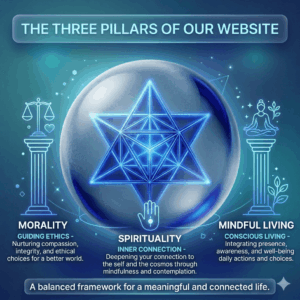
Most approaches to mindfulness teach you to observe your thoughts from a neutral distance. This mindful living guide goes further. Drawing on the western esoteric tradition and direct experiential practice, these guides are designed to awaken a genuinely different quality of awareness — one that is not merely calm, but perceptually expanded. The goal is not to reduce stress, though that often follows. The goal is to bring a new quality of consciousness into everything you do.
I do not invite you to withdraw from your daily life in order to develop this awareness. I invite you to perform your existing activities — your work, your relationships, your ordinary daily actions — with a fundamentally different inner orientation. In this mindful living guide, you will find techniques rooted in energy body development, breath practice, vibrational law, and esoteric physiology. These are not metaphors. They describe real, trainable capacities of the human system that most people never develop simply because no one shows them how.
The most essential foundation of any serious mindful living practice is an accurate understanding of the body’s energy anatomy. Our comprehensive article on the chakra system and your vital energy centres provides exactly that — a practical, non-mystified account of the seven primary energy centres, how they function, how they become blocked, and how deliberate practice opens and develops them. This article underpins much of what follows in this mindful living guide.
Breath is the most immediate and powerful tool available for shifting your state of consciousness. Our guide on the throat breathing technique for cultivating inner stillness describes one of the most effective breath practices I have encountered — accessible to beginners, deeply rewarding for experienced practitioners. The technique works directly on the energy body through the throat centre and produces measurable shifts in both mental clarity and emotional regulation.
Equally transformative is understanding how the law of vibration governs your reality. This is not a motivational concept — it is a precise description of how consciousness, emotion, and the physical world interact through frequency. Grasping this practically changes the way you approach every area of life, from interpersonal relationships to the quality of your inner environment.
A core theme of this mindful living guide is the body as an instrument of perception — not merely a vehicle for the mind. Our research-informed article on how emotions physically affect the body bridges the gap between esoteric understanding and contemporary somatic science, showing precisely how unexpressed or unconscious emotional patterns create physical consequences. Understanding this changes how you relate to your emotional life entirely.
The mirror gazing practice, described in our detailed guide on mirror gazing meditation for self-perception and inner development, is one of the most direct techniques available for developing a clear, sustained relationship with your own consciousness. It is also one of the most underrated. Many practitioners report significant perceptual openings during or after sustained sessions.
One of the questions I am most frequently asked is whether mindfulness practice produces lasting change or simply temporary calm. Our article on how mindfulness deepens memory and long-term awareness addresses this directly, drawing on both neuroscientific research and experiential accounts to show the structural changes that sustained practice produces in cognition, attention, and emotional resilience.
Additionally, the guide on how consciousness relates to time and personal transformation offers a framework for understanding why genuine change feels slow — and how to orient your practice so that you are building something real over months and years rather than chasing peak experiences.
This mindful living guide is for those who sense that the surface approaches to mindfulness — apps, breathing exercises, gratitude journals — are pointing at something real but falling short of it. You don’t need a prior background in meditation or spirituality. You need curiosity, honesty, and a genuine willingness to practice. If that describes you, these guides are written directly for you.
Mindfulness Practice and the Joy of Present Moment Awareness Your mind is rarely fully here. Right now, even as you […]
Mindfulness and Memory: How Present-Moment Awareness Improves Recall and Cognitive Clarity Have you ever sat down to meditate with the
What is meditation, and how can it transform your mind, brain, and entire experience of life? In a world filled
How to Control Your Mind: Practical Ways to Master Your Emotions Control Your Mind before it controls you. Have you