
Throat Breathing Technique: A Complete Guide to Awakening Energy and the Third Eye
What if the simple act of breathing could instantly shift your state of consciousness? Most people spend years searching for tools to quiet the mind, sharpen inner awareness, and access deeper levels of perception — yet the answer may rest in your own throat.
The throat breathing technique is an ancient, deceptively simple practice that activates subtle energy through friction in the larynx. It doesn’t require special equipment, complex postures, or years of training. All you need is your breath, your awareness, and a willingness to explore. In this guide, you’ll learn exactly how to practice this method, how to avoid common mistakes, and how to use it to deepen your connection with the third eye and inner vision.
What Is the Throat Breathing Technique?
The throat breathing technique is a conscious breathing practice in which you generate a gentle friction sound at the back of the lower throat — specifically in the larynx — during both inhalation and exhalation. This is sometimes called throat friction breathing because the focus is not on the breath itself but on the mechanical stimulation of the laryngeal area.
Unlike pranayama or rebirthing exercises, this is not a hyperventilation practice. The breath remains at its natural depth and rhythm. What changes is the quality of awareness you bring to the larynx. This larynx breathing technique works subtly but powerfully, creating a steady, wind-like sound that gradually stills the mind and heightens energy sensitivity.
How the Throat Breathing Technique Works
The larynx is more than just the structure that produces your voice—it can also be seen as a sensitive bridge between the body and deeper awareness. In many traditions, this area is thought to connect physical sensation with subtle internal energy. When you practice throat breathing and create a soft, steady friction here, it generates a gentle vibration.
Over time, this sensation can spread, creating a feeling of resonance that seems to ripple through the body, encouraging a deeper sense of presence and calm.
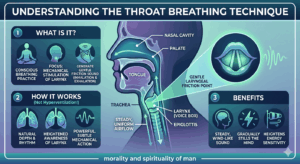
This vibration does not stay local. Over time, practitioners feel it radiate upward toward the space between the eyebrows, the area associated with the third eye.
The larynx breathing technique effectively acts as a tuning fork, bringing your awareness into resonance with deeper states of perception.
This principle connects directly to the broader relationship between breath, energy, and awareness — if you’re curious about how altered states interact with our experience of reality, explore this piece on understanding the connection between consciousness and time.
Step-by-Step Guide to Practicing the Throat Breathing Technique
Practicing the throat breathing technique is straightforward. Follow these steps to begin:
1. Find a comfortable, upright posture. Sit with your spine straight and your neck vertical. The more aligned your neck is, the stronger the energetic effect in the larynx.
2. Slightly open your mouth. Let your lower jaw relax and drop gently. Your upper and lower teeth should not touch. You can breathe through your nose, mouth, or both — whichever feels most natural.

3. Generate the throat friction. Begin breathing and allow a gentle friction sound to form at the lower back of the throat. Think of it as a soft, wind-like sound — not a hum, not a buzz, just a quiet rasp.
4. Maintain natural breathing depth. Do not force deep breaths. The throat friction breathing works through the quality of the friction, not the volume of air. Normal breath depth is ideal.
5. Sustain and relax. Continue for several minutes. With practice, this state becomes effortless and deeply calming.
Common Mistakes and How to Avoid Them
Many beginners struggle with this larynx breathing technique by placing the friction too high — near the palate or nasal area — rather than at the lower throat. This produces a higher-pitched, sometimes irritating sound and can dry or strain the throat.
Other common errors include forcing the breath (unnecessary), tensing the jaw (keep it loose), or trying to make the sound “perfect” from the start. Perfectionism will get in the way. A rough, approximate friction is more than enough to begin experiencing the technique’s effects.
Throat Friction for Third Eye Awakening
One of the most powerful applications of this practice is using throat friction for third eye awakening. As the larynx vibration deepens through consistent practice, it naturally extends toward the area between the eyebrows — the seat of inner vision and heightened perception.
The throat breathing technique amplifies psychic sensitivity. Practitioners often notice a pulsing or tingling sensation between the eyebrows shortly after beginning the friction. Over time, this sensation becomes a reliable signal that awareness is opening and deepening.
The mechanism is elegant: throat friction for third eye awakening works by using the larynx as an energetic amplifier. You stimulate the throat, and the energy rises. The third eye does not need to be forced open — it responds naturally to the vibration you cultivate below it.
To explore how this kind of subtle energy work fits into a broader framework of inner development, visit this complete guide to psychic development and inner vision.
Benefits of the Throat Breathing Technique
Regular practice of the throat breathing technique produces a range of tangible and subtle benefits:
- Mental stillness — The friction sound naturally quietens mental chatter without effort
- Heightened energy sensitivity — You begin to feel subtle vibrations and flows within and around the body
- Enhanced inner perception — Throat friction breathing helps bridge the gap between ordinary and expanded awareness
- Emotional clarity — A quieter mind creates space for deeper self-understanding
- Third eye activation — Sustained practice supports throat friction for third eye awakening over time
These benefits unfold gradually and build on one another. Consistency matters far more than intensity. For a deeper look at what this kind of inner work can lead to, read about the deep spiritual awakening and healing process.
Integrating the Larynx Breathing Technique into Your Spiritual Path
The beauty of the larynx breathing technique is how naturally it fits into an existing spiritual practice. You can use it as a gateway into meditation, applying it for five to ten minutes before sitting in silence. You can also practice it informally — during a quiet walk, before sleep, or at any moment when you want to tune into a more centered state.
The technique adapts to where you are. At first, it may feel unfamiliar. With time, switching it on becomes as natural as taking a deep breath. It becomes an anchor — a reliable way to shift your state whenever the mind becomes noisy or scattered.
This kind of daily energetic practice is a cornerstone of genuine spiritual growth. If you’re ready to understand where this path can lead, explore your spiritual ascension journey explained.
The Deeper Purpose: Ego and Awareness
Beyond the practical benefits, throat friction breathing points toward something profound. As you become more familiar with the vibration in the larynx, you naturally begin to observe your inner life from a greater distance. Thoughts arise — and you notice them, rather than becoming them.
This is the deeper gift of the practice: it creates a gap between stimulus and reaction, between ego and awareness. You begin to watch the mind move rather than being moved by it. Over time, this shift changes how you relate to every experience.
To explore how this relates to the deeper layers of self, read this reflection on exploring the nature of the ego and soul reflection.
The Vibration Knows Where to Go: A Closing Reflection
The throat breathing technique is one of the most accessible and immediately effective tools available for those seeking to deepen their inner life. You do not need to master it before it begins to work — even a rough, approximate friction in the throat starts the process of energetic awakening.
With consistency, this practice gradually quietens the mind, opens sensitivity, and supports throat friction for third eye awakening in a way that feels organic and deeply natural. Start simply, stay patient, and trust the process. The vibration knows where to go.
Frequently Asked Questions
Q1: Is the throat breathing technique safe for beginners?
Yes. The throat breathing technique is safe for most people. It uses normal breath depth and focuses on gentle friction rather than forced inhalation or exhalation. Beginners may initially feel mild throat dryness if the friction is placed too high, but this resolves with practice. If you experience persistent discomfort, lower the friction toward the larynx and reduce the intensity.
Q2: How long does it take to feel the effects of throat friction for third eye awakening?
Many practitioners notice a subtle vibration or tingling between the eyebrows within their first few sessions. Deeper effects — heightened clarity, increased energy sensitivity, and consistent third eye activation — typically emerge after several weeks of daily practice. Progress varies by individual, but even early sessions often produce a noticeable calming of the mind.
Q3: Can I combine the larynx breathing technique with meditation or other spiritual practices?
Absolutely. The larynx breathing technique works exceptionally well as a preparation for meditation. Practicing it for five to ten minutes before sitting in silence helps settle mental activity and opens energetic sensitivity. It can also be used alongside visualization, breathwork, or energy practices to deepen their effects.