
What Is the Ego? Understanding Ego vs True Self and Soul Realization
What if everything you believe about yourself is just a reflection — not the real thing? Most people never question the difference between ego and true self, and that unexamined gap quietly drives anxiety, emotional reactivity, and a persistent sense of disconnection.
The ego vs true self confusion sits at the heart of much human suffering. When you mistake your thoughts, roles, and reactions for who you are, you lose touch with the deeper awareness beneath them. This guide breaks down the nature of the ego, answers what is the ego in spirituality, explains soul realization in plain terms, and gives you a clear, actionable path forward.
Ego vs True Self: What Most People Get Wrong
Most people assume the ego is their enemy — a dark force to suppress or destroy. That is the first mistake.
The ego vs true self relationship is not a war. The ego is a functional layer of identity — a constructed sense of “I” built from thoughts, experiences, memories, and social roles. Your true self is the unchanging awareness that observes all of it.
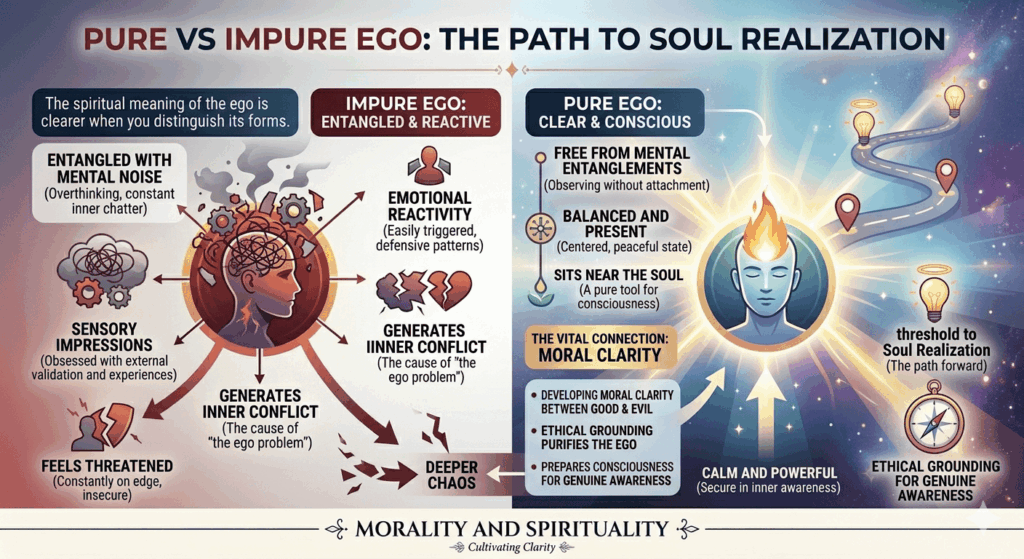
Here is a simple example: when your eyes fail, you say “I am blind.” But only your eyes are limited. You — the observer — remain fully intact. That observer is your true self.
This confusion carries a real physical cost. Understanding how emotions affect your body when you are stuck in ego-identification reveals just how deeply mistaken identity disrupts your well-being.
The Nature of the Ego Explained Simply
Think of your soul as a flame and the ego as its reflection in a mirror. The flame is real. The reflection feels real — but it is a copy, not the source.
The nature of the ego is exactly this: it is consciousness reflected through the lens of your undeveloped intuition. This reflection creates your sense of “I-ness” — the feeling that you exist as a separate individual moving through life, experiencing thoughts and emotions.
So what is the ego in spirituality? It is the subjective sense of self that helps you function, make decisions, and relate to the world around you. It is not evil. It becomes problematic only when you mistake the reflection for the original flame.
The power of thought and consciousness directly shapes how clear or distorted this reflection becomes — and how clearly you see yourself.
Why the Ego Feels Like Your Identity
The ego creates continuity. Your body changes, your beliefs shift, your circumstances transform — yet something in you says: I am still the same person. That persistent sense of sameness is the ego’s core function.
Over time, you fuse with the ego’s narrative. You become your job title, your achievements, your fears, your failures. The story feels like you.
But the story changes. The awareness watching the story does not.
Learning how to control your mind begins the process of separating observer from narrative — and that separation is the first real step toward freedom from ego-driven identity.
Soul Realization: What It Actually Means
Soul realization is not a single dramatic awakening. It is a gradual recognition that you are the observer — not the thoughts, roles, or experiences being observed.
When this recognition stabilizes, the ego’s grip loosens. Fear of judgment, compulsive comparison, the need for external validation — these patterns begin to lose their power. What remains is steady, present awareness.
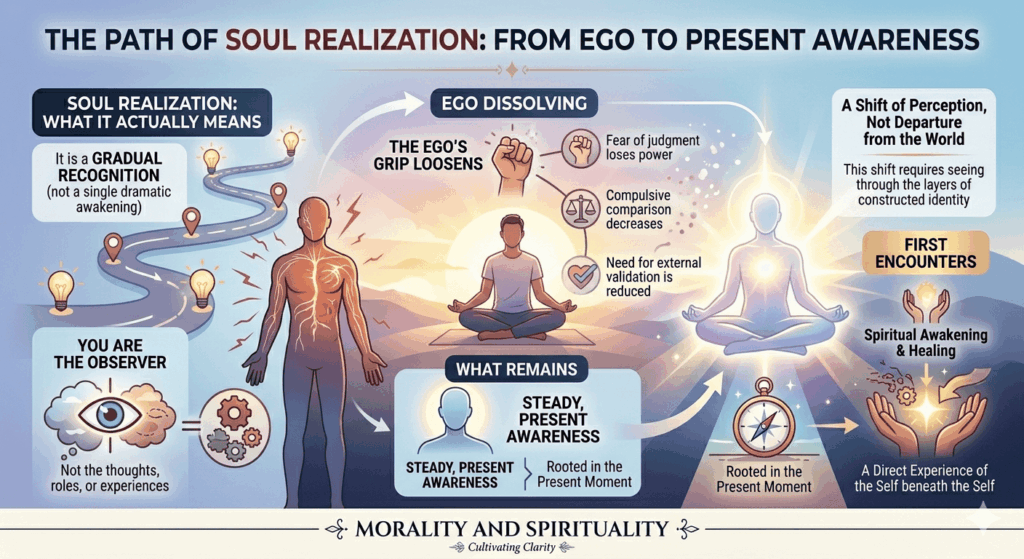
This shift does not require you to leave the world behind. It requires you to see through the layers of constructed identity you have been living as. Many people first encounter this shift through spiritual awakening and healing — a direct experience of the self beneath the self.
How Intuition Reveals Your True Self
Intuition is the soul’s direct perception — knowledge that arrives without filtering through layers of thought or emotion.
In most people, intuition remains underdeveloped. The ego’s reflection then becomes distorted, like light passing through a clouded lens. You navigate life guided by a false image of who you are.
As intuition develops, that reflection clears. You begin to perceive reality more directly — less through the ego’s filters, more from the ground of your actual experience. Deepening your psychic development and intuition accelerates this clarification and strengthens the connection to your true self.
“The less developed your intuition, the more distorted the ego’s reflection becomes — and the more real that distortion feels.”
Pure vs Impure Ego (And Why It Matters)
The spiritual meaning of the ego becomes clearer when you recognize that not all ego is the same.
The impure ego entangles itself with mental noise, emotional reactivity, and sensory impressions. This is the ego that feels threatened, defensive, and constantly reactive. It generates most of the inner conflict people associate with “the ego problem.”
The pure ego, however, sits near the soul. When you become conscious of the pure ego — free from mental entanglements — you approach the threshold of soul realization.
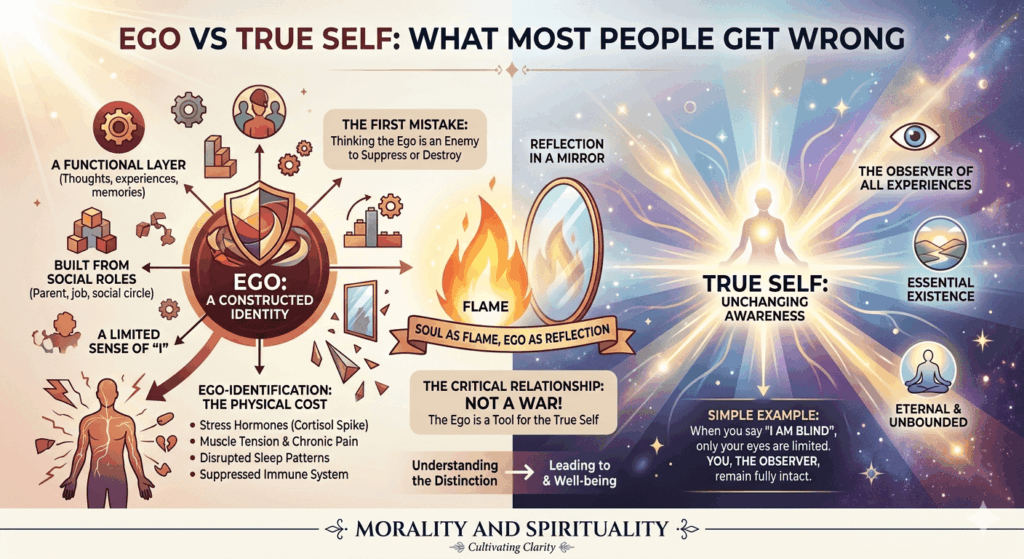
This is why developing moral clarity between good and evil matters deeply. Ethical grounding purifies the ego and prepares consciousness for genuine awareness — not just intellectual understanding of it.
How to Transcend the Ego Without Fighting It
Here is what most spiritual teachings miss about how to transcend the ego: you cannot destroy it by force.
Forcing the ego into submission creates internal conflict. The ego mirrors whatever energy you bring to it — resistance generates more resistance, not freedom.
True transcendence happens through observation and cooperation. You notice the ego’s patterns — fear, comparison, validation-seeking — without judging them. That recognition alone begins to dissolve the ego’s control over your choices and reactions.
Ego and consciousness explained simply: as your awareness expands, the ego’s grip naturally contracts. You do not destroy it — you outgrow it.
Be cautious of shortcuts. As explored in spiritualism misuse and dark practices, forcing spiritual states through unethical means corrupts the natural unfolding of inner transformation.
Meditation, Awareness, and Inner Transformation
Meditation is the most direct tool for experiencing ego vs true self in real time.
In sleep, your mind briefly touches pure awareness — but unconsciously, so the insight vanishes on waking. Meditation makes this same process conscious. You observe thoughts, emotions, and impulses without identifying with them. Gradually, the gap between ego and the observing awareness widens.
The mindfulness and memory connection shows how consistent inner awareness reshapes not just your identity — but your cognitive function and emotional resilience.
Start small. Even 10 minutes of daily practice begins shifting the relationship between ego and observer. Explore meditation practices for beginners to build a foundation that supports real, lasting inner transformation.
Ego vs True Self: Your Next Step Toward Soul Realization
The ego vs true self is not a problem to solve. It is a relationship to understand.
Your ego serves you — it organizes experience, creates continuity, and helps you function in the world. But when it runs unchecked, it pulls you away from the steady awareness that defines your true self.
Soul realization does not require you to become someone new. It asks you to recognize what you have always been beneath the layers of constructed identity.
Start here: sit quietly for 10 minutes. Observe your thoughts without reacting. Notice who is watching. That witness is your true self — and it has always been there.
Ready to go deeper? Explore meditation practices for beginners to experience this shift directly or begin your journey through spiritual awakening and healing for a fuller picture of inner transformation.
Frequently Asked Questions About Ego vs True Self
What is the difference between ego and true self?
The difference between ego and true self is that the ego is your constructed identity built from thoughts, roles, and experiences, while the true self is the unchanging awareness that observes all of them. The ego responds to conditioning and changes constantly; the true self remains constant and clear.
What is the ego in spirituality?
In spirituality, the ego is the sense of “I” that identifies with your body, mind, and personal story. The nature of the ego is that it helps you function in daily life — but it causes deep confusion when you mistake it for your actual identity.
How do I know if I am acting from ego?
You are likely acting from ego when fear, need for validation, comparison, or attachment drives your behavior. The true self acts from clarity and presence — not from reaction or the need to protect a self-image.
Can you live without an ego?
You cannot fully eliminate the ego — it is necessary for daily functioning and decision-making. Through meditation and awareness, however, you can reduce its control and live in closer alignment with your true self.
How do you transcend the ego?
Transcending the ego means observing your thoughts without identifying with them. Consistent meditation, self-inquiry, and mindfulness shift your center of gravity away from ego vs true self confusion and toward steady, grounded awareness.
Want to go deeper into ego vs true self? Start with our guide on meditation practices for beginners to experience this shift directly.
Pingback: Spiritual Awakening Healing: Trauma, Growth & Inner Transformation
Nice peace to read