
Third Eye Awakening: A Complete Guide to Activation, Meditation, and Inner Awareness
Have you ever sensed a deeper layer of reality just beyond your ordinary perception? Third eye awakening is often described in spiritual traditions as a way of accessing deeper awareness and intuition. In modern terms, it can also be understood as improving pattern recognition, self-awareness, and emotional clarity.
This is not mysticism reserved for the few. It is a practical, teachable process grounded in thousands of years of contemplative tradition. Whether you are drawn to this path for healing, spiritual growth, or simple curiosity, the journey begins with one essential step: engaging your inner awareness with intention. In this guide, you will discover what the third eye is, why activating it matters, and exactly how to begin safely and effectively.
In this guide, you’ll learn:
- What third eye awakening really is
- How to open your third eye safely
- Powerful third eye meditation techniques for beginners
- Signs your third eye is opening
- How to activate the pineal gland naturally
What Is the Third Eye?
The third eye is the gateway to inner space — the organ of subtle perception through which you access deeper states of consciousness. In both Hindu and Christian traditions, the body is compared to a temple, and the third eye serves as its portal. Crossing that threshold moves you from thinking about spiritual life to experiencing it.
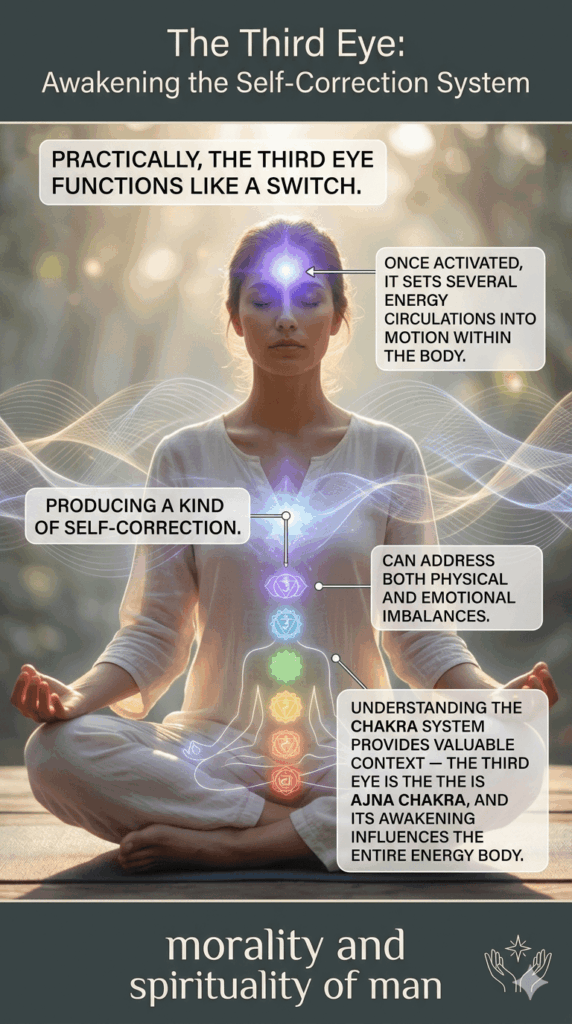
Practically, the third eye functions like a switch. Once activated, it sets several energy circulations into motion within the body, producing a kind of self-correction that can address both physical and emotional imbalances.
This is why understanding the chakra system provides such valuable context — the third eye is the Ajna chakra, and its awakening influences the entire energy body.
Third Eye Awakening: Myths vs Reality
Understanding third eye awakening begins by separating truth from misconception. Many people approach this topic expecting dramatic, supernatural experiences, but the reality is far more grounded—and far more powerful.
Myth: You’ll see visions instantly
Reality: Third eye awakening is not about instant visuals or fantasy experiences. Instead, it develops as subtle awareness, clarity, and heightened perception. Most people first notice quiet shifts—like improved focus, deeper self-awareness, and the ability to observe thoughts without being controlled by them.
These early third eye awakening symptoms are often overlooked because they are calm, not dramatic.
Myth: It gives you supernatural powers
Reality: The real benefits of third eye meditation are psychological and perceptual—not magical. As your awareness strengthens, you begin to:
- Recognize patterns in behavior and emotions
- Make clearer decisions
- Respond instead of react
This aligns with the deeper purpose of learning how to open your third eye—not to escape reality, but to understand it more clearly.
Myth: Awakening the third eye is dangerous
Reality: When approached through grounding practices like meditation and self-awareness, third eye awakening is a safe and gradual process. The key is consistency, not force.
If you’re starting out, building a strong foundation through a complete meditation practice for beginners can help you develop the awareness needed for safe and steady progress.
Myth: You need special abilities to awaken your third eye
Reality: Anyone can develop inner awareness. Third eye awakening is a skill built through attention, reflection, and mental clarity—not something reserved for a select few.
Practices that help you release negative energy and mental clutter
can significantly improve your ability to perceive clearly and deepen your inner awareness.
The truth is simple:
Third eye awakening is not about fantasy—it’s about clarity.
The Spiritual and Healing Power of Third Eye Awakening
Third eye awakening does far more than sharpen spiritual perception. From a therapeutic perspective, many people report significant improvement in physical and emotional conditions simply by establishing a conscious connection with this center. Because the third eye regulates energetic flow, activating it helps restore balance throughout the body — a natural form of self-acupuncture.
This healing dimension connects directly to the mind-body connection in healing. When inner awareness deepens, the body often follows. Spiritual awakening practices centered on the third eye tend to put people in contact with more profound aspects of themselves, and that contact carries its own curative power.
Beyond healing, the third eye opens a connection to consciousness itself. Modern interest in pineal gland awakening mirrors what ancient traditions have always taught: that this center holds extraordinary potential. As your practice deepens, you begin to sense energy moving, perceive subtle light between the eyebrows, and access clarity that analytical thinking alone cannot produce. Explore how the power of thought in shaping consciousness reinforces this inner expansion.
How to Open Your Third Eye Safely
Knowing how to open your third eye starts with understanding that force is counterproductive. The third eye does not respond to pressure — it responds to stillness, receptivity, and consistent practice. Before attempting the opening sequence, establish the right conditions:
Create the right environment. Choose a quiet room where no one will disturb you for at least one hour. Light candles to soften the space.

Prepare your body. Remove your shoes and loosen any restrictive clothing. Lie on the floor with arms by your sides and palms facing upward. Do not cross your legs or arms.
Expect subtlety. The vibration between the eyebrows does not feel dramatic. A faint tingling, a gentle density, or a subtle weight in that area is more than enough to begin. Trust whatever you notice.
Release imagination. Do not visualize anything. Allow what is naturally present to reveal itself.
If you are new to inner work, a complete guide to meditation for beginners will help you build the foundational awareness this practice requires.
Third Eye Meditation Techniques: The Step-by-Step Opening Practice
These third eye meditation techniques are designed for a single, deeply focused session — ideally at the start of a weekend when you have uninterrupted time. Practice alone or alongside others who are actively engaged in the work. Begin with 5–10 minutes of humming to settle your energy, then move through the six phases below.
Phase 1 — Larynx Awareness
Begin breathing with gentle throat friction — a soft, wind-like sound produced at the lower back of the throat during both inhalation and exhalation. Become aware of the vibration this generates in the larynx. Stay aware without concentrating tightly. Flow with the energy for 5–10 minutes. You can explore more on throat breathing from our guide for personalized techniques.
Phase 2 — Awareness Between the Eyebrows
Maintain the throat friction. Shift your awareness gently to the space between your eyebrows. Do not grasp at it. Simply remain open and present there for about 5 minutes.

Phase 3 — Hand Placement
Hold your open palm 3–5 centimetres (1–2 inches) in front of the area between your eyebrows without touching the skin.
Breathe with the friction and hold your awareness between the eyebrows for a few minutes.
Phase 4 — Seeking the Vibration
Place your hand back by your side. Begin looking — gently and without force — for a vibration between the eyebrows. It may feel like a tingling, pulsing, pressure, or subtle density. Remain receptive.
Phase 5 — Connecting Throat and Third Eye
Once you sense even the faintest vibration between the eyebrows, connect it with the throat friction. Hold both in awareness simultaneously. This is the energetic core of third eye awakening: as you sustain the connection, the vibration grows more refined yet more present. Continue for approximately 10 minutes.
Phase 6 — Deep Stillness
Stop the throat friction. Release your focused attention. Lie motionless with eyes closed for 10 minutes or more. Notice any sense of light, colour, or subtle movement between the eyebrows. The more still you become, the deeper you tune in.
Common Experiences During Third Eye Awakening
As you explore how to open your third eye through this practice, a range of sensations may arise — all of them normal signs of third eye activation:
- A tingling, pulsing, or warmth between the eyebrows
- A sense of pressure or density in the forehead area
- Perception of light or colour with eyes closed
- A deep quieting of mental chatter
- Vibrations in the hands, arms, or whole body (simply return awareness to the eyebrows if this occurs)
These experiences confirm that the process is moving. Understanding the law of vibration helps explain why these energetic shifts occur and what they signal on a deeper level.
The Third Eye in Modern Science
While the concept of the third eye comes from ancient spiritual traditions, modern science offers useful insights into what this experience may represent in practical terms.
At its core, third eye awakening can be understood as a shift in how the brain processes awareness, attention, and perception.
The Prefrontal Cortex: Decision-Making & Awareness
The prefrontal cortex is responsible for decision-making, self-awareness, and emotional regulation. As you practice third eye meditation, this area becomes more active and refined, allowing you to think more clearly and respond more intentionally.
This is one of the most overlooked benefits of third eye meditation—greater control over your thoughts and actions.
Attention Training: The Foundation of Mindfulness
Learning how to open your third eye is closely tied to training your attention. Meditation strengthens your ability to:
- Focus without distraction
- Observe thoughts without attachment
- Stay present in the moment
These are the same skills developed through mindfulness practices, which are explored further in our guide on mindfulness and memory awareness.
Neuroplasticity: Rewiring the Brain Through Practice
Neuroplasticity refers to the brain’s ability to adapt and rewire itself based on repeated behavior and focus. As you consistently engage in third eye practices, your brain begins to:
- Strengthen awareness pathways
- Reduce reactive thinking
- Improve pattern recognition
Over time, this leads to noticeable third eye awakening symptoms such as mental clarity, emotional balance, and deeper insight.
Bridging Ancient Wisdom and Modern Understanding
What ancient traditions described as the “third eye” can be seen today as a combination of:
- Heightened awareness
- Improved cognitive processing
- Deepened self-observation
Even concepts like vibration and energy perception can be explored through focused attention and sensitivity, as explained in
the law of vibration and how it influences awareness
In essence:
Third eye awakening is not separate from science—it’s a refined way of experiencing your own mind.
Tips to Strengthen Your Spiritual Awakening Practice
Consistency is what transforms a single session into sustained third eye awakening. Apply these principles to build real momentum:
- Practice throat friction daily, even for 5–10 minutes between full sessions
- Use the day before the Full Moon as a powerful amplifier for chakra meditation techniques
- Pair your practice with developing mindfulness and memory awareness to sharpen subtle perception
- Wear light-colored clothing during sessions; avoid black
- Approach each session with openness rather than outcome-driven expectation
Frequently Asked Questions
Q1: What does third eye awakening actually feel like?
Third eye awakening typically produces a subtle tingling, pressure, pulsing, or warmth between the eyebrows. Some practitioners also perceive soft colours or light behind closed eyes, or notice a deep quieting of the mind that feels distinct from ordinary relaxation. These sensations are gentle — not dramatic. Even a barely perceptible vibration in that area signals that the process is active and developing.
Q2: What are the best third eye meditation techniques for beginners?
The most accessible third eye meditation techniques for beginners combine throat friction breathing with soft, open awareness between the eyebrows. The six-phase practice in this guide is specifically designed as a first opening — no visualization, no forcing, just progressive energetic connection. Consistency across multiple sessions matters more than intensity in any single sitting.
Q3: How long does it take to open your third eye?
Learning how to open your third eye is not a single-session process. Most practitioners notice their first subtle sensations — a faint tingling or pressure — within a single sitting. Deeper, more consistent third eye activation builds over weeks of daily practice. Those who commit to even 5–10 minutes per day typically report clear energetic shifts and pineal gland awakening experiences within two to four weeks.
Conclusion: Third Eye Awakening Begins with Awareness
Third eye awakening is not something you chase—it’s something you develop. It starts the moment you begin observing your thoughts, refining your attention, and choosing awareness over reaction.
Throughout this guide, you’ve learned that:
- Third eye awakening is grounded in awareness, not fantasy
- The real shift comes through attention training, mindfulness, and consistency
- The brain itself adapts through neuroplasticity, strengthening clarity and perception
- The most common third eye awakening symptoms are subtle—calm focus, emotional balance, and deeper insight
Learning how to open your third eye is not about forcing an experience. It’s about creating the conditions for clarity to emerge naturally—through stillness, observation, and daily practice.
The six-phase method you’ve explored is your starting point. Return to it often. Let it become part of your routine—not as a ritual to chase results, but as a tool to sharpen awareness.
Over time, what once felt subtle becomes unmistakable:
You think more clearly.
You react less impulsively.
You begin to see patterns—in yourself and in the world—with precision.
That is the real power of third eye awakening.
Your Next Step
If you’re ready to go deeper, don’t stop here.
Start by strengthening your foundation with
a complete guide to meditation for beginners
Then expand your awareness further through
mindfulness and memory training techniques
And if you feel mentally or emotionally blocked, begin with
releasing negative energy for mental clarity
The third eye is already within you.
Every moment of awareness brings it into focus.
Now the question is simple:
Will you keep observing—or go back to reacting?