
How Ancient Civilizations Defined Zodiac Signs Meaning
The zodiac signs meaning originates in ancient astronomy—not casual stargazing. Early civilizations divided the sky into twelve sections based on the sun’s annual path, linking each section to seasonal changes, agricultural cycles, and spiritual belief. These were never personality labels invented for entertainment; they were cosmological markers encoding humanity’s deepest observations about time, nature, and the deeper power of thought and consciousness in shaping destiny.
Understanding this original framework is essential to grasping why zodiac symbolism has endured across thousands of years of cultural transformation.
Why Zodiac Signs Meaning Was Originally Scientific
Without telescopes, ancient priest-astronomers produced extraordinary calculations using granite-cut instruments and copper plates. The Egyptians computed the influence of celestial bodies on human affairs with remarkable precision.
The Chaldeans, Phoenicians, Hindus, and Chinese each developed parallel zodiacal systems—their structural similarities revealing a shared observational foundation, not coincidence. This scientific rigor forms the original bedrock of the history of astrology and explains why the zodiac’s architecture has proven so enduring.
The Origins of Zodiac Signs in Ancient Astronomy
Early Civilizations and the Study of the Stars
Ancient cultures on every continent constructed observatories to track celestial movements. The early Jewish patriarchs embraced celestial participation in human events—the Book of Judges records that the stars in their courses fought against Sisera.
Even Central and North American Indigenous peoples understood zodiacal patterns, though their signs differed in form and number from Eastern traditions. This universal impulse to map the heavens forms the shared foundation of symbolism, meaning, and interpretation across all human civilizations.
Egyptian, Greek, and Eastern Contributions to Astrology
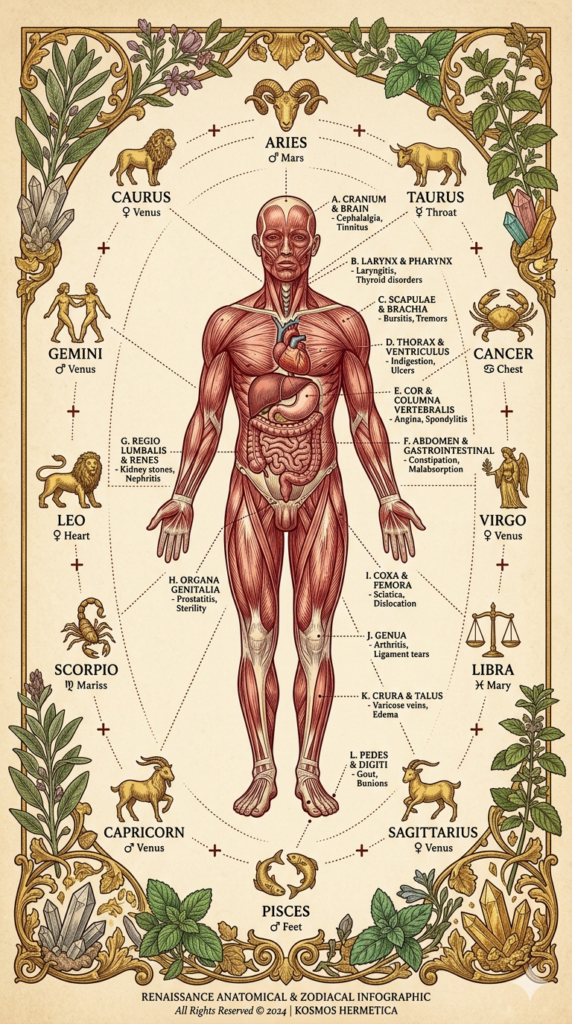
Greek astronomers organized this diverse inheritance into the structured system the Western world still uses. They divided the zodiacal band—a sixteen-degree-wide strip encircling Earth—into twelve sections of thirty degrees each, calling these divisions the Houses of the Zodiac.
The word zodiakos carries Egyptian roots: zo meaning “life” and on meaning “being.” The zodiac is therefore a literal circle of living beings—an etymology that ties Greek astronomical vocabulary directly to its Egyptian ancestry and the shared cultural foundation of the history of astrology.
How the Zodiac System Was Created and Structured
The Twelve Houses and Their Symbolic Meaning
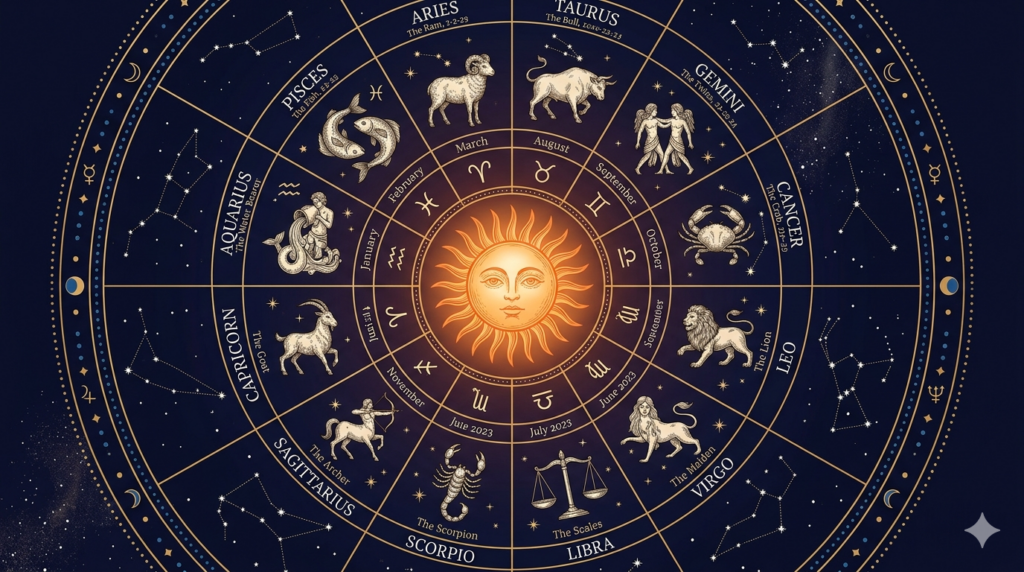
Each zodiac sign occupies a thirty-degree arc of the 360-degree ecliptic—the sun’s apparent annual path around Earth. As the sun moves through each house in sequence, the qualities ancient astronomers associated with each section gave every sign its distinctive symbolic character.
This structural architecture is precisely where zodiac signs meaning emerges—not from imagination, but from centuries of systematic celestial observation and how consciousness shapes the perception of reality.
How Zodiac Signs Were Designed, Not Imagined
The popular theory that shepherds casually traced animal shapes in the night sky dramatically underestimates the sophistication involved. Priest-astronomers deliberately selected each symbolic creature to represent the quality and intensity of the sun’s power as it occupied that zodiacal section.
The first six signs carried benevolent associations tied to warmth and growth; the second six held darker connotations coinciding with winter—a duality Persian cosmology encoded through Ahura-Mazda and Ahriman. Historical evidence suggests the zodiac’s structure may have originally differed from what we know today, reflecting a deeper pattern of cosmic intelligence embedded in its very architecture.
What Is the Precession of the Equinoxes in Astrology?
How Zodiac Signs Meaning Changes Over Time
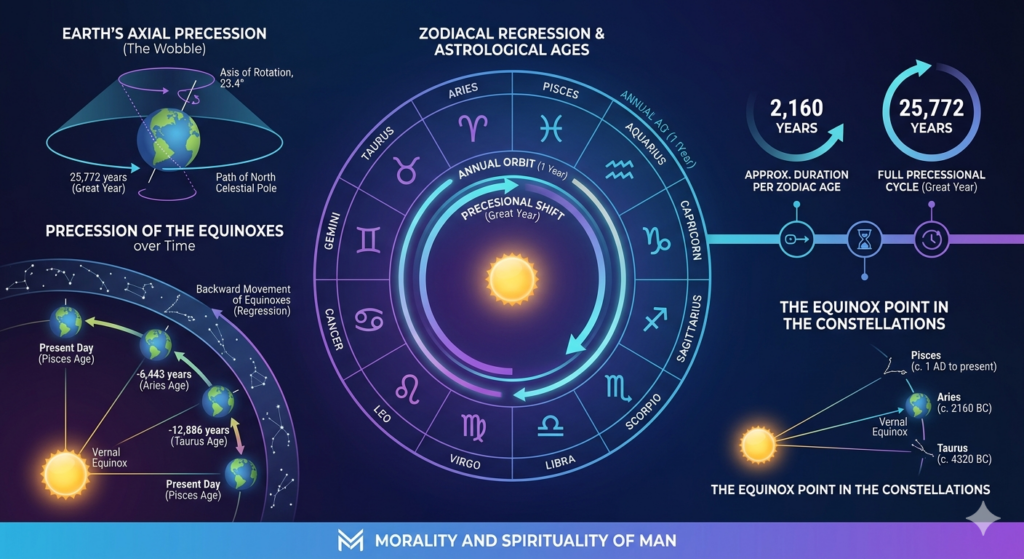
Each year the sun completes its zodiacal circuit but returns to the vernal equinox slightly behind its previous position. This regression accumulates at one degree every 72 years, shifting the sun through one complete constellation every 2,160 years.
As this precessional cycle reshapes which constellation governs each era, the meaning of zodiac signs itself evolves—the cosmic framework adapting to Earth’s slow axial wobble over a 26,000-year cycle. Some scholars also propose the zodiac originally held only ten signs, with Libra emerging when astronomers split a combined Virgo-Scorpio constellation to establish cosmic balance.
Astrological Ages Explained: Taurus, Pisces, Aquarius
During the Taurian Age, bull worship dominated religious life across the ancient world. The Piscean Age brought fish symbolism to the fore—central to early Christianity. The emerging Aquarian Age now shapes contemporary spiritual language around community, innovation, and collective awakening.
To understand how this shift connects to personal transformation, explore what spiritual awakening means in the modern age and the path of spiritual ascension in evolving human consciousness. Each age reframes how ancient peoples—and modern seekers—interpret their place in the cosmos.
Zodiac Symbolism and Its Hidden Meaning Across Cultures
Why the Number 12 Appears in Religion and Astrology
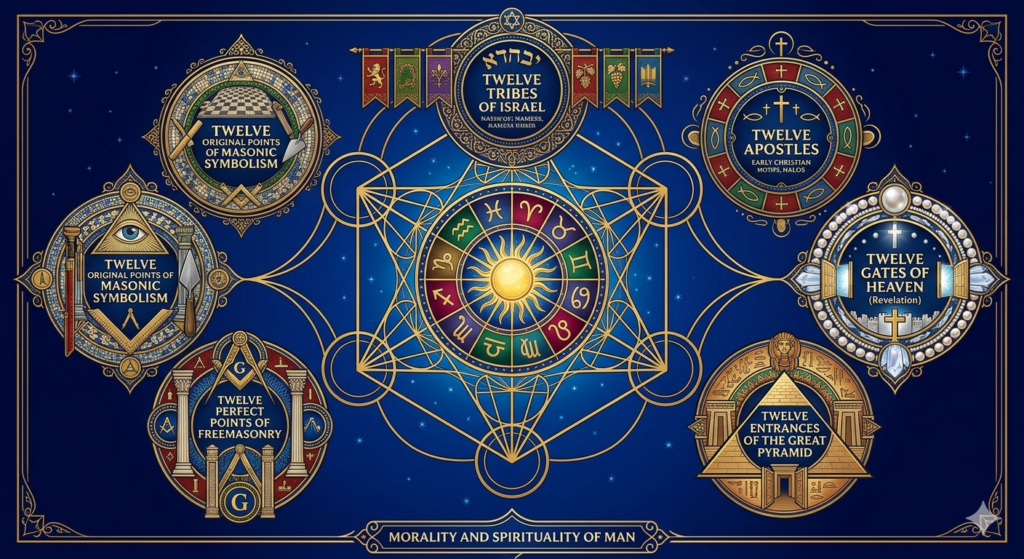
Zodiac symbolism permeated the world’s deepest spiritual systems. Albert Churchward identified the twelvefold zodiac pattern as a universal sacred structure: the twelve tribes of Israel, the twelve apostles, the twelve gates of Revelation, the twelve portals of the Great Pyramid—these are not coincidences.
They reflect a universal symbolic language through which humanity has historically understood existence. The zodiac signs meaning was therefore never confined to star charts; it was encoded into scripture, sacred geometry, and religious architecture worldwide.
Zodiac Signs as a Universal Symbolic System
Understanding the deeper meaning behind numbers in spiritual systems reveals that both the zodiac and numerological traditions draw from the same ancient well of cosmic mathematics. Both systems rely on numerical symbolism to encode invisible truths in visible form.
The zodiac was never just about stars—it was a structured system connecting human experience to cosmic intelligence, functioning as a living language of celestial symbolism that the role of human energy fields in spiritual interpretation still mirrors today.
Advanced Zodiac Structures: Decans, Duodecans, and Hidden Systems
What Are Decans in Astrology?
Ancient astronomers divided each zodiac house into three decans of ten degrees, appointing the three brightest stars in each constellation as co-rulers of that section. This subdivision reveals how astrological meaning was never flat or binary—it was granular, precise, and connected to the full spectrum of celestial movement.
How the chakra system reflects cosmic energy patterns offers a compelling parallel: just as the body is divided into energy centers, the zodiac was divided into ever-finer fields of celestial influence.
The 72 Divisions and Their Spiritual Meaning
Each decan was further halved to create 72 duodecans of five degrees each. Hebrew tradition placed a celestial intelligence over every duodecan, generating the Qabbalistic system of 72 sacred names.
These correspond to the 72 ornamental elements on the seven-branched Tabernacle Candlestick and to the 72 chosen men representing the twelve tribes of Israel—linking astronomy, scripture, and sacred architecture in a single unified system. This reveals the profound depth of ancient astrology systems that modern horoscopes only hint at.
How Zodiac Signs Meaning Relates to Personality and Destiny
Gemini, Sagittarius, and the Connection Between Astrology and Human Behavior
Gemini represents duality in its most elemental form—ancient traditions traced the twins to eggs cracked open by the Bull of Taurus, their mythological echoes persisting in Castor and Pollux, and Romulus and Remus.
Sagittarius presents the centaur: half horse, half human, aiming an arrow toward distant stars—a symbol of the spirit rising from animal nature toward consciousness. Zodiac symbolism reaches its most psychologically resonant expression in this single archetype. Using meditation to understand your inner nature offers a powerful complement to astrological self-knowledge.
Zodiac Signs and the Soul’s Journey
Greek mystics taught that the soul descends from the Milky Way through one of twelve zodiacal gates, assuming the nature of whichever symbolic creature governs that entry point. Ancient cosmology extended this framework into the arc of human life: seven planets govern seven ages of man, from the moon ruling infancy to Saturn overseeing dissolution.
Julius Firmicus Maternus preserved the classical world horoscope in his Mathesis—a planetary blueprint encoding zodiac signs and destiny as the architecture of existence itself. For a deeper exploration, see what happens after death from a spiritual perspective.
“The zodiac was never just about stars—it was a structured cosmic map connecting the human soul to the intelligence of the universe itself.”
The Enduring Power of Zodiac Signs Meaning
Ultimately, zodiac signs meaning is not simply a personality shorthand—it is a living record of humanity’s oldest attempt to understand destiny, identity, and cosmic order. From the Egyptian observatories that first mapped the heavens to the Qabbalistic names embedded in scripture, the zodiac has always been a bridge between the visible and invisible worlds.
The evolution of zodiac signs meaning reveals that the stars were never merely above us—they were always a mirror held up to the human soul, reflecting the architecture of a universe designed with intention, precision, and purpose.