
How to Control Emotions Using Awareness, Transmutation, and Inner Self Understanding

Why do you feel overwhelmed by anger, fear, or anxiety — even after years of trying to control emotions? Most people assume they are simply wired that way. They suppress, distract, or escape — and nothing changes.
Here is the truth most people never hear: your emotions are not the enemy. They are signals. They are revealing the root cause of emotions buried deep beneath the surface of your inner world — wounds, false beliefs, and unmet needs your conscious mind has never fully addressed.
In this guide, you will learn how to truly control emotions by developing emotional self awareness, discover what actually drives your reactions, and use emotional transmutation to convert emotional pain into focused personal power.
What Does It Really Mean to Control Emotions?
Controlling emotions does not mean suppressing or numbing them. It means observing, understanding, and consciously directing emotional energy — rather than reacting to it blindly.
Most people get this wrong. They believe staying calm requires feeling nothing. But real emotional control is not about becoming a stone. It is about becoming the observer of your emotions rather than being consumed by them.
When you learn to control emotions through awareness and conscious redirection, you stop being ruled by every wave of feeling that rises. You begin to use those feelings. That process begins with building emotional self awareness — the trained ability to recognize what you are feeling before it seizes control of your behavior.
To build this foundation, explore how to control your mind effectively — a critical first discipline that makes emotional mastery possible.
The Root Cause of Emotions Most People Ignore
Every emotional reaction is triggered by something deeper — old beliefs, unhealed wounds, or unmet needs. The root cause of emotions is always internal, not external.
Here is what most people miss entirely: the event outside you is only the trigger. The real root cause of emotions lives within — a limiting belief formed in childhood, a wound that was never resolved, an attachment you have never consciously examined. The outer world presses a button. But the button was already loaded.
Understanding this one truth changes everything. When you stop blaming circumstances for how you feel, you reclaim your power over your inner life.
The emotion stops being your enemy and becomes data — pointing precisely at what requires healing.
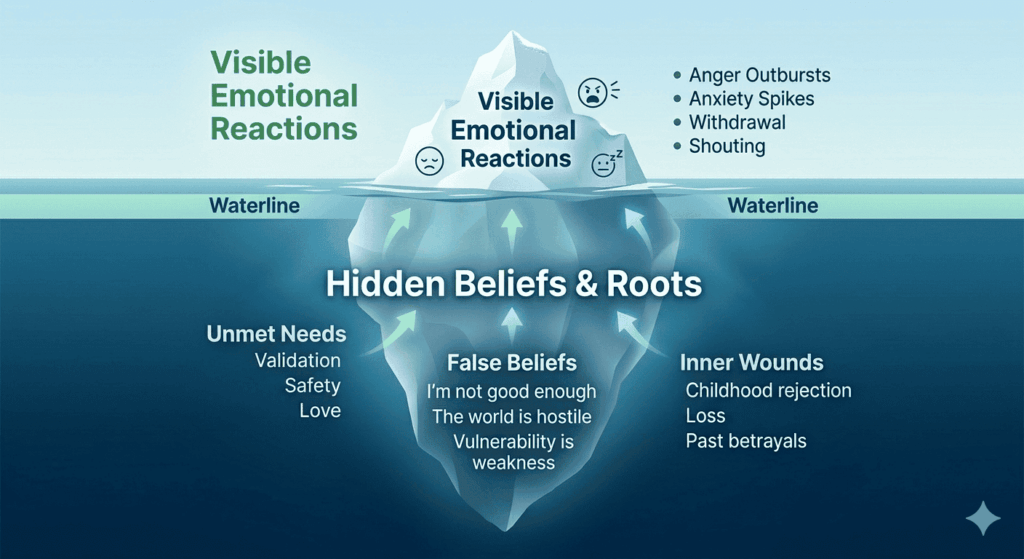
Discover how the nature of the ego and identity shapes your emotional patterns at the deepest level and learn how emotions affect your body when this root material is left unaddressed.
Emotional Triggers and Why You Overreact
Emotional triggers activate stored experiences from the past — not just what is happening right now. Your strongest reactions are rarely about the present moment alone.
When someone overreacts to a small situation, they are not responding to today. They are responding to every unresolved version of a similar moment they have carried since the past. Old material, long stored below the surface, erupts through a present trigger. The current event simply provided the opening.
This is why genuine emotional mastery requires going beneath your surface reactions to find what is stored. The body remembers everything the mind believes it has moved past.
Understand deeply how fear affects the body — one of the most pervasive hidden forces behind emotional overreaction — and explore how spiritual healing and personal growth address unresolved emotional material at its actual root.
Emotional Self Awareness: The First Step to Mastery
You cannot control emotions you are not aware of. Emotional self awareness allows you to observe emotions as they arise — without becoming them.
This is the foundational skill. Before transmutation, before somatic release, before any form of mastery — there must be awareness. Emotional self awareness is the ability to catch an emotion in the moment of its rising, before it floods your perception and hijacks your response.
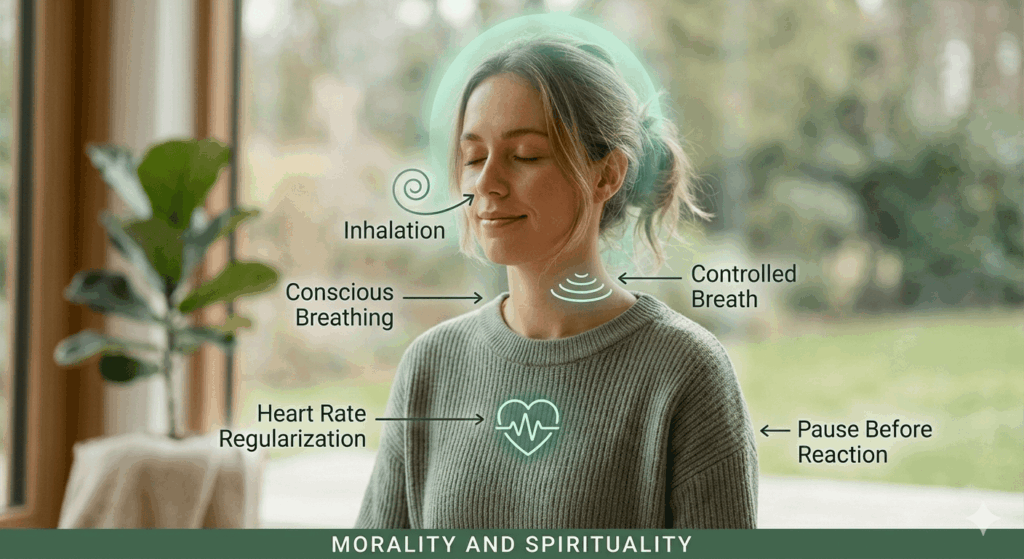
Most people collapse the gap between stimulus and reaction entirely. They feel something — and immediately become it. They are the anger.
They are the anxiety. Emotional self-awareness creates a pause between what arises and what you choose to do — and in that pause lives your freedom.
Pause and reflect: When was the last time you caught an emotion before it caught you?
This inner observation is deeply supported by understanding the mindfulness and memory connection and by learning what meditation really is beyond its surface-level misconceptions. Developing this emotional self awareness also connects powerfully to the chakra system and emotional energy, which governs how emotional forces move through and accumulate in the body.
Emotional Transmutation: Turning Pain into Power
Emotional transmutation is the process of converting negative emotional energy into constructive, creative force — not suppressing it but consciously redirecting it upward.
This is where emotional mastery moves from theory into genuine transformation. Emotional transmutation works because emotional energy is neutral at its core. It is neither inherently destructive nor inherently creative. What determines its effect is the direction and consciousness with which you engage it.
Grief, approached with awareness, can be transmuted into deep compassion. Anger, understood and redirected, becomes focused, unstoppable action. Fear, met without resistance, transmutes into precision and alerted readiness. Emotional transmutation does not deny what you feel — it elevates it into something that serves your growth.
The untrained person is ruled by emotion. The disciplined student studies it. The wise person uses emotional transmutation as a deliberate tool for evolution and self mastery.
Explore how to release negative energy safely and understand the law of vibration to see exactly why the emotional frequency you carry shapes your entire reality and what you attract into it.
Somatic Emotional Release: Letting the Body Process Emotion
Somatic emotional release allows the body to discharge stored emotional energy through breath, movement, and conscious awareness — rather than through suppression or explosive outburst.
Emotions are not only mental events. Every feeling first stirs in the emotional body, then presses directly into the nervous system, the breath, the muscles, and the glands. When emotion is neither consciously expressed nor understood, it does not simply vanish. It becomes stored in the body as chronic tension, unexplained pain, or recurring reactivity.
Somatic emotional release creates a conscious channel for that stored energy to move through. Rather than erupting outward destructively or being driven inward as suppression, the emotional charge is invited to discharge safely through breath and intentional body awareness. This is the body completing what the mind could not resolve alone.
Learn the powerful throat breathing technique as a direct tool for conscious somatic emotional release, and explore the mind body connection and your health to understand how unprocessed emotion silently shapes your physical wellbeing over time.
Practical Steps to Control Emotions in Real Time
To control emotions in real time, pause before reacting, breathe consciously, identify what you feel, trace it to its root, and redirect the energy with clear intention.
Here is a simple, repeatable process you can apply immediately in any emotionally charged moment:
- Pause — Interrupt the automatic reaction before it takes control of your response
- Breathe — Use slow, intentional breath to regulate the nervous system and create space
- Identify — Name the emotion clearly and without judgment
- Find the root — Ask: What belief, wound, or unmet need is this emotion pointing to?
- Redirect — Channel the emotional energy consciously into a constructive, chosen response
This is not a passive practice. It requires real discipline. But with consistent application, it becomes your natural default — and it fundamentally transforms how you navigate every challenge life brings.
For targeted practice, explore proven desire and anger control techniques designed to shift emotional patterns at their source rather than at their surface.
How to Use Emotions for Self Mastery
Every emotion contains instruction. When understood, emotions become precision tools for growth — not obstacles standing in the way of peace.
This realization changes everything about how you move through your inner life. When you stop fighting your emotions and start reading them as data, you reclaim enormous amounts of energy previously lost to inner conflict. You begin to extract the wisdom encoded in every feeling — and that wisdom is always pointing somewhere useful.
Insecurity points to where confidence must be deliberately built. Jealousy reveals what you genuinely desire and have not yet claimed. Fear marks the exact threshold where your growth is being demanded of you. Every emotional disturbance, approached with awareness and honest inquiry, becomes a teacher.
The power of thought and consciousness is your greatest ally in this entire process — learn to align your mental and emotional energies toward mastery rather than toward perpetual inner conflict.
Emotions are not your weakness. They are your most honest messengers. The goal was never to eliminate feeling. The goal is to become the one who feels deeply — and chooses wisely.
Frequently Asked Questions About How to Control Emotions
How can I control emotions without suppressing them?
To control emotions effectively, focus on awareness rather than suppression. Observe what you feel, identify the root cause of emotions, and consciously redirect the energy instead of resisting it. This builds emotional self awareness and prevents destructive reactions. Strengthening this skill starts with learning how to control your mind effectively, which forms the foundation of emotional mastery.
What is emotional transmutation and how does it work?
Emotional transmutation is the process of transforming emotional energy into constructive action. Instead of reacting impulsively, you channel emotions like anger or fear into focus, discipline, or creativity. This allows you to control emotions while using them as fuel for growth. To deepen this practice, it helps to understand how to release negative energy safely without suppression or emotional buildup.
What is the fastest way to manage emotional triggers in the moment?
The fastest way to control emotions during a trigger is to pause, breathe deeply, and name the emotion without judgment. Then trace it back to its root cause and consciously choose your response. This creates space between reaction and action. Practicing effective desire and anger control techniques can significantly improve your ability to stay in control during intense emotional moments.