
Atlantis Mythology: The Lost Civilization of Poseidon and the Ancient Gods
Few legends have gripped human imagination as completely as Atlantis. First recorded by the Greek philosopher Plato in Timaeus and Critias around 360 BCE, Atlantis was described as a powerful island empire located beyond the Pillars of Hercules — the modern Strait of Gibraltar.
For millennia, scholars have debated whether Plato crafted a philosophical parable or preserved the genuine memory of a vanished world. Scientists have since joined the inquiry, examining ocean geology, volcanic activity, and zoological anomalies for answers. Among the most legendary sacred places associated with ancient civilizations, none has generated more enduring fascination or deeper philosophical inquiry.
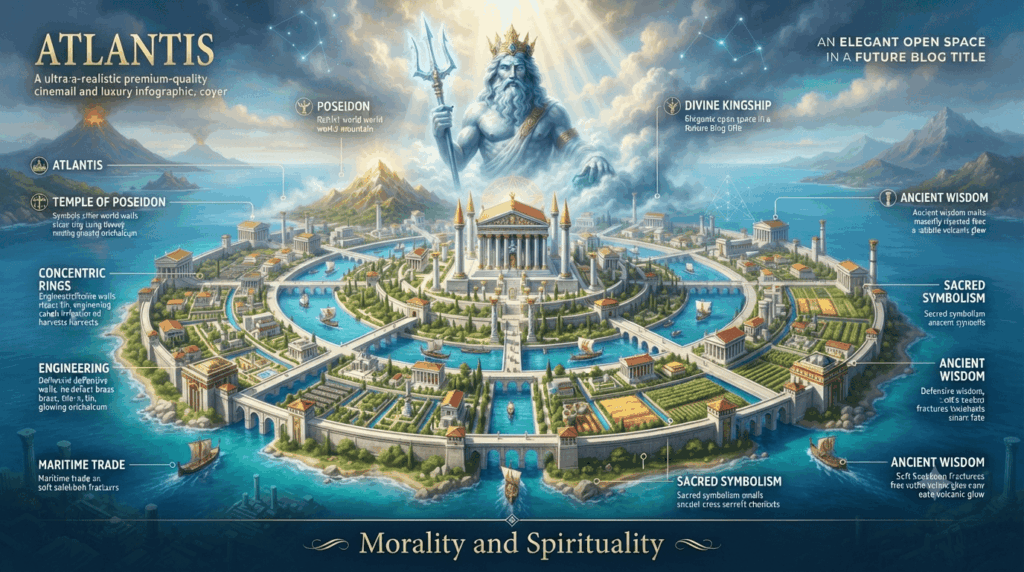
In this guide, you will discover the origins of Atlantis mythology, Poseidon’s divine kingdom, the civilization’s remarkable achievements, its catastrophic fall, and the spiritual symbolism that has shaped religious and philosophical traditions for centuries.
The Origins of Atlantis Mythology
Atlantis mythology begins entirely with Plato, who introduced the story around 360 BCE across two dialogues: Timaeus and Critias. According to Plato, the account was transmitted from Egyptian priests to the Athenian statesman Solon and passed down through successive generations. Atlantis was said to have flourished beyond the Pillars of Hercules, roughly nine thousand years before Solon’s time, as a civilization of immense power and advanced development.
Scholars remain divided on Plato’s intent. Some read the account as a moral allegory about pride and hubris; others argue it may preserve the memory of a submerged Atlantic continent destroyed by prehistoric catastrophe. This enduring debate — spanning philosophy, geology, history, and religion — is precisely what elevates Atlantis beyond a simple legend into one of antiquity’s most examined and consequential stories.
Was Atlantis a Submerged Atlantic Continent?
Scientific investigation of a possible submerged Atlantic continent gained momentum as geologists and zoologists examined the Atlantic basin. Volcanic material recovered from great depths along a region stretching from the Azores toward Iceland revealed evidence of intense prehistoric volcanic activity. The volcanic character of existing Atlantic islands further supported the possibility that a much larger landmass once occupied the region before collapsing through catastrophic eruptions.
Zoological research proposed that this lost landmass may once have connected the Iberian Peninsula with North Africa, functioning as a biological corridor. These findings do not confirm Plato’s specific claims, but they demonstrate that the question of a submerged Atlantic continent deserves serious geological inquiry rather than automatic dismissal. Whether the Atlantis story reflects a literal geological event, a historical memory, or a philosophical construction, the scientific inquiry it inspires remains genuinely productive.
Poseidon and Atlantis: The Divine Kingdom
In ancient tradition, when the gods divided the earth among themselves, Poseidon received dominion over the sea and the vast island of Atlantis. At the island’s centre lived a mortal family — Evenor, his wife Leucippe, and their daughter Cleito. After her parents died, Cleito became Poseidon’s companion, and together they produced five pairs of twin sons. The eldest, Atlas, became supreme king, lending his name to both the island and the surrounding ocean.
Poseidon then reshaped the central mountain into a series of concentric rings of alternating land and water, supplied by warm and cold natural springs. Within Atlantis mythology, this divine arrangement was simultaneously architectural and cosmological — a physical expression of sacred order.
The union of Poseidon and Atlantis, forged through his bond with Cleito, became the founding myth of an entire royal lineage and the spiritual justification for its authority over the known world.
The Lost Civilization of Atlantis and Its Remarkable Engineering
The lost civilization of Atlantis distinguished itself through extraordinary feats of engineering. Bridges connected the concentric land rings while canals linked the capital directly to the open sea, enabling oceanic trade at the empire’s heart. An elaborate irrigation network watered the surrounding plain, yielding two harvests each year. Defensive walls encased each ring, adorned with successive layers of brass, tin, and the precious metal orichalcum.
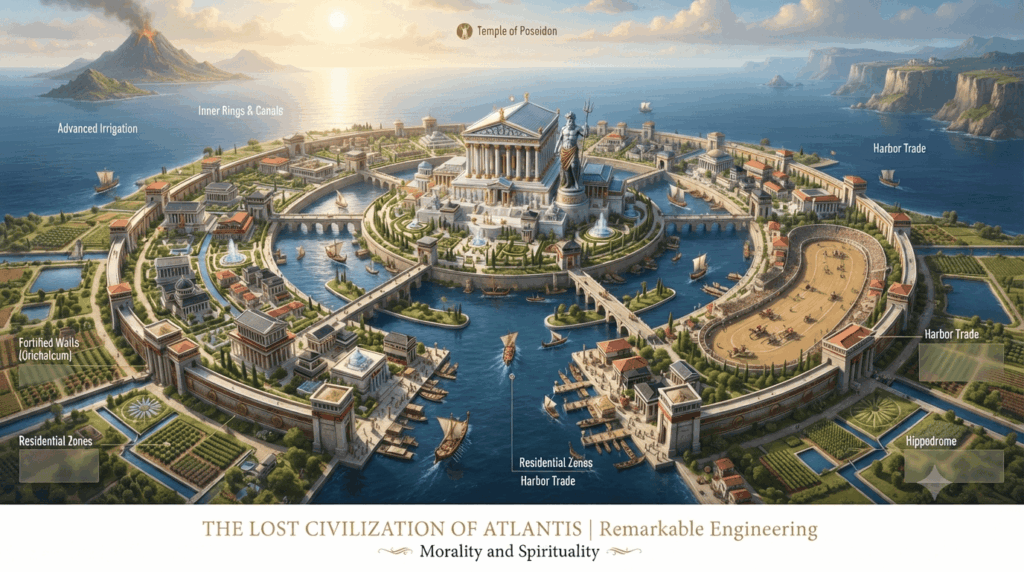
Stone quarried in white, black, and red furnished magnificent temples, harbours, and public structures. Gardens, athletic grounds, baths, and a vast horse-racing course reflected a civilization of exceptional sophistication. Ships from distant maritime nations crowded the harbour.
Atlantis mythology’s account portrays an empire where natural abundance, disciplined governance, and divine heritage combined to create a civilization without rival in antiquity. At its spiritual crown stood the legendary Temple of Poseidon.
The Temple of Poseidon
The Temple of Poseidon was Atlantis’s supreme architectural achievement. Silver sheathed its exterior; golden pinnacles crowned the structure above. Inside, among the most breathtaking examples of ancient sacred architecture and occult sites ever described, walls and columns were adorned in ivory, gold, silver, and orichalcum.
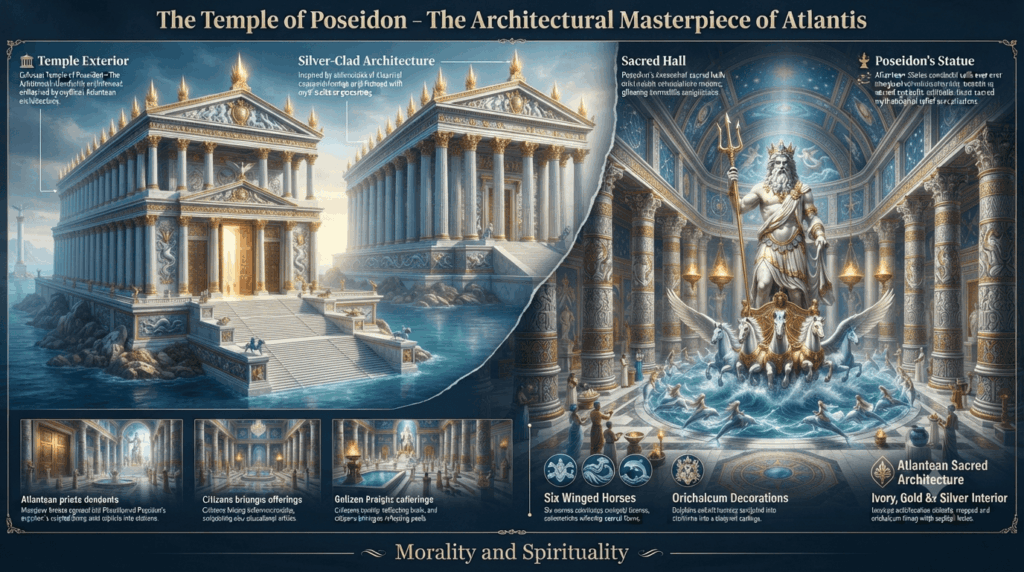
A colossal statue of Poseidon driving a chariot of six winged horses, encircled by one hundred Nereids riding dolphins, dominated the hall.
Government, Laws, and the Ten Kings
The lost civilization of Atlantis was governed as a federation of ten kingdoms. A sacred constitution, engraved upon an orichalcum pillar in the Temple of Poseidon, regulated their collective conduct. At regular intervals, all ten kings assembled to renew oaths, perform solemn sacrifice, and render collective judgment. Clothed in ceremonial azure robes, they recorded decisions on golden tablets.
Their constitution prohibited warfare between kingdoms, required mutual defence, and demanded majority approval before any king could condemn a fellow royal. Law, cooperation, and collective accountability — rather than personal ambition — defined this political order, and it functioned brilliantly until prosperity slowly eroded the divine character the founders had established.
The Fall of Atlantis: Pride, Corruption, and Divine Judgment
As generations passed, the divine nature of Atlantis’s rulers diluted into mortal pride and ambition. Prosperity bred corruption. Rather than preserving ancestral justice, the kings pursued conquest and launched campaigns against the Greek states in pursuit of global domination.
Zeus, witnessing this collapse, assembled the gods in council. The consequences of moral decline — which the pursuit of moral clarity between good and evil has warned against across traditions — proved catastrophic. In Atlantis mythology, divine judgment arrived as violent earthquakes and overwhelming floods that struck in a single day and night.
The island sank beneath the ocean; the earth swallowed its armies. What ambition had built, corruption destroyed in an instant.
Atlantis as a Spiritual and Philosophical Allegory
Beyond history, Atlantis mythology functions as a richly layered philosophical allegory. The ten kings embody sacred principles explored through Pythagorean Tetractys and sacred number symbolism, arranged as five complementary pairs of opposites governed by the Monad — the supreme unity. Whether interpreted as the literal memory of a submerged Atlantic continent or as pure philosophical symbolism, this numerical structure reveals a cosmological design embedded in the story’s architecture.
The sinking represents far more than physical destruction. It symbolises the descent of spiritual consciousness into material existence — cosmic involution preceding conscious spiritual evolution and return to divine awareness. This mirrors the Biblical expulsion from Eden: the same archetypal fall from divine wholeness into mortal experience.
The sacred mountain at Atlantis’s centre corresponds to Olympus, Meru, and Asgard — the universal world mountain of every major tradition. Its summit, the City of the Golden Gates, anticipates later visions of the Holy City and the New Jerusalem with its golden streets. The cross and the serpent — Atlantis’s enduring sacred symbols — belong to the larger family of universal spiritual symbols and their deeper meanings found across every sacred tradition.
Atlantis and Its Influence on Ancient Traditions
The lost civilization of Atlantis is portrayed in ancient tradition as the fountainhead of humanity’s earliest religious and philosophical wisdom. Enlightened initiate-priests travelled from its golden temples across the world, founding pyramids, sanctuaries, and ceremonial centers modeled on the City of the Golden Gates. They carried teachings that advanced the evolution of higher human consciousness across Egypt, Mesoamerica, and beyond.
Chaldean traditions describe Oannes — a sage who emerged from the sea to teach writing, agriculture, astronomy, and sacred mysteries. Mesoamerican accounts of Quetzalcoatl mirror this pattern almost exactly. The sacred wisdom these teachers deposited in Egypt eventually flowed into the hidden wisdom preserved through Jewish Qabbalah, reflecting a continuous esoteric current connecting Atlantis to the world’s great mystery traditions.
Conclusion
Atlantis mythology endures not because humanity craves a lost paradise, but because the story reflects something permanently true about civilization. It shows the heights achievable through wisdom, cooperation, and divine inspiration — and the ruin that follows the misuse of spiritual knowledge and destructive magical practices.
Whether Atlantis was a literal continent or a philosophical allegory matters far less than the moral it carries: pride undoes what wisdom builds. Its symbols — the sacred mountain, the golden temple, the divine king fallen from grace — remain as urgent today as when Plato first set them down. The ocean may have consumed Atlantis, but the lesson it preserves has never sunk.
Frequently Asked Questions About Atlantis Mythology
What is Atlantis mythology?
Atlantis mythology refers to the body of legend, philosophy, and symbolism surrounding the lost island civilization first described by Plato in Timaeus and Critias around 360 BCE — encompassing historical debate, esoteric allegory, and enduring moral teaching.
Was Atlantis a real civilization?
Scholars and scientists continue debating whether a submerged Atlantic continent ever existed. Geological and zoological evidence offers partial support, but no definitive proof has confirmed Plato’s account.
Who ruled Atlantis?
Poseidon and Atlantis were bound from the civilization’s founding. The sea god fathered ten kings through the mortal Cleito. Atlas, the eldest, became supreme ruler and gave the island and ocean their names.
Why did Atlantis sink?
Plato attributes its destruction to moral corruption among the rulers and divine judgment by Zeus, manifesting as catastrophic earthquakes and floods that consumed the entire island in a single day and night.
What does Atlantis symbolise?
Atlantis symbolises the descent of spiritual consciousness into material existence, the dangers of pride and unchecked ambition, and the preservation — and eventual loss — of ancient divine wisdom.
Where was Atlantis believed to be located?
Plato placed the lost civilization of Atlantis beyond the Pillars of Hercules — broadly interpreted as the Atlantic Ocean, west of the modern Strait of Gibraltar.