
Jewish Qabbalah: Meaning, Origins, Teachings, and the Secret Doctrine of Israel
Jewish Qabbalah (also spelt Kabbalah) is the mystical tradition of Judaism that seeks to explain the hidden relationship between God, humanity, and creation. While the Torah teaches divine law, Qabbalistic teachings explore the deeper spiritual meanings believed to exist beneath the literal text.
For centuries, mystics, philosophers, and scholars have studied Jewish Qabbalah to understand consciousness, symbolism, divine emanation, and the soul’s journey toward spiritual perfection. Whether you encounter it spelt Kabbalah or Qabbalah, the tradition itself points toward one destination: the hidden wisdom at the heart of existence.
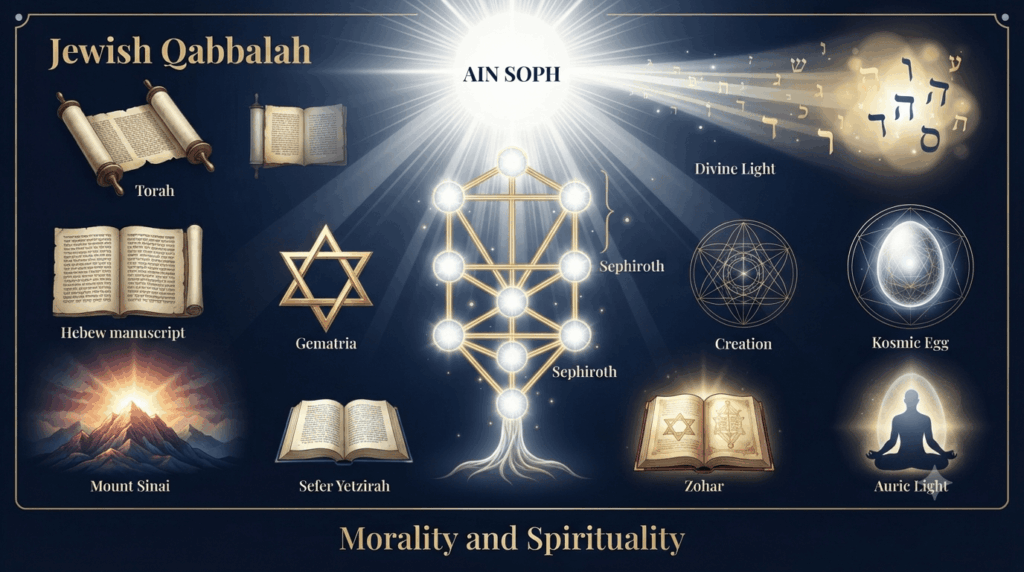
In this guide, you’ll discover the meaning and origins of Jewish Qabbalah, its sacred texts, the Tree of Life, Qabbalistic teachings, mystical methods such as Gematria, and the profound symbolism that has shaped Jewish mysticism and Western spiritual traditions for centuries.
What Is Jewish Qabbalah?
Jewish Qabbalah is the highest and most secret branch of Hebrew theology — described by its own tradition as “the soul of the soul of the law.” While standard religious instruction gave the Jewish people the written Torah, and the Mishna offered a deeper layer of meaning to rabbis and scholars, Qabbalah was reserved exclusively for the most advanced spiritual initiates.
Its purpose was radical: to reveal the deepest truths about God, the structure of the universe, and the inner nature of the human soul.
What separates Jewish mysticism from mainstream Judaism is this orientation toward direct inner experience rather than outward observance alone. Where Judaism emphasises law, ethics, and community practice, Jewish Qabbalah turns inward — toward divine light, hidden symbolism, and the soul’s origins. Both are expressions of the same tradition, but Qabbalah operates in the space beneath the surface of scripture, seeking what the literal words alone cannot convey.
The Origins of Qabbalah
Traditional Belief
According to Jewish mystical tradition, the origins of Qabbalah trace back to divine revelation itself. Moses ascended Mount Sinai three times, each time remaining for forty days. During the first ascent he received the written Law; during the second, the inner meaning of the Law; and during the third, the secret doctrines of Qabbalah. Rather than recording these mysteries openly, Moses concealed them symbolically within the first four books of the Pentateuch.
Earlier still, tradition holds that God first taught Qabbalistic principles to the angels before humanity’s fall. These heavenly beings later transmitted this knowledge to Adam, enabling humanity to recover its lost spiritual state. Successive patriarchs — including Shem, Isaac, and David — received this hidden wisdom through specific angelic instruction, preserving it across generations.
Historical Scholarship
Academic scholars generally place the formal development of Qabbalistic literature between the 1st and 13th centuries CE, with foundational texts emerging in medieval Jewish communities across Spain, southern France, and the Middle East. While the tradition claims ancient and even divine origins, historians view it as an evolving mystical system shaped by Neoplatonic philosophy, Gnostic influences, and centuries of Jewish theological reflection.
Both perspectives can coexist: the tradition points toward eternal wisdom; scholarship traces how human beings organised, preserved, and transmitted it.
What Does Qabbalah Mean?
The word Qabbalah means “the received tradition” or, more evocatively, “the hidden wisdom.” It refers specifically to the unwritten teachings passed down through initiation — doctrines too sacred or too easily misunderstood to be committed openly to text.
This Qabbalah meaning carries a dual sense: received, because it was transmitted directly from teacher to student; and hidden, because it was deliberately concealed within symbol, allegory, and number. The Torah, on this reading, contains “books within books” — layers of meaning inaccessible to literal reading alone.
For anyone interested in symbolic meanings and how sacred texts encode deeper truths, Qabbalah offers one of history’s most sophisticated systems for doing exactly that.
The Sacred Books of Jewish Qabbalah
Three texts form the literary bedrock of Qabbalistic tradition.
Sefer Yetzirah (Book of Formation)
One of the oldest surviving Qabbalistic texts, the Sefer Yetzirah explores how God created the universe through the twenty-two letters of the Hebrew alphabet and the ten primordial numbers known as Sephiroth. It presents creation as an act of divine language — not raw power, but structured, symbolic speech.
Zohar (Book of Splendour)
The Zohar is the most celebrated and influential of all Qabbalistic works. Written largely in Aramaic, it takes the form of a mystical commentary on the Torah, weaving together narrative, allegory, and deep cosmological speculation. For many practitioners, the Zohar is to Kabbalah what the Talmud is to rabbinic Judaism — essential, authoritative, and inexhaustible.
The Book of Revelation (Apocalypse)
Though its authorship and precise dating remain subjects of scholarly discussion, this text is regarded within certain Qabbalistic schools as a key source of cosmological and prophetic teaching, connecting Jewish mysticism to broader streams of esoteric thought in the ancient world.
Together, these three works became the principal sources from which Qabbalistic philosophy and mystical speculation were drawn across the centuries.
The Five Branches of Qabbalistic Teachings
Qabbalistic science was organised into five distinct branches, each addressing a different dimension of existence.
| Branch | Purpose | Modern Understanding |
|---|---|---|
| Natural Qabbalah | Exploring the hidden mysteries of nature and the physical world | Parallels systems thinking, ecology, and natural philosophy |
| Analogical Qabbalah | Demonstrating the unity of creation and the correspondence between humanity and the universe | Reflects the Hermetic principle “as above, so below” |
| Contemplative Qabbalah | Seeking knowledge of higher spiritual realities through intellectual and mystical contemplation | Aligns with mindfulness practice and meditative traditions |
| Astrological Qabbalah | Examining the spiritual nature and influence of celestial bodies | Connects to astrology, sacred astronomy, and cosmic cycles |
| Magical Qabbalah | Healing, talismans, invocations, and interactions with invisible spiritual intelligences | Related to psychic energy and hand signal traditions across esoteric schools |
Taken together, these five branches reveal Qabbalah’s comprehensive ambition: to understand creation, humanity, and the hidden laws governing both the visible and invisible worlds.
Qabbalistic Cosmogony Explained
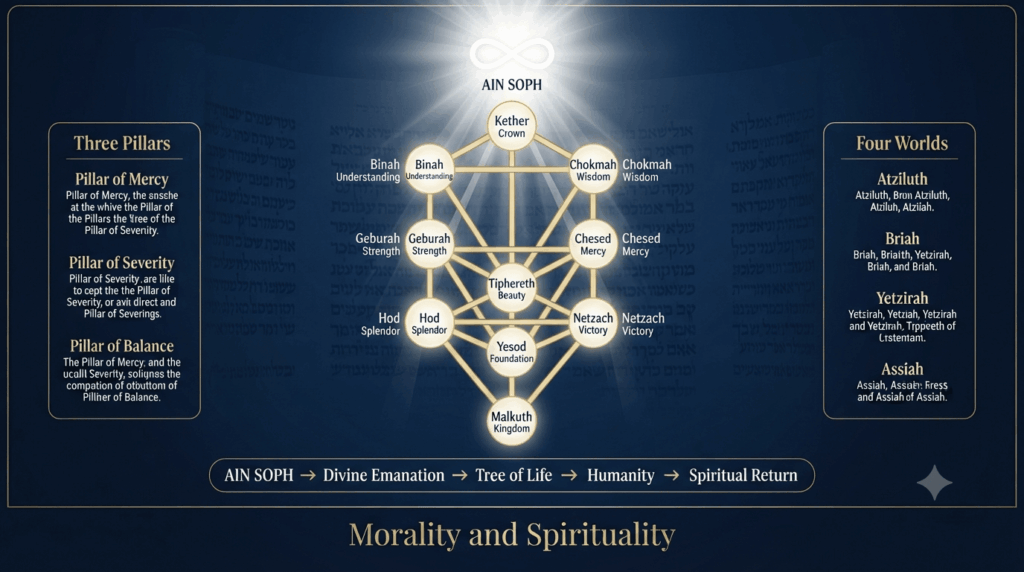
AIN SOPH: The Infinite Absolute
At the foundation of Qabbalistic cosmology stands AIN SOPH — the infinite, eternal, and incomprehensible Absolute that exists beyond all human definition. The Qabbalists describe it by eliminating every conceivable attribute: it is neither substance, essence, intelligence, nor gender. It simply is — the limitless ground of all being. Symbolised by a closed eye and a perfect circle, AIN SOPH contains the potential for all creation within its boundless silence.
The First Point: Creation Begins
Creation begins not with an outward explosion but with an inward withdrawal. AIN SOPH contracts toward its own centre, and from this act of divine self-limitation, the first point of manifestation appears. This first point becomes the source from which divine light radiates outward, giving rise to all worlds and spiritual hierarchies.
Divine Light and the Cosmic Egg
The withdrawal of AIN SOPH creates a primordial space filled not with emptiness but with a subtle, crystalline divine light from which creation unfolds. The entire process takes place within what Qabbalists call the Kosmic Egg — the circular boundary within which all cycles of birth, growth, decay, and dissolution occur.
The Auric Egg and Return to Source
Mirroring the Kosmic Egg is the Auric Egg — the ovoid field of consciousness surrounding every human being. Just as the Kosmic Egg contains the universe, the Auric Egg contains the latent powers of the individual soul. The interplay between the human aura and personal consciousness is central to understanding Qabbalistic anthropology.
Human consciousness concentrates into the Ego just as divine consciousness concentrates into that first point of creation. Through successive lifetimes — births, deaths, and rebirths within this Auric Egg — the soul evolves until it transcends the Wheel of Necessity and reunites with its divine source. Understanding this process is also the beginning of true self realization.
The Three Mystical Keys of Interpretation
The deeper meanings within the Torah are accessed through three classical interpretive methods.
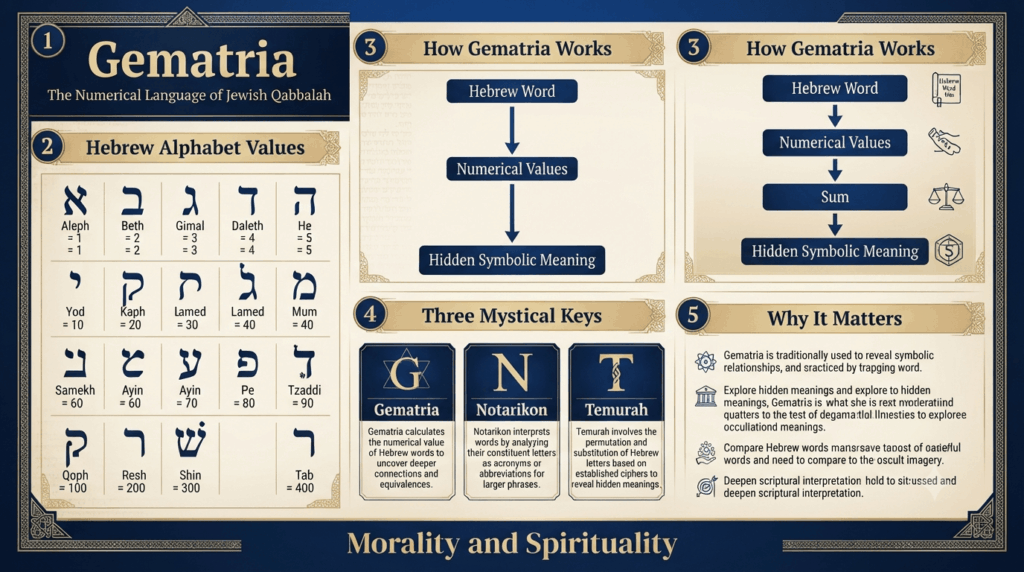
Gematria
Gematria uncovers hidden meaning through the numerical values assigned to Hebrew letters and words. When two words share the same numerical value, a conceptual relationship is implied between them — revealing connections invisible to ordinary reading. This makes Qabbalah one of the earliest and most sophisticated systems of sacred numerology; a full numerology guide can help illuminate how number-based interpretation has shaped spiritual traditions globally.
Notarikon
Notarikon derives new words and meanings from the initial or final letters of a series of words, or expands a single word into a complete phrase by treating each letter as the first letter of a new word. It is a system of sacred abbreviation, compressing entire teachings into single terms.
Temurah
Temurah reveals symbolic truths through the systematic substitution or rearrangement of Hebrew letters. By applying specific cipher systems, Qabbalists decode alternative readings of scriptural passages, uncovering layers of meaning that the plain text does not show. For anyone exploring understanding symbols in religious literature, Temurah offers a striking example of how encoding and decoding shape sacred language.
Adam and Eve as Spiritual Symbols
In Qabbalistic interpretation, the account of Adam and Eve is not a historical record but a profound spiritual allegory about human consciousness. Eve represents the material, emotional, and mortal dimension of human nature that emerges from the greater spiritual being symbolised by Adam. The expulsion from Eden signifies the descent of consciousness from the realm of divine truth into material existence — a fall into forgetfulness rather than punishment for sin.
The deeper implication is that human relationships carry spiritual significance: they reflect soul-level patterns playing out in physical life. Redemption comes not through obedience alone, but through wisdom, self-knowledge, and spiritual awakening.
Masculine and Feminine Energies
Among the most compelling elements of Qabbalistic anthropology is its treatment of gender as a spiritual principle. The original human soul, in this tradition, was androgynous — containing both masculine and feminine aspects in perfect unity. The physical separation into male and female bodies represents a step down in manifestation rather than an original design.
One interpretation teaches that the soul was divided into complementary halves, giving rise to the concept of soul mates seeking reunion across successive lifetimes. Another view holds that every individual remains spiritually androgynous, with one polarity becoming dormant in physical existence. Spiritual growth gradually reawakens the dormant half, restoring inner wholeness.
This is the deeper significance of polar opposites in Qabbalistic thought: masculine and feminine are not opposites in conflict, but complementary poles of a single spiritual reality seeking reunion.
The Spiritual Meaning of the Garden of Eden
The Garden of Eden in Qabbalistic symbolism is the House of the Mysteries — a metaphor for the state of divine consciousness from which the soul descends into material life. The Tree of Life and the Tree of the Knowledge of Good and Evil represent stages of spiritual initiation rather than literal trees.
The serpent, often read as the villain of the story, is reinterpreted in Qabbalah as an angel of awakening — an adversary whose role was not to destroy but to provoke the soul into growth. This reframing aligns with the Qabbalistic principle that adversity is the catalyst for enlightenment, and that third eye awakening comes not through comfort, but through the courageous encounter with one’s own ignorance.
How Jewish Qabbalah Influenced Western Mysticism
The reach of Jewish Qabbalah extends far beyond the Jewish community. During the Middle Ages and Renaissance, it profoundly shaped the development of Christian mysticism, alchemy, Hermeticism, Rosicrucianism, and Freemasonry. Scholars fascinated by the hidden meaning of Scripture turned to Qabbalistic methods to unlock what they believed were universal spiritual truths.
Esoteric Christianity drew heavily on Qabbalistic frameworks — especially the Tree of Life, the Sephiroth, and divine emanation. Modern spirituality continues to echo Qabbalistic ideas about consciousness and the power of thought as a creative spiritual force.
Common Misconceptions About Qabbalah
Is Qabbalah magic? The Magical branch of Qabbalah exists, but it represents one of five branches — not the whole tradition. Most Qabbalistic study focuses on theology, cosmology, and inner transformation.
Is it a religion? Qabbalah is a mystical tradition within Judaism, not a separate religion. It supplements rather than replaces Jewish practice and belief.
Can anyone study it? Historically, Qabbalah was reserved for mature, advanced students. Today, its texts are widely available, though serious practitioners emphasise the need for a qualified teacher.
Is it the same as occultism? Qabbalah influenced many Western occult traditions, but it originated as a purely spiritual and theological discipline within Jewish thought.
Does it replace Judaism? No. Qabbalah deepens engagement with Jewish teaching rather than superseding it.
Frequently Asked Questions
What is Jewish Qabbalah?
Jewish Qabbalah is the mystical branch of Judaism concerned with the hidden meanings of Scripture, the nature of God, the structure of creation, and the spiritual evolution of the human soul.
What is the Tree of Life?
The Tree of Life is the central diagram of Qabbalistic cosmology — a map of ten divine attributes (Sephiroth) through which God manifests creation and through which the human soul ascends toward reunion with its source.
What does AIN SOPH mean?
AIN SOPH means “without end” — the infinite, unknowable Absolute that precedes and underlies all of creation. It is neither a being nor a concept; it is pure, boundless existence.
Why is it called a secret doctrine?
Because its teachings were historically transmitted only to advanced initiates who had demonstrated the maturity and moral development necessary to receive them without misuse or misunderstanding.
Conclusion: The Living Relevance of an Ancient Tradition
Jewish Qabbalah is not a relic. It is a living system of thought that asks the questions every serious seeker eventually faces: Who am I beneath the surface? What is the relationship between my inner life and the cosmos? How do I move from ignorance to wisdom?
The Qabbalistic tradition answered these questions through cosmology, symbol, number, and allegory — building a complete map of consciousness that has guided mystics, philosophers, and spiritual practitioners across three thousand years and counting.
That map is still available. The only question is whether you are willing to read it.
Continue your exploration of these living traditions:
- Spiritual Ascension Path Guide — Understand the soul’s upward journey
- Desire and Anger Control — Master the lower nature the Qabbalists described
- How to Cultivate Moral Living — Align your life with ethical spiritualism
- Spiritualism Ethics Moral Guide — Explore the intersection of spirit and responsibility.