
Esoteric Christianity: Hidden Teachings of Jesus and the Universal Christ
Millions of people have encountered Christianity through its official doctrines, sacraments, and canonical Gospels. Yet a parallel tradition has always existed beneath the surface—one that interprets the life and mission of Jesus of Nazareth as a profound initiatory mystery rather than a straightforward historical account. This tradition, broadly known as Esoteric Christianity, holds that Christ’s deepest teachings were never fully recorded in public scripture but preserved within secret brotherhoods, Mystery Schools, and initiatory communities.
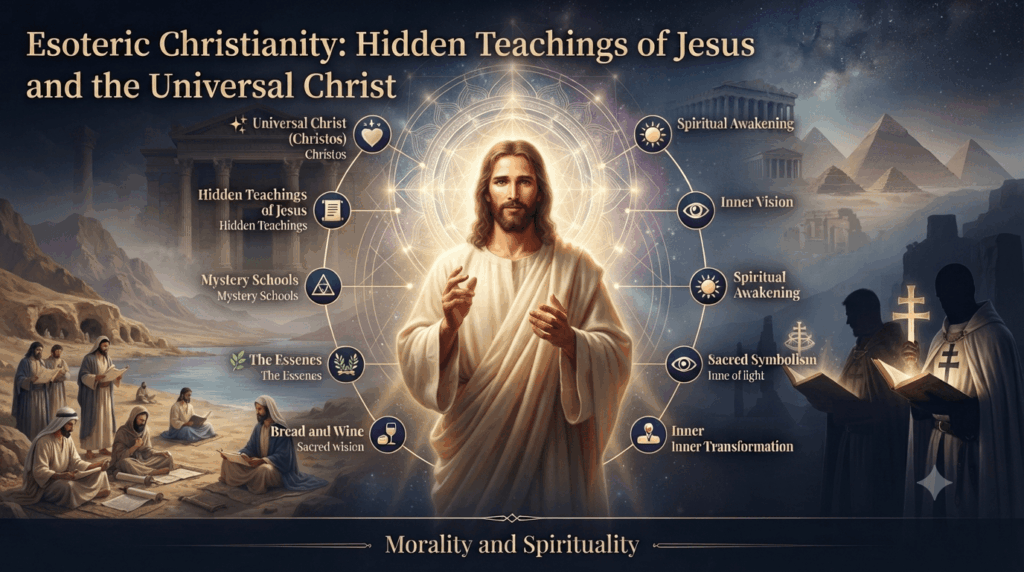
In this guide, you’ll discover the origins of Esoteric Christianity, explore the hidden teachings of Jesus, examine the role of the Essenes and ancient Mystery Schools, understand the distinction between Jesus and the Universal Christ (Christos), and uncover the symbolic meanings behind the Gospel narrative. Whether you’re interested in Christian mysticism, comparative religion, or spiritual symbolism, this article offers a balanced exploration of the historical traditions, esoteric interpretations, and philosophical ideas that have shaped this enduring spiritual path
What Is Esoteric Christianity?
Esoteric Christianity explores the inner, hidden dimensions of Christian teaching. Where mainstream Christianity emphasises institutional faith, doctrinal belief, and external ritual, esoteric Christianity focuses on direct spiritual experience, symbolic interpretation, and the transformation of consciousness through Gnosis — direct inner knowing.
The tradition maintains that Jesus taught two distinct bodies of wisdom: exoteric teachings presented publicly through parables, and esoteric teachings reserved for initiated disciples. This distinction appears within the canonical Gospels themselves, where Jesus tells his inner circle that they have been given the mysteries of the kingdom. Mystic Christianity regards these mysteries as the true heart of Christ’s mission.
| Feature | Mainstream Christianity | Esoteric Christianity |
|---|---|---|
| Source of authority | Scripture and Church | Inner experience and initiation |
| Interpretation | Literal and doctrinal | Symbolic and allegorical |
| Salvation | External grace through faith | Inner awakening of the Divine Self |
| Jesus | Unique divine savior | Revealer of the universal Christ principle |
Origins of Mystic Christianity
The roots of esoteric Christianity reach deep into the ancient world. Early Christianity developed within a Mediterranean culture saturated with mystery schools, initiatory cults, and philosophical traditions that shaped its language and symbolism.
Justin Martyr, one of the earliest Christian apologists, openly acknowledged that beliefs surrounding Christ’s birth, crucifixion, and resurrection paralleled traditions found in Greco-Roman religion. He argued that Christianity fulfilled universal spiritual truths already reflected across multiple faiths.
Early Church debates also reveal that the chronology of Jesus’ life was far from settled. St. Irenaeus, the second-century Bishop of Lyons, challenged the popular account that Jesus died at approximately thirty-three years of age — arguing, based on apostolic tradition, that Jesus continued teaching into a significantly more mature stage of life. This contested chronology suggests that “thirty-three years” is a symbolic figure encoding the stages of spiritual ascension rather than verified biography.
Jesus and the Hidden Teachings
Alternative traditions describe a Jesus who travelled and studied in Greece, India, Tibet, and Ceylon before beginning his public ministry. These accounts suggest that significant Eastern philosophical influence shaped his teaching — a claim that aligns with the notable parallels between the Sermon on the Mount and Buddhist ethical instruction.
Some traditions also preserve accounts of more than one religious teacher named Joshua during the same period, potentially explaining inconsistencies within the Gospel accounts. The secret teachings of Jesus, in this framework, concern the awakening of the indwelling divine nature — a truth available to every soul willing to undertake the inner work of transformation.
The Essenes and Ancient Mystery Schools
No group is more central to esoteric Christianity than the Essenes. These ascetic Jewish communities devoted themselves to prayer, meditation, communal living, healing, and graded initiatory degrees. Their emphasis on the immortality of the soul and sacred knowledge directly parallels Eastern spiritual schools — leading many traditions to regard them as the primary educators and initiators of Jesus. Their use of builders’ symbols and commitment to esoteric knowledge also established enduring connections with later Freemasonry and Western esoteric traditions.
Within this framework, Joseph and Mary were devout Essene initiates who consciously prepared to bring forth a great spiritual teacher. The Immaculate Conception, esoterically understood, signifies this spiritual preparation rather than a supernatural biological event. Exploring understanding soul immortality deepens the Essene teaching that the soul does not perish but continues its journey toward divine reunion.
Jesus and the Universal Christ (Christos)
One of the most important distinctions in esoteric Christianity is between Jesus — the historical teacher — and Christos — the universal divine principle present within every human being. The word “Christ” is not a surname but a title derived from the Greek Christos, meaning “the anointed one.”
Christos represents the eternal spiritual Self, the Divine Mind, the inner light that every soul carries at its core. Jesus is the revealer and embodiment of this principle, not its exclusive owner. This distinction mirrors the journey of awakening your true self — recognising that beneath the ego lies an eternal divine nature.
Salvation, in this understanding, is not an external transaction but an inner awakening — the resurrection of the Christos within the individual through inner spiritual transformation. Early Christian mystics understood being “born again” as a profound renewal of consciousness, not a one-time declaration. Connecting with the Divine Mind and higher consciousness opens this transformative process.
The Gospel as Spiritual Allegory
Esoteric Christianity interprets the Gospel narrative as an initiatory allegory encoding the universal journey of the soul. The birth, ministry, crucifixion, resurrection, and ascension of Christ illustrate stages of inward development available to every sincere seeker — not merely events that occurred once in history.
The traditional thirty-three years of Jesus’ life symbolise successive degrees of spiritual initiation: death represents the ego’s surrender; resurrection symbolises the awakening of the Divine Self; ascension represents the soul’s return to its eternal source. This allegorical reading adds a deeper layer of meaning, transforming the Gospel from biography into a living map of consciousness.
Symbolism within Esoteric Christianity
Symbolic language runs throughout the esoteric tradition. The sacred monogram IHS, the bread and wine of the Last Supper, and the priestly order of Melchizedek all carry layers of meaning beyond their surface appearance. The Last Supper’s ritual directly parallels the offerings of Melchizedek described in Genesis — connecting Jesus to an ancient lineage of spiritual priesthood.
Early Christian writers also drew parallels between Christ and Dionysus, recognising that identical spiritual truths manifest across many traditions. Decoding ancient esoteric symbolism reveals this inherited symbolic depth, while developing spiritual insight opens the inner eye capable of perceiving it.
Mystic Christianity and the Early Church
The Knights Templar stand as one of the most historically significant custodians of esoteric Christian tradition. Through initiation into the mysteries of the Essenes, Nazarenes, Johannites, and other mystical communities of the Holy Land, the Templars acquired sacred knowledge that threatened orthodox authority. Many historians associate their persecution — ordered by King Philip IV of France and Pope Clement V in the early fourteenth century — directly with this hidden knowledge.
Inconsistencies among the writings of the early Church Fathers further support the esoteric claim that official Christianity was shaped by politics and theological debate rather than direct historical knowledge. Alternative accounts were suppressed, and the rich diversity of early Christian mystical thought was gradually narrowed into a single official doctrine.
Lessons for Modern Spiritual Seekers
Esoteric Christianity offers modern seekers a transformative framework — a shift from passive belief to active inner work, from inherited doctrine to direct spiritual experience.
The core message is universal: within every human being lives a divine spark — the Christos, the inner Christ, the true Self — waiting to be awakened. The life of Jesus demonstrates the path: purification, initiation, service, surrender, and union with the Eternal. Whether approached through contemplative prayer, study of the ancient Mysteries, or the symbols embedded in Christian scripture and art, esoteric Christianity ultimately points toward one destination — the realisation of the divine nature within, and the soul’s conscious return to its eternal source.
Frequently Asked Questions
What is the difference between esoteric and mainstream Christianity?
Mainstream Christianity emphasises doctrinal belief, institutional authority, and external ritual. Esoteric Christianity focuses on direct inner experience, symbolic interpretation of scripture, and awakening the divine nature within each individual.
What is Christos or the Universal Christ?
Christos is Greek for “the anointed one.” In esoteric Christianity, it refers to the universal divine principle within every human soul — the eternal spiritual Self that Jesus revealed and embodied, not a title exclusive to him.
Who were the Essenes?
Ascetic Jewish initiatory communities devoted to prayer, healing, and sacred knowledge. Many esoteric traditions regard them as the community that educated and initiated Jesus, preserving ancient Mystery School wisdom that deeply shaped early Christianity.
Why do esoteric traditions interpret the Gospels as allegory?
Because Jesus encoded deeper spiritual truths within symbolic narratives suited to different levels of understanding. Read allegorically, the Gospel maps the soul’s journey from material consciousness to divine union.
The Enduring Message of Esoteric Christianity
Ultimately, Esoteric Christianity invites us to look beyond literal interpretations and discover the timeless spiritual truths symbolised in the life of Jesus, the Universal Christ, and the ancient Mysteries.
Whether your journey begins with awakening your true self or exploring inner spiritual transformation, the path points toward the same destination: realising the divine presence within and living with greater wisdom, compassion, and spiritual awareness. If this exploration resonated with you, continue discovering the deeper connections between ancient wisdom, symbolism, and consciousness throughout our growing library of spiritual guides.
This article draws on comparative religious scholarship, early Church writings, and the traditions of Western esoteric philosophy. It is intended for educational and spiritual inquiry.