
Common Superstitions Explained: The Hidden Origins, Meanings, and Psychology Behind Popular Beliefs
Have you ever knocked on wood after sharing good news or wondered why so many people avoid black cats or fear the evil eye? These everyday rituals have survived for centuries because they offer comfort, hope, and a sense of control during uncertain moments.
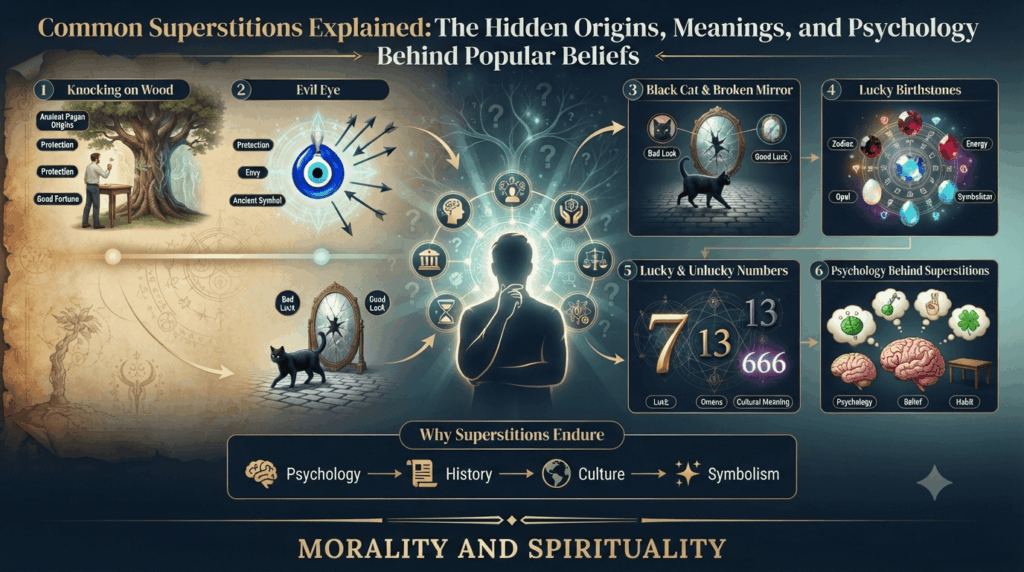
In this guide, you’ll find common superstitions explained through history, psychology, and symbolism. We’ll uncover the meaning of common superstitions, explore how cultural beliefs and superstitions developed across different societies, and separate historical origins from modern misconceptions. By the end, you’ll understand why these traditions continue to influence millions of people today.
Why Do People Believe in Superstitions?
The psychology of superstitions shows that people naturally search for patterns when facing uncertainty. Throughout history, these habits became lasting cultural beliefs and superstitions, passed from one generation to the next because they provided reassurance during unpredictable situations.
One of the best-known studies came from psychologist B. F. Skinner, who found that random rewards led animals to repeat unrelated actions, believing they caused success. Humans behave similarly. Wearing a lucky shirt, knocking on wood, or crossing your fingers can reduce anxiety, even when the ritual has no direct effect on the outcome.
This connection between belief and behavior helps explain why many superstition myths remain so persuasive today. If you’d like to understand how thoughts influence beliefs and actions, read our guide on the power of thought and consciousness. Likewise, learning how fear affects the mind and body explains why uncertainty often strengthens superstitious thinking instead of weakening it.exactly why these habits are so hard to shake—and why you might not want to shake all of them.
Origins of Popular Superstitions: Tracing Historical Roots
The origins of popular superstitions are rooted in animism, early religion, and humanity’s earliest attempts to explain misfortune. Let’s trace three of the most enduring ones.
Knocking on Wood – Invoking the Spirit of the Trees
Among the best-known origins of popular superstitions, knocking on wood dates back to ancient pagan cultures that believed trees were home to powerful spirits. Touching or knocking on a tree was thought to invite protection, express gratitude, or prevent good fortune from being taken away. As Christianity spread across Europe, the custom gradually became associated with touching the wood of the crucifix while making a solemn oath.
Today, knocking on wood remains one of the world’s most recognizable traditional superstitions. You have probably done it yourself: “I’ve never been in a car accident…” followed by two quick knocks on a nearby table. Whether viewed as habit or belief, this ritual is an excellent example of the meaning of common superstitions—simple actions that offer reassurance during uncertain moments.
Its remarkable survival across centuries and cultures reveals how cultural beliefs and superstitions continue to shape everyday behavior. Exploring the deeper symbolism behind everyday objects and rituals helps explain why traditions like knocking on wood continue to resonate across generations. More importantly, it demonstrates that the power of many traditions lies not only in their historical origins but also in the meaning people continue to assign to them today.
Key origins of this superstition:
- Pagan veneration of tree-dwelling spirits
- Christian adoption as a crucifix-touching ritual
- Modern cultural reflex against tempting fate
The Evil Eye – An Ancient Curse Worn as a Protective Amulet
The evil eye superstition is a cultural belief and superstition shared across Mediterranean, Middle Eastern, South Asian, and Latin cultures. It holds that a malicious glare—especially one charged with envy—can transmit harm to its target. The protective amulets designed to counter this curse, particularly the iconic blue glass nazar, have become globally recognised symbols.
What fascinates me most is that these protective amulets actually work—not through magic, but because they shift the wearer’s mental state from fear to security. Understanding how thought and intention carry real psychic energy explains the spiritual mechanics behind why this belief has endured for thousands of years. If you want to apply this practically, clearing negative energy from your personal field is a grounded next step.
Black Cats and Broken Mirrors – Folklore Beliefs That Shaped Cultures
The black cat superstition is a folklore belief rooted in medieval Europe, where black cats were considered witches’ familiars—demonic companions dispatched to carry their mistress’s ill will. A black cat crossing your path meant the witch had sent her agent against you.
Interestingly, in parts of Britain and Japan, black cats are considered good luck. The same creature, opposite meanings—context is everything.
Broken mirrors carry a different weight. Ancient cultures believed the reflection housed the soul; shattering a mirror meant fracturing something essential. The Romans tied seven years of bad luck to their belief in a seven-year cycle of bodily renewal. Both of these historical superstitions invite a deeper question about identity—one that connects directly to how ancient cultures perceived the soul’s image and the true self.
The Deeper Meaning of Common Superstitions and Symbols
Beyond their origins, the meaning of common superstitions often lives inside the symbols themselves—colors, stones, and numbers that carry centuries of accumulated cultural weight.
Color Symbolism in Superstition – What Shades Really Mean
Color symbolism is woven deep into traditional superstitions worldwide. Red wards off evil spirits in Chinese culture and is prominently displayed during New Year celebrations. Black has long signified mourning, danger, and misfortune in Western contexts, while white represents purity and protection across most global traditions.
These associations aren’t arbitrary—colors carry vibrational frequencies that measurably affect mood, perception, and even physiological response. The connection between color and the body runs deeper than folklore: how color vibrations align with your body’s chakra energy centers reveals why color superstitions have never fully faded from human culture.
Lucky Birthstones and Zodiac Birthstones – The Power of Lucky Stones
Lucky birthstones trace their origins to the Breastplate of Aaron described in Exodus—twelve sacred stones representing the twelve tribes of Israel, later mapped to months and zodiac signs. Wearing your zodiac birthstone was believed to align you with cosmic energies specific to your birth time.
| Month | Birthstone | Traditional Meaning |
|---|---|---|
| January | Garnet | Protection, vitality |
| April | Diamond | Clarity, invincibility |
| July | Ruby | Passion, strength |
| October | Opal | Creativity, intuition |
| December | Turquoise | Healing, communication |
Birthstone meanings carry cultural weight that has survived thousands of years. Their astrological roots are far richer than most people realise—exploring the astrological history behind zodiac birthstones opens one of history’s most enduring symbolic systems.
Numbers, Omens, and the Modern Superstition Myths We Still Keep
Numbers carry symbolic weight that borders on the sacred. Thirteen is so feared in Western culture that entire hotel floors are renumbered to skip it—a legacy of the Last Supper’s 13th guest. Seven is universally regarded as lucky. And 666 remains one of the most culturally loaded numbers in existence.
These aren’t idle superstition myths—they are embedded in architecture, sports, business decisions, and daily behaviour. If numeric symbolism interests you, decoding the real spiritual meaning behind the number 666 is a compelling place to start.
How to Transform Superstition into Mindful Awareness
Here’s what I find most valuable about understanding common superstitions explained through a modern lens: they don’t have to be about fear or passive luck. You can transform them into conscious rituals.
The next time you knock on wood, pause. Let it become a genuine moment of gratitude for what’s going well. When you wear your birthstone, treat it as a wearable intention—an affirmation you carry with you. When you feel the pull of a cultural belief and superstition, ask honestly: does this protect me or does it limit me?
Cultural beliefs and superstitions evolved alongside human consciousness. Which ones you carry forward is entirely your choice. And bringing mindful awareness to everyday rituals is precisely how ancient habit becomes modern wisdom.
Conclusion
Our exploration of common superstitions explained reveals a timeless truth: people have always searched for meaning, protection, and reassurance in an unpredictable world. Although the origins of popular superstitions stretch back thousands of years, the emotions that inspired them—fear, hope, gratitude, and curiosity—continue to shape human behavior today. Understanding the meaning of common superstitions helps us appreciate these traditions as reflections of history, psychology, and culture rather than simply dismissing them as myths.
Whether you still knock on wood, avoid certain omens, or simply enjoy learning about cultural beliefs and superstitions, understanding their origins allows you to engage with them thoughtfully instead of automatically.
If you’d like to explore how your beliefs, thoughts, and perceptions influence your everyday experiences, continue with our guide on the power of thought and consciousness. You may discover that the strongest influence on your life is not luck or superstition—but the mindset through which you interpret the world.
Frequently Asked Questions
What is the real meaning of knocking on wood?
The superstition of knocking on wood originates from pagan cultures that believed spirits lived in trees. Touching bark invoked their protection or gave thanks to avoid reversing good fortune. Today it persists as a traditional superstition to prevent tempting fate after a boast—so automatic most people don’t realise they’re doing it.
Why is the evil eye superstition still so widespread?
The evil eye superstition endures because it addresses a universal human emotion: envy. The belief that a malicious glare can transmit misfortune led to protective amulets like the nazar, which provide genuine psychological comfort as a cultural belief and superstition across many societies and centuries.
Do lucky birthstones have real power?
Lucky birthstones are rooted in birthstone meanings traced back to the Biblical Breastplate of Aaron and later systematised as zodiac birthstones. Their power lies primarily in the wearer’s belief—a placebo effect well supported by the psychology of superstitions—and in the deep cultural resonance of lucky stones meaning carried across generations.