
The Hand Signal Alphabet: Master Secret Finger Spelling Step by Step
Have you ever wanted to pass a message across a crowded room without saying a single word? The hand signal alphabet makes that possible while also being easier to learn than most people expect. Although this system relies on physical movements, successful communication also depends on the relationship between thought and consciousness, since every gesture begins as a clear mental intention before it becomes a visible action.
You will discover how to communicate using hand signals in real situations, see full spelling examples, and leave with a daily practice routine you can start today. Whether you are new to silent hand communication or simply looking to sharpen what you already know, this guide covers everything.
What the Hand Signal Alphabet Is
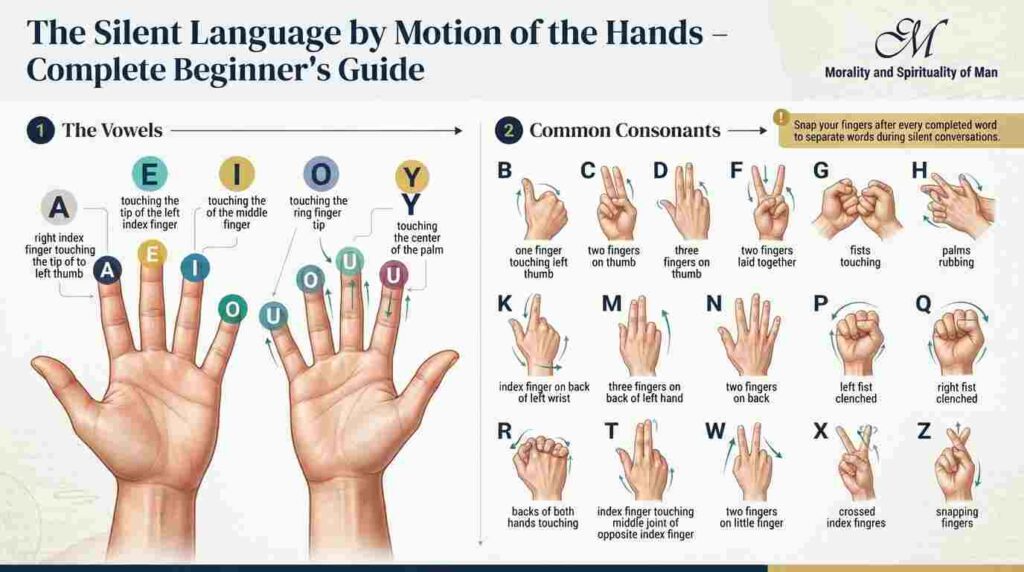
The hand signal alphabet is a silent coding system in which every letter of the alphabet maps to a specific position on the hand. One person spells; the other reads. No sound, no paper, no device required.
This method was formally recorded in a text called The Silent Language, which described teaching the complete alphabet to a stranger in under half an hour. The author called it a form of hand gesture communication—a way to carry on a full private conversation in plain public view.
Like many historical communication systems, it illustrates how symbols and gestures convey deeper meaning, enabling people to exchange information through agreed visual signs rather than spoken words.
Vowels on the Hand
Start with the vowels, because once you own them, the remaining letters become far easier to anchor in memory.
Every vowel sits at the tip of a finger on your left hand:
- A = tip of the thumb
- E = tip of the forefinger
- I = tip of the middle finger
- O = tip of the ring finger
- U = tip of the little finger
- Y = the palm of the hand
Point to each position with your right forefinger. That is the entire vowel layer of this finger spelling system — six positions, one hand, all within easy reach.
Consonants and Finger Positions
The consonants use the left thumb and the back of the left hand. Learn these clusters first:
- B, C, D = one, two, three fingers on the left thumb — a simple, memorable count
- L, N, M = one, two, three fingers on the back of the left hand — the same count on a new surface
- T = forefinger touching the middle joint of the other forefinger (it literally looks like the letter T)
- S = backs of both hands pressed together
- X = two forefingers crossed
- R = little fingers linked together
Why the Snap Separates Words
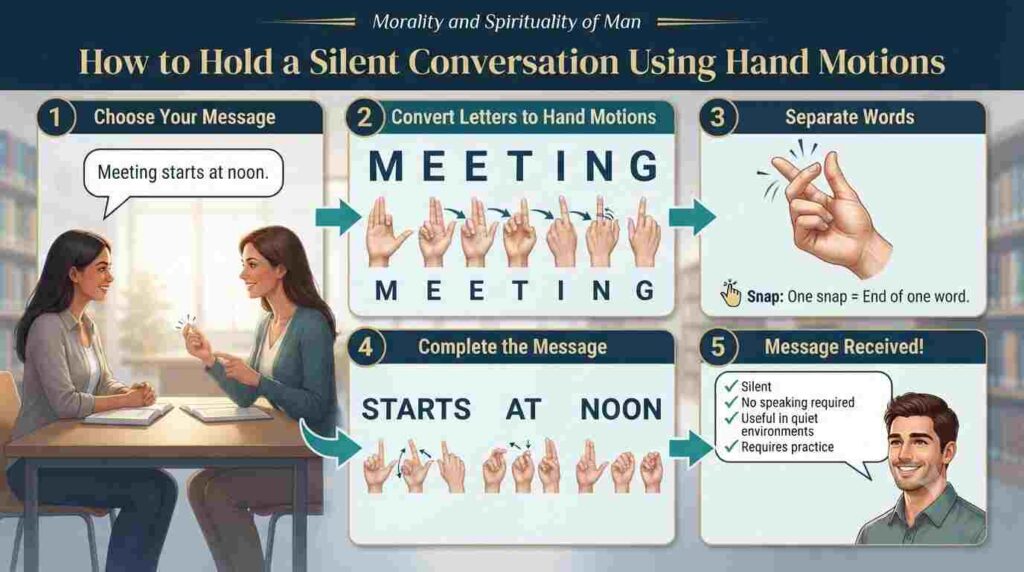
Between every word, give one quick snap of your fingers. This signal tells your partner that one word has ended and the next is about to begin. Without it, the letters blur into one long, unreadable stream. Keep the snap small and casual — to anyone who has not learned the system, it reads as nothing more than a restless hand gesture.
How Silent Hand Communication Works
Silent hand communication works because both partners share the same mental letter map. The speller positions their right forefinger at each letter location; the reader tracks that forefinger, builds letters into words, and waits for each snap to close the word.
Understanding the relationship between thought and consciousness sheds real light on why this system is so effective: focused attention transforms a simple finger position into precise, shared meaning.
Why Timing Matters
Go slow first. Each letter position needs roughly half a second of clear visibility before you move to the next. This feels slow to the speller but reads cleanly to the receiver. Speed arrives naturally after consistent practice — you cannot rush your way to fluency, but you can practice your way there.
How to Practice With a Partner
Start with short, common words — “yes,” “no,” “stop,” “now” — until both of you can send and receive without a single hesitation. Then graduate to full sentences. Keep sessions between ten and fifteen minutes, and treat each one as a game rather than a test. Relaxed, pressure-free repetition is the fastest path to fluency.
Common Beginner Mistakes
The two most common errors are forgetting the snap between words and moving the hand too quickly between letters. Both disappear with deliberate, slow practice in the first week.
Secret Hand Signals in Practice
Secret hand signals become genuinely useful when you need to communicate without drawing any attention at all. In a crowded café, a formal meeting, or any public space, a deliberate series of finger positions goes entirely unnoticed by everyone except your partner.
A Classic Public Example — “Madam, I am your humble servant”
Here is the full phrase, move by move, exactly as it was recorded in The Silent Language:
MADAM → M (three fingers on back of hand) · A (thumb tip) · D (three fingers on thumb) · A · M → snap
I → I (middle finger tip) → snap
AM → A (thumb tip) · M (three on back of hand) → snap
YOUR → Y (palm) · O (ring finger tip) · U (little finger tip) · R (linked little fingers) → snap
HUMBLE → H (stroke palms together) · U · M · B (one on thumb) · L (one on back) · E (forefinger tip) → snap
SERVANT → S (backs of hands) · E · R · V · A · N (two on back) · T (forefinger to middle joint) → snap
A Modern Example of hand signal alphabet— “Climate action is urgent”
You can apply the same hand signal alphabet to any sentence. Spell each letter using the same positions, snapping between every word. This demonstrates that the secret hand alphabet for communication adapts effortlessly to any context, whether historical or contemporary, intimate or public.
How to Keep the Message Discreet
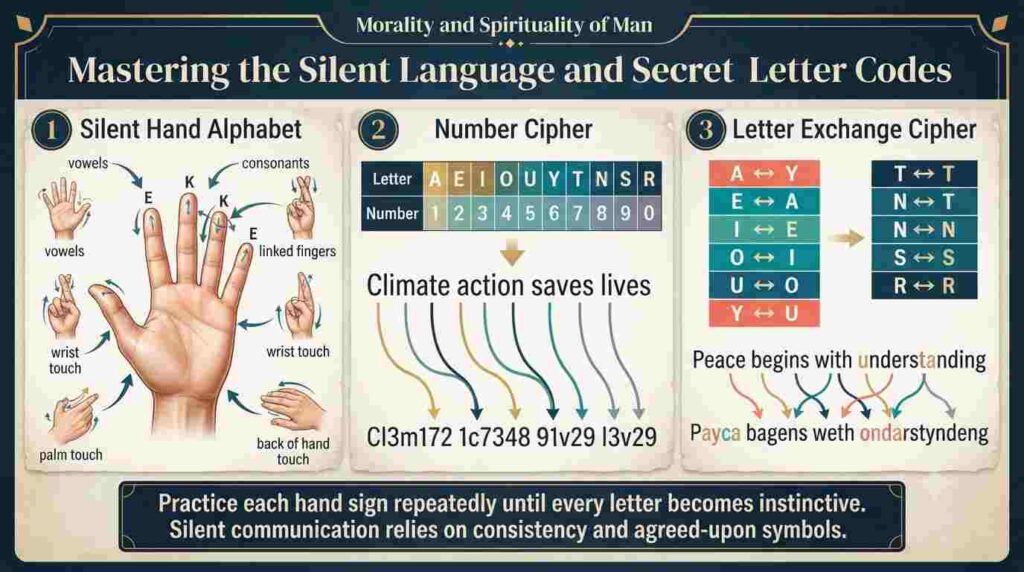
If you ever suspect that someone nearby has learned the same letter map, you can shift the vowel positions to different parts of the hand. Only your trusted partner needs to know the new placement. This built-in substitution feature was part of the original system — and it remains one of its cleverest design decisions.
How to Learn the Hand Signal Alphabet
Think of this section as your practical finger spelling communication guide. Here is how to learn the hand signal alphabet without overwhelming yourself or burning out in the first week.
Pair this process with a simple mindfulness practice guide — a calm, focused mind absorbs spatial memory far more quickly than a scattered one. When concentration during drills feels difficult, exploring practical ways to control your mind can make each practice session dramatically more productive.
A 10-Minute Daily Routine
- Minutes 1–3: Recite the five vowel positions with your eyes closed until you can touch each fingertip without looking.
- Minutes 4–6: Drill the B-C-D cluster (one, two, three fingers on the thumb) until the movement is automatic.
- Minutes 7–9: Spell one complete word from the first letter to the closing snap without pausing.
- Minute 10: Spell your full name.
Memory Cues for Faster Recall
Let the shapes carry the memory for you. B, C, D follow a one-two-three count on the thumb — the same logic as counting on your fingers. T looks like the letter T when one forefinger meets the middle joint of the other. X is literally two fingers crossed. M has three strokes; it uses three fingers on the back of the hand. Once you spot the visual logic, the letters stop feeling arbitrary. Refer to the visual illustration above.
Weekly Review
Once a week, spell a sentence you have never used before. New sentences force your brain to retrieve letters it might otherwise let go rusty. Ten deliberate minutes every Sunday keeps the whole system sharp.
Historical Communication Techniques Behind the Method
This system did not emerge from a single invention. Historical communication techniques like this one developed across communities where speech was inconvenient, dangerous, or simply impractical. Historical silent communication methods appeared in deaf communities, military units, religious orders that observed silence, and among people who needed privacy in close quarters where walls were thin and ears were sharp.
Silent communication methods of this kind were designed to be taught quickly and remembered permanently — the hallmark of a genuinely useful technology. Reading about symbolism and meaning interpretation adds real depth to this picture: every position on the hand is a symbol, and every snap is a precisely placed boundary marker in a living, breathing language.
Final Practice Example and Conclusion
Step-by-Step Spelling Demo
Let me close with one complete, short demonstration. Spell the phrase: “I see you.”
- I → middle finger tip → snap
- SEE → S (backs of both hands) · E (forefinger tip) · E (forefinger tip) → snap
- YOU → Y (palm) · O (ring finger tip) · U (little finger tip) → snap
Nine gestures. Three snaps. With one week of consistent practice, you can deliver that in under five seconds.
A Final Review of the Method
The hand signal alphabet rests on one simple idea: every letter has a home on the hand, and a snap marks the end of every word. Master the vowels first, group the consonants by their number-line logic, and practice with a real partner at least three times a week. The system rewards patience and punishes rushing — give it the time it deserves.
What to Practice Next
Start with your own name. Then spell a sentence you use every day. When you are ready to go deeper, explore the cipher layer — where vowels are substituted for numbers (a=1, e=2, i=3, o=4, u=5, y=6) — and apply it to short phrases. “Climate action is urgent” becomes “Cl3m172 1ct348 39 50g287.” Unreadable to any observer. That is precisely the point.
The secret hand signals are already in your hands. Silent hand communication is a skill that connects you to centuries of human ingenuity and keeps a completely private channel open wherever you go. I encourage you to begin today, practice with someone you trust, and share what you learn.
Frequently Asked Questions
How long does it take to learn the hand signal alphabet?
Most beginners can memorize the vowel positions of the hand signal alphabet in a single practice session and become comfortable spelling short words within a week of daily practice. Spending just 10–15 minutes each day on silent hand communication helps develop muscle memory and improves accuracy. If you want to strengthen concentration while learning, explore our guide on practical ways to control your mind, which explains techniques for improving focus during practice.
Is the hand signal alphabet the same as sign language?
No. The hand signal alphabet is a letter-by-letter spelling system in which each finger position represents an individual letter, making it useful for secret hand signals and private communication. Sign languages, by contrast, are complete natural languages with their own grammar, vocabulary, and sentence structure. Understanding how symbols and gestures convey deeper meaning also helps explain why this historical system relies on agreed visual representations rather than spoken words.